.png)

The Middle East After Gaza: Strategic Stalemates and Uncertain Futures
As 2025 ends, the Middle East remains in flux—Gaza quiet but unresolved, Iran under strain, Gulf cautious, and global powers navigating a region where pauses don’t mean peace.

Lt Gen Syed Ata Hasnain is a former Commander of India’s Kashmir Corps and Chancellor of the Central University of Kashmir.
December 16, 2025 at 3:57 AM IST
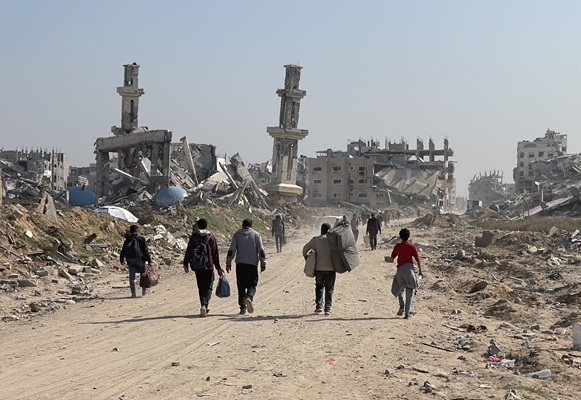
As 2025 draws to a close, the Middle East appears quieter than it did a year ago, yet it remains unsettled. The guns in Gaza have largely fallen silent, but the conflict has not truly concluded. What has emerged is a temporary pause, driven largely by exhaustion on all sides. Gaza now sits at the centre of the region’s strategic landscape, shaping alignments and anxieties even as no actor can claim a decisive outcome.
Israel enters the year-end without strategic closure. Hamas has absorbed severe military punishment: leadership attrition, destruction of infrastructure, and sharply reduced freedom of action. Yet Israel’s campaign has also extracted political and diplomatic costs. International scrutiny has intensified, humanitarian concerns dominate discourse, and domestic divisions have sharpened. Deterrence has been partially restored, but its long-term sustainability remains uncertain.
Hamas, for its part, has survived rather than prevailed. Its ability to govern Gaza or rapidly regenerate military capability remains constrained. Nevertheless, regional history suggests that militant and terror-oriented organisations rarely disappear entirely. They adapt, fragment, and eventually reconstitute. Hamas and Hezbollah are likely to re-emerge over time, but the process will be slow, uneven, and shaped by leadership losses, financial pressure, and regional fatigue.
The central reality is that the Gaza conflict has produced no clear victor. Ceasefires function primarily as tactical pauses, creating space for recovery rather than pathways toward political settlement.
Israel: the Trump Variable
Donald Trump’s return to the White House introduces a familiar dynamic. His preference for transactional outcomes and visible deal-making contrasts with the region’s slower strategic rhythms. There is reason to believe Washington may favour continuity in Israel’s leadership over uncertainty, particularly while ceasefires remain fragile and regional escalation risks persist.
Trump’s ambition to advance a settlement in Gaza is understandable from a political standpoint. Strategically, however, the ground is not yet prepared. Gaza remains a humanitarian and governance challenge rather than a viable negotiation platform. Accelerated diplomatic timelines risk outpacing realities on the ground and producing fragile outcomes.
Iran: Under Pressure
Iran remains the region’s most consequential variable. It is not isolated in the classical sense; its influence stretches across Iraq, Syria, Lebanon, and Yemen, and its strategic partnerships with Russia and China remain intact. Yet 2025 has imposed strain. Economic pressure, diplomatic constraints, and the cumulative impact on its regional proxies have encouraged caution rather than escalation.
Hezbollah has avoided full confrontation. The Houthis have drawn sustained military attention. Hamas has suffered extensive damage. These developments have not dismantled Iran’s regional network, but they have narrowed its operational space. Tehran’s posture today reflects strategic patience rather than assertion.
As argued many times by me, Iran’s longer-term trajectory depends less on external pressure than on internal evolution. Much hinges on the longevity of Supreme Leader Ali Khamenei and the succession dynamics that will inevitably follow. Elite competition, generational discontent, and economic fatigue persist beneath the surface. The IRGC has been weakened at the leadership level and will probably take time to re-emerge to earlier operational capability. The downfall of Basharat Assad also means some proxy capability diluted.
Trump is unlikely to pursue regime change through direct military confrontation. If pressure intensifies, it is more likely to take indirect forms—economic leverage, diplomatic isolation, and encouragement of internal dissent. Iran has absorbed pressure before; its strategic foundations remain intact, even if under visible strain. Its nuclear ambitions remain intact, but its ability to translate intent into credible capability appears to have suffered erosion under sustained pressure.
Syria: Terror and Uncertainty
Syria warrants attention, albeit briefly. The conflict there remains frozen rather than resolved. Past experience cautions against complacency. The sudden rise of ISIS after global attention shifted elsewhere demonstrated how quickly dormant threats can reappear under favourable conditions.
At present, transnational terrorism does not dominate the Middle Eastern landscape. Yet the structural conditions that enable its resurgence—displacement, governance vacuums, economic despair—continue to exist in pockets across the region. The Middle East has repeatedly shown an ability to surprise those who assume equilibrium has been achieved.
Gulf States: Managed Stability
Saudi Arabia’s posture reflects caution shaped by Vision 2030’s need for stability and investor confidence. The UAE continues to project governance competence and diplomatic balance. Qatar maintains its role as a mediator, preserving channels of communication that others avoid. Together, they contribute to a regional architecture designed to limit escalation rather than resolve entrenched disputes. At some future stage they will transit to that role but that state is still elusive.
The United States remains central to Gulf security arrangements. Despite expanding engagement by China and Russia, Washington’s role in deterrence, crisis management, and escalation control remains unmatched. The region’s future will be shaped less by militant initiatives and more by how states manage risk and sustain equilibrium.
Looking Ahead to 2026
The principal danger lies in misinterpretation. Temporary restraint may be read as a strategic shift. Pauses may be mistaken for peace. Fatigue may be confused with transformation. History suggests such assumptions often prove costly.
Israel will continue to recalibrate without closure. Gaza will remain a humanitarian and political dilemma. Iran will watch, probe, and wait. Gulf states will work quietly to prevent escalation from derailing their futures. External powers—particularly the United States—will attempt to shape outcomes faster than the region can comfortably absorb.
The year ahead is unlikely to deliver dramatic breakthroughs. It will instead be defined by efforts to hold the line, manage pressures, and prevent miscalculation. In the Middle East, survival often passes for success, and stalemate is frequently mistaken for stability.
More From BasisPoint