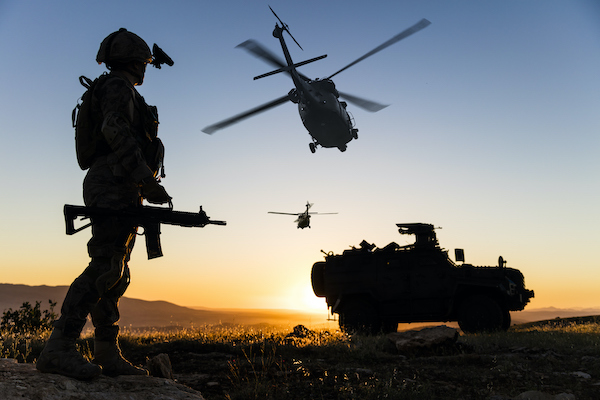
We are fascinated by military technology, but rarely pause to examine its limitations through the lens of history. Every generation of military professionals has been tempted by the belief that a new technology has fundamentally transformed warfare. The machine gun, the tank, the aircraft, the helicopter, precision-guided munitions, drones, cyber capabilities and now artificial intelligence have each arrived with promises of decisive advantage. Each innovation has altered the conduct of war, enhanced military capability, and expanded the reach and lethality of the armed force.
The objective has remained unchanged: to destroy the adversary’s resources, break his will, disrupt his society and impose one’s own political will. Technology has undoubtedly increased the efficiency with which these objectives can be pursued.
Yet, a century of warfare suggests that something equally important has survived every technological revolution. It’s the human factor that has refused to disappear and has remained central to resistance.
Technology Moves Faster Than Doctrine
One reason is that technology develops faster than the ability of institutions to optimise its use. Every major military innovation passes through a prolonged phase of experimentation, adaptation and doctrinal refinement.
The tank appeared on the battlefields of the First World War, but it took nearly two decades before armies understood how to integrate armour, air power, communications and manoeuvre into an effective operational concept. Aircraft transformed warfare, but strategic bombing, close air support and air superiority evolved only through years of experience and error. The helicopter revolutionised mobility, yet its limitations became evident as adversaries developed countermeasures and adapted their methods.
The same pattern is visible today with drones, artificial intelligence and autonomous systems. Their potential is evident, but their optimal employment remains a work in progress. During this period of adaptation, adversaries are never passive. They innovate, disperse, conceal, deceive and develop counters of their own.
The result is a continuous contest of adaptation in which human ingenuity remains the decisive variable.
The Persistence of Will
History offers repeated reminders that technological superiority alone rarely guarantees strategic success. The US entered Vietnam with overwhelming advantages in mobility, logistics, air power and firepower. Yet, the conflict demonstrated that political will, national identity and strategic patience could offset material asymmetry. The helicopter transformed the battlefield, but it could not determine the outcome of the war.
The Soviet Union’s experience in Afghanistan revealed a similar reality. Decades later, the US and its coalition partners encountered the same challenge. Twenty years of technological superiority, surveillance dominance and precision strike capability ultimately confronted an adversary whose principal strengths were endurance, adaptability and patience.
The ongoing conflict in Ukraine reinforces the lesson. It is perhaps the most technologically transparent battlefield in history. Drones observe, satellites monitor, and sensors track movements with unprecedented precision. Yet, after years of conflict, the critical variables remain morale, resilience, leadership, national identity and political determination. Human will, not technology, continues to shape the outcome.
The Expanding Human Domain
Paradoxically, the technological age has not diminished the importance of the human factor; it has expanded it. Alongside advances in military hardware has emerged an equally important set of capabilities centred on the human mind. Information warfare, psychological operations, strategic communication, narrative competition and cognitive warfare have become integral elements of modern conflict.
This evolution reflects a simple truth. Technology can destroy infrastructure, but it cannot by itself secure legitimacy. It can strike targets, but it cannot guarantee political submission. Societies still withstand suffering, and populations are prepared to endure hardship.
The battlefield has therefore expanded beyond land, sea, air, cyber and space. It now includes perception, belief, identity and public confidence, more than ever before.
Every technological revolution in warfare has been accompanied by efforts to influence the human mind. Radio enabled propaganda. Television shaped public perception during Vietnam. The internet transformed information warfare. Social media accelerated influence operations. Artificial intelligence may soon amplify them further.
Lessons from Contemporary Conflict
Recent conflicts offer powerful illustrations. Despite immense destruction, the wars in Ukraine and Gaza demonstrate that physical devastation and political submission are not necessarily identical outcomes. Morale and will remain central to national resilience.
This should not be interpreted as a rejection of technology. Modern warfare is unquestionably more dependent on advanced systems than ever before. Precision, speed, connectivity and intelligence have transformed military operations. No serious military can afford to ignore these developments.
However, the enduring lesson is that technology and the human factor are not competitors. They are partners in an evolving relationship. Technology enhances military power, but human beings determine how effectively it is employed, how rapidly it is adapted and how resiliently it is opposed.
The Enduring Constant
Wars are ultimately fought through increasingly sophisticated means, but they remain profoundly human enterprises. Technology may shape the battlefield, but endurance, leadership, morale, conviction and purpose continue to determine how long nations fight, how much suffering they absorb and whether they ultimately prevail.
Yet a larger question now emerges. Will there ever be an end to the historical cycle of technological innovation, doctrinal adaptation and human response? Artificial Intelligence and other emerging technologies may bring warfare closer than ever before to influencing beliefs, perceptions and decision-making. For the first time, technology is increasingly directed not merely at the physical dimensions of war, but at the cognitive domain itself.
If the battlefield of the future increasingly shifts towards the human mind, new forms of competition involving influence, persuasion and perception may become as important as traditional military power. Yet history offers a cautionary lesson. Human beings have adapted to every technological revolution in warfare. There is little reason to believe they will cease to do so now.
The future of conflict may therefore lie not in the triumph of technology over the human factor, but in an even more intense contest for the human mind. The return of the human factor is, therefore, not a new phenomenon. It never really left.
.png)