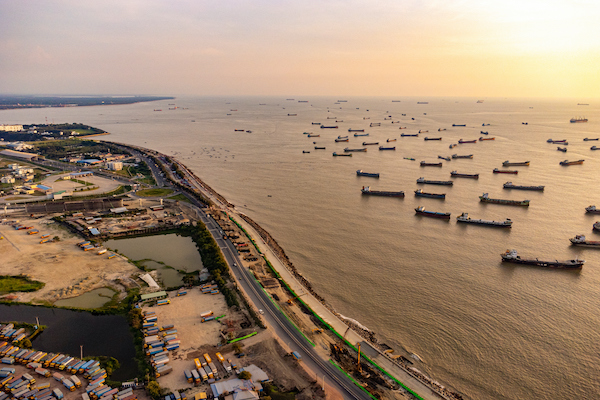
The Bay of Bengal is often discussed today in the language of geopolitics — shipping lanes, ports, naval deployments and strategic competition. Yet historically, the Bay represented something much larger. It was one of Asia’s great connective spaces, linking eastern India with Sri Lanka, Myanmar, Thailand, Indonesia and beyond through trade, scholarship, religion and maritime exchange. The Bay did not divide civilisations; it connected them.
For centuries, monks, merchants, scholars and seafarers moved across these waters carrying not only commodities but also ideas, languages, art, political influence and cultural practices. The Bay of Bengal functioned as a civilisational arc long before the emergence of modern nation-states or the vocabulary of globalisation.
This idea of “civilisational connectivity” should not be interpreted narrowly or geographically alone. The Bay was not merely a body of water. It symbolised a wider ecosystem of interaction extending from the Gangetic plains to Southeast Asia through maritime networks, intellectual exchange and commercial mobility. Its importance lay in the relationships it enabled.
In many ways, this older connectivity weakened during the colonial period and later receded from India’s strategic imagination after Independence. Yet, changing geopolitics and the rise of the Indo-Pacific are now restoring the importance of the Bay of Bengal region.
Ports, Pilgrimage and Maritime Exchange
Ancient India’s eastern seaboard played a critical role in sustaining these networks. Tamralipti, among the subcontinent’s great ancient ports, connected the Gangetic heartland to maritime Asia. Through such ports, traders, Buddhist pilgrims, manuscripts and scholars moved towards Sri Lanka, Southeast Asia and China.
The spread of Indian influence across Southeast Asia occurred less through conquest, and more through culture, commerce and intellectual interaction. Indian epics, scripts, architecture, administrative ideas and Buddhist traditions travelled widely across the region, creating a remarkable degree of civilisational familiarity. Maritime routes became conduits of soft power centuries before the term existed.
Buddhist networks were particularly important in this process. Monasteries, centres of learning and pilgrimage circuits formed part of an interconnected Asian intellectual space. Maritime connectivity amplified the movement of ideas in ways often underappreciated in contemporary strategic discourse.
At the same time, India’s maritime history was not confined to cultural exchange alone. The Chola naval expeditions demonstrated naval capability, strategic ambition and the importance of securing commercial routes across the Bay and beyond. India’s historical engagement with the Bay combined commerce, culture and maritime capability in a single strategic ecosystem. The region was viewed not as a peripheral maritime boundary, but as a connected space through which influence, ideas and economic activity naturally flowed.
Colonial Disruption and Strategic Reorientation
The arrival of European colonial powers fundamentally altered this ecosystem. The Bay gradually transformed from an interconnected Asian space into an imperial maritime corridor organised around extraction, controlled trade and colonial administration. Traditional commercial and cultural linkages weakened under colonial priorities.
Independent India inherited another strategic reality. Partition, conflict with Pakistan and later tensions with China shifted India’s security focus overwhelmingly towards continental concerns. National strategic thinking became centred on land borders, Himalayan defence and continental threats. As a consequence, India’s eastern maritime orientation received comparatively less strategic attention for decades.
At the same time, India’s Northeast — despite its enormous cultural richness and strategic importance — presented geographical and infrastructural challenges for deeper overland connectivity with Southeast Asia. Mountainous terrain, insurgencies and limited infrastructure complicated the development of seamless regional integration.
India’s Act East policy has rightly attempted to address these challenges through improved land connectivity via Myanmar and the Northeast. These initiatives remain strategically vital and should continue to receive sustained attention. The Northeast itself can become a bridge between South Asia and Southeast Asia because of its geography, diversity and cultural affinities.
However, recent instability in Myanmar also highlights the limitations of relying excessively upon a single continental corridor. Historically, India’s deepest engagement with Southeast Asia emerged not only through land routes, but across the maritime spaces of the Bay of Bengal.
Maritime connectivity should therefore be viewed not as an alternative to continental outreach, but as an equally important pillar of India’s eastern strategy.
BIMSTEC and the Return of the Bay
The Bay of Bengal is now regaining strategic centrality. The Indo-Pacific concept, China’s growing maritime presence, Bangladesh’s economic rise, the importance of the Andaman and Nicobar Islands, including the Great Nicobar project, and expanding regional trade are collectively reshaping the region.
In this changing environment, BIMSTEC deserves greater strategic attention. BIMSTEC should not be seen merely as another regional organisation. In many ways, it represents a partial recovery of older patterns of connectivity across the Bay of Bengal.
Its significance lies precisely in its ability to connect South Asia and Southeast Asia through shared geography, economic interests and historical memory. Cooperation in trade, energy, digital infrastructure, maritime security and disaster management can gradually create a more integrated regional architecture. In this emerging geography, Bangladesh occupies a particularly important position. Beyond its growing economic significance, Bangladesh represents a critical connective bridge between India’s continental Northeast, the Bay of Bengal maritime system and the wider Southeast Asian region. The restoration of transport, riverine and maritime linkages across eastern South Asia has the potential to partially recover patterns of connectivity that existed long before Partition and colonial disruption altered the region’s natural geography. The future of India’s eastern strategy may depend as much upon cooperative regional connectivity with Bangladesh as upon conventional geopolitical competition in the Indo-Pacific.
Climate and disaster resilience are becoming especially important areas for cooperation. Cyclones, rising sea levels, migration pressures and coastal vulnerabilities affect nearly every country in the Bay region. Collaborative responses in these domains can create habits of trust and strategic cooperation extending beyond conventional diplomacy.
In recent years, India’s maritime thinking has increasingly reflected this broader cooperative approach. Initiatives such as SAGAR seek to position the Indian Ocean and the Bay of Bengal not merely as arenas of strategic competition, but as spaces for collective security, connectivity and shared prosperity. Similarly, the Indo-Pacific vision articulated under Narendra Modi has emphasised inclusivity, maritime cooperation and regional partnerships rather than exclusive blocs or spheres of influence.
The growing strategic importance of the eastern maritime space is also visible in projects such as the development of Great Nicobar Island. Located near the approaches to the Malacca Strait, the project reflects India’s recognition that maritime infrastructure, logistics networks and strategic presence in the Bay of Bengal and eastern Indian Ocean will play an increasingly important role in the Indo-Pacific century. Its significance lies not only in defence preparedness, but also in connectivity, trade, transshipment capability and regional integration.
The Bay of Bengal today is therefore not merely a maritime theatre; it is an emerging strategic community. In many ways, India is now rediscovering that its eastern maritime geography is not peripheral to its future, but central to it.
Reimagining India’s Eastern Horizon
India stands at an important strategic moment. The future of Asia will increasingly be shaped in the Indo-Pacific, and the Bay of Bengal will form one of its most significant sub-regions. Yet India’s engagement with the Bay cannot remain confined to ports, naval exercises and connectivity projects alone.
A broader strategic vision is required — one that combines maritime security with cultural diplomacy, educational exchange, economic integration and regional cooperation. The rediscovery of the Bay of Bengal is therefore not simply about reclaiming influence. It is about recovering an older understanding of connectivity itself.
Before it became a theatre of geopolitical competition, the Bay of Bengal was a bridge of civilisations. Its waters carried not only commerce, but also ideas, scholarship and cultural exchange. Reimagining this civilisational connectivity in contemporary terms may offer India an opportunity to shape a more connected and cooperative eastern future — one rooted not merely in strategy, but in historical confidence and regional partnership.
.png)