.png)

Stalled Talks, Iran Still Holds the Cards
Truce talks exposed fault lines, not convergence. With negotiations stalling and leverage intact, Iran appears better placed in this phase.

Rajesh Mahapatra, ex-Editor of PTI, has deep experience in political and economic journalism, shaping media coverage of key events.
April 12, 2026 at 3:28 PM IST
The high-stakes engagement between US and Iranian officials in Islamabad on Saturday was less a step toward resolution than a reflection of how far apart the two sides remain. While both camps chose to keep the channel nominally open, signals emerging from Washington and Iran suggest that the discussions may have stalled.
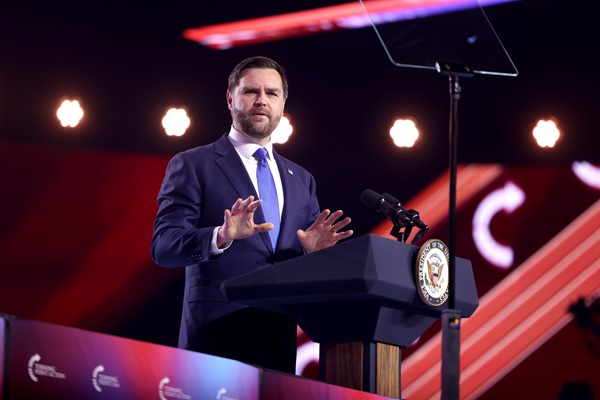
Comments from US Vice President JD Vance indicate that key differences remain unresolved, and that the negotiating space may, in fact, have narrowed. Speaker of Iranian Parliament Mohd. Bagher Ghalibaf, who led the delegation from Tehran, said Iran’s “logic and principles” have been explained to the Americans, and “it’s time for them to decide whether they can earn our trust or not.”
The absence of clarity on sequencing, timelines, or even the contours of a follow-up engagement reinforce this uncertainty. What is being presented as continuity of dialogue may equally be read as an inability to bridge core disagreements. In that sense, the truce talks do not represent a pivot toward de-escalation, but rather a pause in a negotiation struggling to find direction.
If anything, the early contours of the current phase of negotiations suggest that Iran has been able to hold its negotiating line, while the US appears compelled to show flexibility. That asymmetry, though still evolving, has implications for how the next phase of the conflict may unfold.
How did things come to such a pass for the world’s most powerful country? Five factors stand out.
Regime Miscalculation
The initial assumption that targeting Iran’s top leadership would trigger systemic collapse appears to have underestimated the regime’s institutional continuity. Leadership transitions, rather than destabilising the system, seem to have consolidated authority within a more hardline structure. The expectation that external pressure would translate into internal dissent has not materialised in any decisive way, suggesting that the political resilience of the Iranian state was misread at the outset.
Endurance Test
The US also appears to have underestimated Iran’s capacity to absorb and respond to sustained military pressure. Despite the scale of the attacks, Iran has retained a significant portion of its operational capability. Reporting from Reuters indicates that a substantial share of its missile and drone arsenal remains intact, allowing it to prolong the conflict and expand its geographic footprint. The ability to sustain engagement over time has shifted the conflict into a more drawn-out phase, where attrition, rather than swift dominance, defines outcomes.
Domestic Constraints
At the same time, the domestic backdrop in the US has introduced additional constraints. Political signalling from Washington has become less linear, reflecting both electoral considerations and the broader costs of escalation. While wartime dynamics have historically bolstered presidential approval, the current episode appears more contested, with public and political responses evolving in ways that limit strategic optionality.
Alliance Gaps
Unlike earlier conflicts in the region, the US has struggled to assemble a broad-based coalition. Key allies have adopted more cautious positions, preferring de-escalation over alignment with an open-ended military campaign. The absence of coordinated action has reduced Washington’s ability to shape the external environment, even as it continues to bear the primary burden of escalation.
Hormuz Leverage
Perhaps the most consequential shift has been the growing centrality of the Strait of Hormuz. Even without a full disruption of flows, the mere possibility of constrained access has introduced a persistent risk premium into global energy markets. Iran’s geographic position allows it to exert influence disproportionate to its economic size, effectively turning the waterway into a strategic lever. What began as a conflict centred on nuclear capability has, in part, morphed into a contest over control of critical supply routes.
What was initially framed as a decisive effort to degrade Iran’s capabilities has thus evolved into a more complex and uncertain engagement. The conflict now bears the characteristics of a prolonged contest, where time, resilience, and control over escalation matter as much as immediate military outcomes.
At this stage, the balance does not suggest resolution. It points instead to a phase where leverage is unevenly distributed and where the range of viable options is narrowing. In that configuration, Iran, at least for now, appears to hold the stronger hand.
More From BasisPoint