.png)

Rubio’s Gospel - Let’s Carve Up the Global South
At Munich, Rubio sketched a new Western century rooted in Christian civilisational pride and economic sovereignty. This is bound to unsettle post-colonial nations.
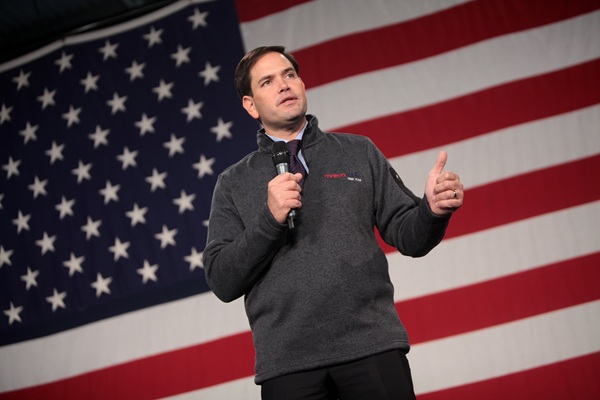

Rajesh Ramachandran is a former Editor-in-Chief of The Tribune group of newspapers and Outlook magazine.
February 16, 2026 at 9:35 AM IST
The Chief Diplomat of the US, as Secretary of State Marco Rubio described himself, made an epoch-making exposition of the Western Alliance’s political and economic priorities at the Munich Security Conference on Saturday, which ought to make the post-colonial nations of the Global South anxious. Rubio cannot be dismissed as a MAGA rabble-rouser, and the standing ovation of his European audience is the spontaneous eruption of a faithful congregation.
Instead, Rubio’s speech needs to be understood as a US roadmap for Europe’s revival.
While claiming that the US is but the child of Europe, Rubio made a startlingly racist reading of American history: “Our story began with an Italian explorer whose adventure into the great unknown to discover a new world brought Christianity to the Americas — and became the legend that defined the imagination of our pioneer nation.”
There was no reference to the original people of the Americas and, worse, no acknowledgement of any contribution by the non-white people who helped make the American miracle happen; but only the English, the Scots, the Irish, the Germans, the French, and Spanish contributions figured in.
It is not normal for a modern, secular politician to harp on religion, culture and civilisation at a security conference. One would have expected clerics and religious hotheads to make thunderous “civilisation-in-peril” declamations. But Rubio took a bigger plunge, referring to “civilisation” ten times, Christianity twice, culture, spirituality, and god. For, there was no doubt what the alliance stood for any longer — the Western, White, Christian civilisation. It was not a theological invocation of Jesus Christ of Nazareth, but a political reading of Christianity as a civilisational banner under which European empires once expanded.
Rubio reduced national security to the defence of the Christian way of life: “The fundamental question we must answer at the outset is what exactly we are defending, because armies do not fight for abstractions. Armies fight for a people; armies fight for a nation. Armies fight for a way of life. And that is what we are defending: a great civilisation that has every reason to be proud of its history, confident of its future, and aims to always be the master of its own economic and political destiny.”
To ensure that there is no doubt whatsoever about what he was referring to, Rubio claims all the fruits of modernity to have been harvested in the European kitchen gardens. Europe, according to his gospel, gave the world the rule of law, the scientific revolution and universities. And the geniuses of the modern world are restricted to Dante, Shakespeare, Michelangelo, Da Vinci, Mozart, Beethoven, Beetles and the Rolling Stones. Nothing was left to imagination, nor was there any scope for confusion in terms of whose way of life Rubio was talking, or rather, who he was framing as the legatees of the lesser civilisations.
By invoking symbols such as the Sistine Chapel and the Cologne Cathedral, Rubio not just attempted to testify to the greatness of the Euro-American past, but also claimed they merely foreshadow the wonders that await “us in our future”.
Imperial Errors
The shifting of the American manufacturing base to China is being portrayed as a policy blunder, but it is being blamed on others. Economic policy markers have been defined by political lexicon. For instance, supply chain diversification is being perceived as a loss of national or ethnic sovereignty: “loss of our supply chain sovereignty was not a function of a prosperous and healthy system of global trade. It was foolish. It was a foolish but voluntary transformation of our economy that left us dependent on others for our needs and dangerously vulnerable to crisis.”
To correct the past mistakes, Rubio wants to herald a “new Western century”; one in which there is no mass migration. He has spelt out controlling the borders as a “fundamental act of national sovereignty”, which, while keeping out non-Europeans, will not be termed xenophobic or treated as hatred.
In this new European century, the Western alliance will make huge strides in commercial space travel, artificial intelligence, industrial automation, flex manufacturing and “creating a Western supply chain of critical minerals not vulnerable to extortion from other powers” (read China).
And it is in this context of advancing new scientific and possibly territorial frontiers for the Western alliance that Rubio makes his only reference to the Global South. The need for “… a unified effort to compete for market share in the economies of the Global South” is reminiscent of the colonial carving up of Asia and Africa by the European empires, more so, since Rubio insists that it was foolish to have ever conceived of a rules-based global order bound with ties formed by trade and commerce replacing nationhood.
The renewal and restoration of the Western alliance in order to reassert Christian civilisational goals are not, obviously, going to be done through equitable negotiations, but coercion — preserving the freedom of action that allows the West to shape its destiny the way it wants. And that too by completely abandoning the colonial guilt: “This is the path that President Trump and the United States have embarked upon. It is the path we ask you here in Europe to join us on. It is a path we have walked together before and hope to walk together again. For five centuries, before the end of the Second World War, the West had been expanding — its missionaries, its pilgrims, its soldiers, its explorers pouring out from its shores to cross oceans, settle new continents, build vast empires extending out across the globe.”
A neo-colonial agenda could not have been more precise and direct. Rubio even made an attempt to slam old “anti-colonial uprisings” as mere Communist conspiracies, denying legitimacy to Asian and African aspirations. This speech can be treated as Trumpian rhetoric or read as a reassertion of Euro-American dominance. It could easily have been made by arch colonialist Winston Churchill, but even he would have been more measured than to have marked the whole of Asia and Africa the White Man’s happy hunting grounds.
More From BasisPoint