.png)

Preah Vihear and the Politics of Memory in the Thailand–Cambodia Conflict
The Thailand–Cambodia conflict is less about borders than memory, pride and politics—revealing how identity disputes endure, escalate, and defeat regional diplomacy.
Rami Niranjan Desai is an anthropologist and a scholar of the northeast region of India. She is a columnist and author and presently a Distinguished Fellow at the India Foundation.
December 18, 2025 at 6:54 AM IST
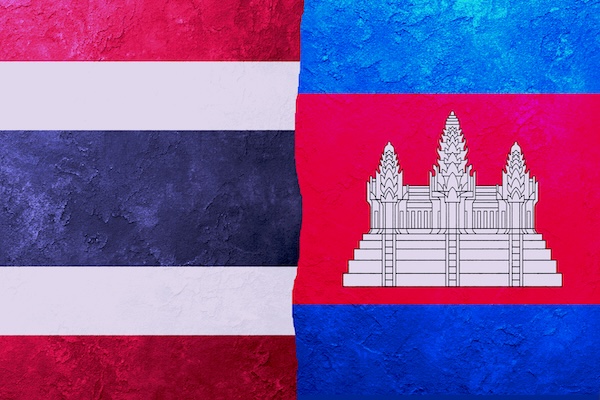
As the conflict between Thailand and Cambodia steps into its second week, the world watches helplessly. On the Thai side, it is reported that one civilian and fifteen soldiers have been killed, and more than 400,000 people have been displaced. On the Cambodian side, eleven civilians have been reportedly killed, at least 75 injured, and more than 100,000 people displaced.
The recurring conflict between the two countries has the Preah Vihear temple at its heart. The 11th-century Khmer Hindu temple symbolises cultural and civilisational pride for Cambodians, and a symbol of colonial injustice for the Thais. The temple, located on a cliff along the Thailand-Cambodia border, was placed on the Cambodian side during the French colonial rule in Indochina. For Thailand, then Siam, this was colonial injustice, as the border should have followed the natural watershed, which would have placed the temple in Thai territory.
In 1962, the International Court of Justice ruled that the temple belonged to Cambodia, based largely on an accepted French-era map. Thailand accepted the ruling reluctantly, but never fully internalised its legitimacy among political elites or the public. While the inadequacies of colonial cartography have plagued many post-colonial states, including India, the Thailand–Cambodia border dispute throws up many questions.
Although the two countries are generally cooperative and share a long history, the conflict cannot be dismissed as a simplistic territorial dispute. Questions of historical and civilisational memory, nationalist mobilisation, political advantage, and the limits of the much-celebrated ASEAN consensus model must all be taken into account when comprehending the Cambodia-Thailand conflict.
Political Advantage
The world has changed. Unlike the past, when limited media reach constrained the spread of public emotion, today’s information ecosystem allows grievances to travel fast and wide. In the emerging global order, identity has become central, and as Southeast Asia navigates major power competition and political stress, unresolved identity conflicts are easily manipulated for political gain.
Thailand-Cambodia border tensions have often coincided with moments of domestic political change. Whether during elections or leadership transitions, the border dispute has been used to raise nationalist sentiment—either to push back opposition or to deflect attention. Standing firm against a neighbour also resonates deeply in societies shaped by experiences of colonial domination, leaving populations acutely sensitive to cultural or territorial encroachment.
When Cambodia sought UNESCO World Heritage status for Preah Vihear in 2008, the Thailand-Cambodia conflict erupted, continuing until 2011. Protests broke out in Thailand, prompting military posturing on both sides. Cambodia’s Prime Minister Hun Sen, by appealing to the ICJ, aimed to portray Cambodia as a victim seeking international legal resolution, stirring nationalist sentiment and portraying himself as a strong leader ahead of elections. He also managed to divert attention from internal challenges, including allegations of corruption and human rights abuses.
Thai Prime Minister Samak Sundaravej initially supported a joint Thai-Cambodian statement backing UNESCO recognition of the temple. This stance was weaponised by the political opposition, the People’s Alliance for Democracy, leading to the resignation of the Foreign Minister Noppadon Pattama, and Samak’s eventual removal from office. His successor, Abhisit Vejjajiva, adopted a harder line on sovereignty, rejecting third-party mediation from ASEAN. Once again, the border dispute displaced attention from Thailand’s deeper political crisis, particularly the pro-Thaksin movement.
The 2025 border clashes are no different. This year’s escalation followed Prime Minister Paetongtarn Shinawatra’s ouster over the leak of a phone conversation with Cambodian leader Hun Sen. She referred to him as “uncle” and criticised the leadership of the Royal Thai Armed Forces. Despite the close relationship between their fathers, the conversation created the opening opposition groups had been waiting for. They accused the leadership of “submitting” to a foreign leader. The Thai military in return took a strong stance on the border. In Cambodia, Prime minister Hun Manet used the crisis to consolidate his authority. Today, the dispute is no longer merely territorial; it is deeply entrenched in national honour.
Mediation Fatigue
In July 2025, after intense fighting and airstrikes, a ceasefire was brokered by ASEAN chair Malaysia, alongside US and China. More recently, in December 2025, the ceasefire collapsed, and Thai forces launched Operation Sattawat. Reactions to international mediation have since been mixed. Recently, President Donald Trump claimed he had brokered a ceasefire between Thailand and Cambodia, a claim swiftly denied by Thai Prime Minister Anutin Charnvirakul.
The US has previously been criticised for a transactional approach to the conflict, raising doubts about Washington’s long-term commitment. This notion pushed Thailand towards leaning on China for mediation. Cambodia, too, has been slowly increasing its strategic alliance with China, which is Cambodia’s largest source of foreign investment, loans and infrastructure financing.
Elsewhere in the region, including Myanmar, China has emerged as a key power broker, capable of negotiating with both the Tatmadaw and ethnic armed organisations.
ASEANS’s limitations have also become increasingly evident. While the organisation projects regional harmony, its institutional constraints have hampered effective conflict resolution. The inability to enforce compliance with ASEAN’s Five-Point Consensus on Myanmar is a case in point.
India’s Role
There are important lessons here for Southeast Asia. The Thailand-Cambodia border issue underscores how even small territorial disputes can be manipulated and escalate into identity-driven, long-term conflicts. Identity politics has become a defining feature of today’s geopolitical churn. Regional organisations such as ASEAN—and even SAARC—lack the mechanisms to enforce durable solutions. Yet, as energy corridors and digital connectivity expand across Southeast Asia, stable borders will become increasingly vital.
This is where India can play a constructive role. India enjoys strategic trust in both Thailand and Cambodia and has maintained positive diplomatic engagement with both. Crucially, it stands outside the US–China rivalry while also being a stakeholder in shared civilisational memory. India can help reframe the issue—not as a zero-sum sovereignty dispute, but as one involving a shared civilisational heritage. India need not solve the problem for Thailand and Cambodia, both capable actors in their own right, but it can assist in de-escalation, limiting external great-power influence and contributing to regional stability. After all, at the heart of this conflict lies a Hindu temple.
More From BasisPoint