.png)

Pakistan’s Baluchistan Moment: Military Power Without Political Imagination
A long-ignored insurgency resurfaces in Balochistan, exposing the limits of military force without political vision—and the urgent need for reconciliation over repression.
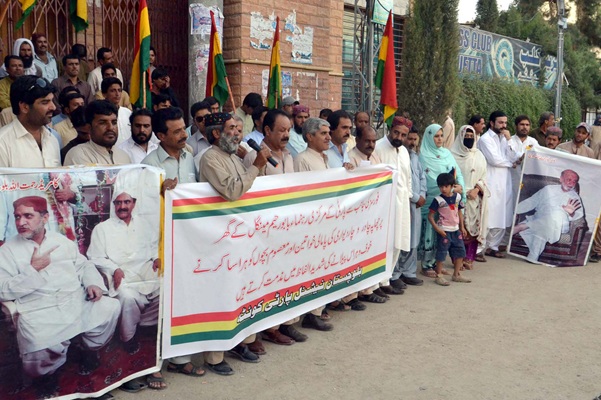

Lt Gen Syed Ata Hasnain is a former Commander of India’s Kashmir Corps and Chancellor of the Central University of Kashmir.
February 6, 2026 at 3:11 AM IST
Pakistan’s internal security crisis has moved beyond episodic violence into something far more structural. What is unfolding in Baluchistan today is not merely another spike in militancy but the resurfacing of a long-suppressed conflict whose political roots were never addressed. Each cycle of violence is met with the same response; kinetic force, temporary suppression, and the assumption that restored order equates to lasting peace. History, including Pakistan’s own, suggests otherwise.
The Pakistani state, led overwhelmingly by the Pakistan Army, has consistently relied on military dominance as its principal instrument of internal control. Villages have been evacuated and razed, not to separate militants from civilians, but to deny terrain altogether. While Pakistani security forces used helicopters and drones to oust militants and carried out ‘clearance operations’ reported in Baluchistan, independent documentation of widespread village evacuation or indiscriminate artillery bombardment in the province is limited in international media. However, in Pakistan’s tribal belt and Khyber Pakhtunkhwa, there is extensive reporting of helicopter gunships and artillery being used in operations that emptied civilian areas and destroyed infrastructure—an approach that has long-term effects on local support.
Such methods may degrade insurgent capability in the short term, but they also embed resentment deep within the social fabric. Counterinsurgency that fails to distinguish between insurgents and the population ultimately manufactures its own successors.
Pakistan’s problem has never been the absence of battlefield success. The Army has demonstrated its capacity for decisive operations, most notably during Operation Zarb-e-Azb. Yet translating military success into political resolution requires statesmanship—an attribute conspicuously missing from Pakistan’s internal security playbook. Zarb-e-Azb disrupted networks; it did not dismantle ideologies, reform governance, or reconcile alienated populations. The celebration of success was premature because kinetic dominance, by itself, does not end insurgencies.
There is a persistent tendency in Islamabad to view Baluchistan through the prism of force projection alone, as though overwhelming firepower can compensate for the absence of legitimacy. That assumption is increasingly untenable. Pakistan cannot bomb Baluchistan into submission the way Israel sought to overwhelm Gaza—and even there, despite unmatched military superiority, the Israel–Gaza war has exposed the limits of force without a credible political end-state. Military dominance does not equal victory when the population remains hostile and the political question unresolved.
This moment also invites an uncomfortable historical comparison. In early 1971, between January and March, Pakistan faced a deteriorating situation in East Pakistan. Then, as now, the military believed coercion could suppress political aspiration. The difference lies in form, not essence. In East Pakistan, mass street mobilisation—rather than militant violence—became the engine of separatism, generating international empathy and moral pressure. There is no Sheikh Mujibur Rahman-like political figure in Baluchistan today, and the resistance lacks unified leadership. Yet the warning signs remain disturbingly familiar; a politically alienated population, militarised governance, and an Army convinced of its indispensability and infallibility. The end-state of that earlier crisis was the birth of Bangladesh—a strategic catastrophe Pakistan has never fully introspected upon.
Pakistan appears to have learnt little from either East Pakistan or Khyber Pakhtunkhwa. In both cases, the belief that coercion could substitute for political engagement proved disastrously wrong. Once the population begins to experience the state primarily as an occupying force rather than a guarantor of order, legitimacy erodes rapidly. What follows is not pacification, but the hardening of resistance and the internationalisation of grievance. Once such thresholds are crossed, the struggle of a people transforms irreversibly. It ceases to be about militancy alone and becomes about dignity, memory, and revenge. At that point, reconciliation becomes exponentially harder.
By contrast, the Indian Army’s counter-insurgency and counter terror experience offers a markedly different doctrinal trajectory. In Kashmir, there are no tanks or armoured personnel carriers dominating civilian spaces. Weaponised helicopters have almost never been used. Over 36 years of counter-terrorism operations, India has progressively recalibrated the balance between hard and soft power—integrating political outreach, administrative reform, and even judicial intervention. Similar balances were struck in North East India, where insurgencies were addressed through a combination of force, dialogue, and accommodation. Even in the Red Corridor, the gradual emphasis on governance and development reflects an understanding that ideas, not weapons alone, form the centre of gravity.
Ironically, while the Pakistan Army studies the Indian Army obsessively for conventional warfare and Line of Control contingencies, it seems unwilling—or unable—to absorb lessons from India’s counter-insurgency and counter terror experience. For Pakistan, the approach remains largely one-dimensional; kinetic hard power and the physical elimination of armed opponents. Individuals may be neutralised, but the idea survives. In Kashmir, the Indian Army explicitly recognised that the “idea of azadi,” and the public mindset sustaining it, constituted the true centre of gravity—and targeted it through calibrated socio-political-military strategy rather than brute force.
Predictably, as internal pressure mounts, Pakistan will seek to externalise blame. India is already being accused of orchestrating unrest to divert attention from a self-generated crisis. Such narratives often gain unfortunate traction in diplomatic circles, where empathy for Pakistan’s security predicament overrides a clear-eyed assessment of causality. The danger lies in allowing a domestic insurgency—rooted in decades of exclusion, coercion, and denial—to be reframed as an external conspiracy.
A further distortion in Pakistan’s internal security narrative lies in the continued differentiation between “hostile” militants and so-called “useful” or “friendly” terrorist groups nurtured for employment against India. This selective tolerance, sustained over decades by elements within the security establishment, has corroded the credibility of Pakistan’s counter-terrorism claims. The diplomatic community stationed in Islamabad is not unaware of this reality. What is lacking is not information, but the willingness to
acknowledge that terrorism incubated as state policy cannot be selectively contained without eventually turning inward. For India, exposing this contradiction—calmly, consistently, and with evidence—must remain central to any long-term narrative strategy on Pakistan.
India must therefore remain prepared on two fronts. Diplomatically, it must firmly but calmly contest attempts to internationalise Pakistan’s internal failures. The Pakistani diplomatic and psychological offensive will inevitably come; we need to be watchful and proactive. Strategically, India must maintain vigilance, mindful that Pakistan’s internal crises have historically been followed by diversionary external adventurism. At the same time, principled advocacy for the rights and political inclusion of the Baloch people is not interference; it is a reminder that stability achieved through repression is inherently fragile.
Pakistan stands at a crossroads. It can persist with force without imagination, or it can recognise that no internal conflict is ever truly resolved on the battlefield alone. The tragedy is not that Pakistan lacks power, but that it lacks the intellectual and political willingness to use power in service of reconciliation. Until that changes, Baluchistan will remain not merely a security problem—but a warning.
More From BasisPoint