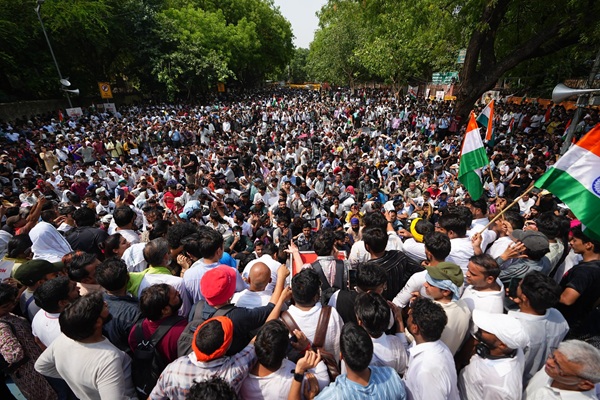
The campaign against the NEET paper leak at Jantar Mantar over the past weeks, which saw young aspirants protesting, demanding accountability and, eventually, securing the resignation of Union Education Minister Dharmendra Pradhan, has done more than just settle one controversy.
It has reopened a conversation Indian politics has avoided for way too long: what does the country's youngest generation actually want from its democracy, and who will speak for it?
The CJP Moment
The Cockroach Janta Party (CJP), which spearheaded the protests, has emerged as the most visible voice of India's youth in years. But its leaders and observers alike caution against reading this narrowly. The NEET leak was merely the trigger. The underlying grievances run deeper: unemployment, stagnant private-sector hiring, layoffs, recurring competitive-exam leaks, government vacancies left unfilled for years, and now the looming anxiety of AI displacing entry-level jobs.
Together, these have led to a mood of uncertainty, nervousness and quiet anger among young Indians that no single resignation can dissolve.
Having tasted an early, tangible victory, CJP is unlikely to fold its tents. Movements that win once, tend to keep raising the stakes, and there is a real possibility that CJP evolves from a pressure group into something more organised — potentially a youth-oriented political formation.
This is not idle speculation. A recent VoteVibe survey suggests genuine electoral space exists for a party built explicitly around youth concerns, and that such a formation could draw meaningful support if it were to contest elections.
Should that happen, it would introduce a new, unpredictable variable into India's electoral arithmetic, one capable of upsetting the calculations of established parties in constituencies with a strong number of young voters.
Country of the Young, Led by the Old
Beneath the protests lies a structural imbalance that is hard to ignore: India is among the youngest nations in the world, yet its political leadership skews strikingly old. MPs under 40 constitute barely 10 percent of Parliament, down sharply from 34 percent in 1957. The Union Cabinet, with more than 70 members, has just a single minister below the age of 40. The average age of the Congress Working Committee stands at 68; the BJP's Parliamentary Board is not far behind at 67.5. Across the political spectrum, there is a conspicuous absence of young leaders with genuine mass appeal or organisational heft.
This representational gap is arguably as combustible as the unemployment numbers themselves. A generation that sees no one like itself in positions of power is a generation likely to disengage — or to revolt.
There are early signs that parties are taking note: reshuffles in Narendra Modi's cabinet, and in the BJP's Bihar unit under Nitin Nabin are being watched closely for the induction of younger faces. Whether this amounts to genuine generational change or cosmetic accommodation will be one of the more consequential political stories of the coming year.
The Government's Calculus
The government is visibly on the back foot, openly conscious of the discontent brewing among the young. For years, this constituency was managed comfortably through the familiar levers of religious and caste-based mobilisation, on the assumption that youth would vote along the same lines as their elders. The Tamil Nadu elections punctured that assumption, demonstrating that young voters can swing outcomes when sufficiently motivated by issues distinct from traditional identity politics.
The stakes for the BJP are considerable. Voters aged 18 to 30 make up roughly 30 percent of the electorate, and this cohort — together with their parents, the urban and semi-urban middle class, and India's aspirational segment — has formed the non-ideological core of the "Modi factor," delivering the party 35 to 40 percent support in the 2024 general election. Any erosion here strikes at the heart of the BJP's winning coalition, which is precisely why Pradhan’s resignation was conceded swiftly, rather than allowed to fester.
There are also signs of a shift in political communication strategy. Modi's increasing personal presence on Instagram, moving away from X and WhatsApp toward a platform that skews younger, signals an attempt to project accessibility and two-way engagement, rather than the one-directional messaging of the past. Symbolism aside, the government now understands that goodwill alone will not suffice; it will need to show tangible outcomes on jobs, exam reforms and youth representation.
The Opposition's Dilemma
The Opposition is hoping this youth anger will dent the ruling establishment, giving it an edge. But the arithmetic is not so straightforward. Notably, the credit for Pradhan's resignation has gone to CJP and the protesting students themselves, not to any opposition party, a reminder that these protests represent a vote of no confidence against the entire political class, not merely the government of the day.
The Opposition's struggle to own this narrative was starkly illustrated in the Bankipur by-poll, where Jan Suraaj Party (JSP), a relatively new entrant, defeated the BJP. That outcome suggests voters disillusioned with the status quo are not automatically migrating to traditional opposition parties; they may, instead, be searching for entirely new political vehicles.
For the Opposition to convert this moment into real electoral gains, it will need to do more than capitalise on mere optics. It must make youth employment, exam-leak reform and job creation central, sustained themes in upcoming state elections, backed by credible policy proposals, not just criticism of the government.
The Bottom Line
Jantar Mantar was not merely about one leaked exam. It was a wake-up call. India's youth, long assumed to be a passive or easily managed constituency, has demonstrated it can organise, sustain pressure and extract concessions. Whether this energy consolidates into a new political formation, forces existing parties to genuinely widen their leadership pipelines, or dissipates once immediate demands are met remains to be seen. What is clear is that no party — governing or opposing — can afford to take the youth vote for granted any longer.
.png)