.png)


Rajesh Ramachandran is a former Editor-in-Chief of The Tribune group of newspapers and Outlook magazine.
August 7, 2026 at 7:01 AM IST
By-elections are usually won by parties in power. Exceptions often indicate a political shift or, at the very least, serve as early warning signs from a frustrated electorate. That may be the message from the recent results in Bihar and Madhya Pradesh. Earlier this week, the BJP suffered a particularly striking defeat, losing the Bankipur assembly by-election by 19,324 votes.
The Bihar Assembly election concluded on November 14, less than nine months ago. The BJP-led National Democratic Alliance won a thumping victory, securing 202 seats in the 243-member assembly. Bankipur was one of them.
The BJP had been winning this central Patna constituency since 1995. Even at the height of Lalu Prasad Yadav’s dominance over Bihar, the party held Bankipur like a pocket borough, never losing it in 30 years.
The seat was known as Patna West before delimitation. Nabin Kishore Prasad Sinha won it in 1995 and retained it in 2000 and 2005. His son, Nitin Nabin, inherited the BJP ticket and won in 2010, 2015, 2020 and 2025.
Bankipur was as close to a BJP fortress as any assembly constituency in Bihar. Its electorate was dominated by middle-class, forward-caste, employed, educated and completely urbanised voters who strongly opposed Lalu Prasad Yadav’s politics of Muslim-Yadav mobilisation.
Nitin Nabin was elected unopposed as the BJP’s national president on January 19 and assumed office the following day. Bankipur consequently needed a new legislator, necessitating a by-election. That contest ended in disaster for the BJP.
In 2025, Nabin had polled 98,299 votes and won by 51,936 votes, with turnout at 41%. The Jan Suraj Party, led by political strategist Prashant Kishore, had fielded Vandana Kumari, who received only 7,717 votes.
Less than nine months later, that electoral order was overturned. The Jan Suraj Party rose from a distant third position to defeat both the BJP and the Rashtriya Janata Dal, winning the seat by 19,324 votes.
The BJP polled just 44,827 votes, less than half its tally in the assembly election. The RJD’s vote count fell even more sharply, to 14,273 from 46,363. Turnout declined to just 35%, reflecting considerable voter apathy.
What changed between November 2025 and August 2026?
Exam Failures
Repeated leaks of the National Eligibility-cum-Entrance Test question papers made the future appear bleak for 2.2 million aspirants. Tens of thousands among the 1.7 million Central Board of Secondary Education Class 12 students were affected by the answer-paper scanning fiasco. Glitches in the Common University Entrance Test directly affected another 3,700 candidates.
The middle class was being hit repeatedly. For many families in small towns, higher education is the clearest route out of economic insecurity. Repeated failures in the examination system appeared to be closing even that route.
Then there was the question of political accountability. Education Minister Dharmendra Pradhan was not moved out of his portfolio. The Supreme Court had acknowledged that there were localised question-paper leaks in Patna and Hazaribagh during the 2024 NEET examination. Yet the problem recurred in 2026, while the political establishment carried on with little visible accountability.
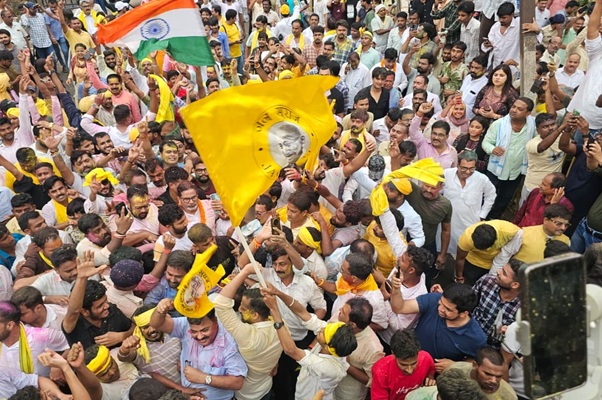
This discontent found expression in the “Cockroach Janata Party” protest, Sonam Wangchuk’s hunger strike and the convergence of large numbers of people, young and old, at the Jantar Mantar protest site.
The anger of the middle class was visible in Bankipur, a constituency at the heart of the BJP’s middle-class and upper-caste support base. Many of these voters were unlikely to switch to the RJD. The relatively new Jan Suraj Party offered them a vehicle through which to convey their deep disappointment with the BJP.
Many may have voted for a party other than the BJP for the first time. Some expressed their anger by staying away, contributing to the poor turnout. A substantial section of BJP voters appears to have shifted its support to Prashant Kishore’s party.
The result also suggests that the Congress has an opportunity to win back a section of the middle class. Its “vote chori” campaign did not strike a chord with these voters, nor did many of the other issues raised by the party leadership.
Question-paper leaks during entrance examinations are different. They threaten the future of middle-class children and strike directly at families’ educational aspirations. That was the red line the BJP leadership failed to recognise.
Failures within the Ministry of Education were overlooked, while the politics of doles, beneficiaries and election-winning tactics continued unabated.
Wider Warning
The Bankipur result is a loud warning that the BJP government may have crossed a red line with a section of the middle class. The middle class may not determine elections on its own, but its disaffection can shape the wider political mood.
The United Progressive Alliance expanded welfare for the rural poor through the National Rural Employment Guarantee Act and other measures. Yet when Anna Hazare’s anti-corruption agitation mobilised the middle class, the Congress and the UPA were swept out of power amid widespread public anger.
Bankipur suggests that another such shift may be beginning.
Datia is not a typical middle-class constituency. It is a largely rural seat in the Gwalior-Chambal region of Madhya Pradesh. Former Home Minister Narottam Mishra held it for three consecutive terms, winning in 2008, 2013 and 2018.
Rajendra Bharti of the Congress wrested the seat from the BJP in 2023. His conviction by a Delhi court for bank fraud and cheating subsequently led to the by-election. Datia is typically regarded as an upper-caste constituency, with Brahmin and Rajput candidates dominating the electoral contest.
Despite Bharti’s conviction and an intensive campaign by Madhya Pradesh Chief Minister Mohan Yadav, the Congress retained the seat by 6,016 votes. Ghanshyam Singh, a member of the former Bundela ruling family who had represented Datia in 1993 and 2003, defeated the BJP’s Ashutosh Tiwari and returned as the constituency’s legislator.
Taken together, Bankipur and Datia suggest growing discontent within sections of the BJP’s middle-class and upper-caste support base. These are constituencies the party has long regarded as secure. The results do not augur well for it. End
Also Read:
The Wrath of the Middle Class
More From BasisPoint