.png)

Rajesh Ramachandran is a former Editor-in-Chief of The Tribune group of newspapers and Outlook magazine.
February 27, 2026 at 8:49 AM IST
India’s gravest internal security threat was resolved early this week. The surrender of Tippiri Tirupati alias Devji on February 24 marks the end of the decades-long reign of terror of the Communist Party of India (Maoist). Sure, there still will be pockets of violence in inaccessible forest villages of Odisha, Chhattisgarh or Maharashtra. But they would not collectively construe the concern that made former Prime Minister Manmohan Singh define Naxalism or Maoism on May 24, 2010 as the “biggest internal security challenge facing our country.”
Tirupati is being variedly identified as the general secretary of the CPI (Maoist), the head of its all-important Central Military Commission that runs the People’s Liberation Guerrilla Army, and its most senior Central Committee and Politburo member. There are also conflicting reports that the Central Committee could not meet to officially elect him the general secretary.
Still his surrender underscores the complete decimation of the CPI(Maoist) underground militaristic hierarchy because he was the figurehead of the organisation after the death of the last general secretary Nambala Keshav Rao alias Basavaraju on May 21, 2025 in an encounter with police forces in Chhattisgarh’s Abhujmarh forests. After Basavaraju’s killing, the CPI (Maoist) had a vertical split when its political and ideological head and spokesperson Mallojula Venugopal Rao alias Sonu surrendered to Maharashtra Chief Minister Devendra Fadnavis in Gadchiroli on October 15, 2025.
It was apparent that it had a lot to do with a factional fight between Rao and Tirupati because a day after the former laid down his AK–47, the Central Committee expelled him, calling him a “traitor”. The split preceding Rao’s capitulation could have been over the military cul de sac the party found itself in—from which the only way out was abject surrender—or a leadership tussle between Rao and Tirupati for the general secretary’s position. It could as well have been both. For, often personal ambition is couched in grand ideological debates in cadre-based parties.
Now, the very faction, which called Rao a “traitor” for articulating that there is no future for an armed insurrection against the Indian State, has given up the guerrilla war. Soon after Rao’s submission the most ruthless local commander, who led the PLGA’s battalion No. 1, was eliminated in an encounter with the Andhra Pradesh’s Greyhounds in the trijunction between Andhra Pradesh, Chhattisgarh and Telangana, proving that there is no rear for the defeated guerrillas to retreat. Hidma had directly led the massacre of 76 CRPF personnel in 2010, 27 top Congress leaders of Chhattisgarh in 2013 and also the ambush and murder of 22 security men in 2021.
Hidma, a local Koya tribesman, was the most bloodcurdling killing machine among them all with multiple layers of security and informants in all the villages. Hidma’s killing was proof that armed insurgency was no longer a feasible project even in hitherto impregnable forest bases. They were trapped. The Central Reserve Police Force’s elite COBRA units, Andhra’s Greyhounds, the District Reserve Guards of Chhattisgarh, its disbanded Koya Commandos, the state special forces of Maharashtra, Odisha and Jharkhand, and their formidable network of informants coordinated by the Centre’s intelligence machinery involving both tech-int and hum-int finally overwhelmed the Maoist insurgents.
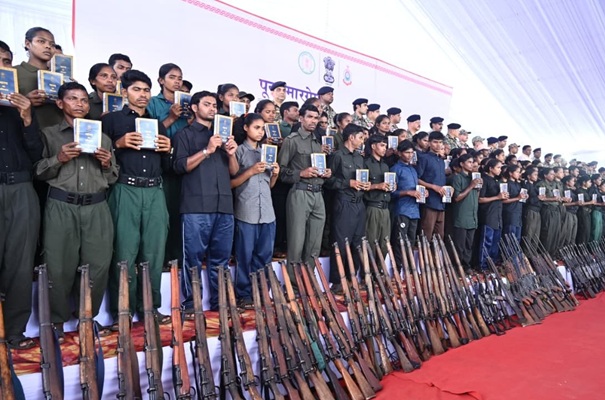
This absolute military failure has prompted Tirupati’s surrender. An ignominious death was the only other option. Unlike Rao’s celebrated surrender along with 60 of his followers (and 200-odd in a separate function in Bastar in Chhattisgarh), Tirupati capitulated in a scaled-down ceremony in the presence of police officers. There were no politicians to honour him with a shawl and a copy of the Constitution. The optics made it amply clear that Tirupati was under duress. Yet, at 62, Tirupati looked dapper with his shirt tucked in, sporting a salt-and-pepper moustache and holding his head high.
There are a couple of senior Maoist leaders left in the jungles and less than 200 foot soldiers but that does not constitute the infamous Maoist corridor from Pashupati in Nepal to Tirupati in Andhra with a potential to strike at will in 223 districts across 20 states. The war has been won. It began in 1989 by IPS officer KS Vyas who raised the elite anti-Maoist force, Greyhounds, to fight the People’s War Group, which Kondapalli Seetharamaiah founded in 1980. Kondapalli won the first battle by killing Vyas in 1993. This essentially Telugu Maoist project drawing cadres from Warangal Regional Engineering College and other college units of Radical Students Union in erstwhile Andhra Pradesh became pan-Indian in 2004 when PWG merged with Maoist Communist Centre to become CPI (Maoist).
The man who created this all-India footprint and established a network of overground workers tying up with Kashmiri, Khalistani and LTTE terrorists was Muppala Laxman Rao alias Ganpati, who took over from Kondapalli in 1992. Ganpati, who went untraceable in 2018, built up the party organisation, its formidable military wing, created the strong overground network that influenced (or got influenced by) foreign diplomatic corps, western academia and the mainstream media. He turned the trijunction of undivided Andhra Pradesh, Chhattisgarh and Maharashtra into a fortress and ruled like a king, spreading the party to Odisha and even West Bengal, which was an irony.
For, the first Maoist uprising happened in Phansidewa, Kharibari and Naxalbari (thus called Naxalism) in the Siliguri subdivision of the Darjeeling district of West Bengal in April 1967, when Charu Majumdar, Kanu Sanyal and Jangal Santhal split from the CPI(Marxist) to form the CPI(Marxist-Leninist). The uprising was welcomed by the Chinese Communist Party as the spring thunder of India in July 1967 and in no time spread across the country with militant clashes getting reported from Bihar to Kerala.
The idea to fight till death against oppression, exploitation and deprivation appealed to youthful idealism across Indian campuses. The 1967 uprising failed in about 10 years and the next bigger wave has failed yet again. But the idea remains appealing for the idealistic youth and will get rekindled whenever oppression against the voiceless poor—rural or urban—crosses the threshold of tolerance. Till then roads, schools, hospitals, water, electricity and jobs in the remote forest hamlets of central India would ensure that Maoist insurgency remains defeated.
More From BasisPoint