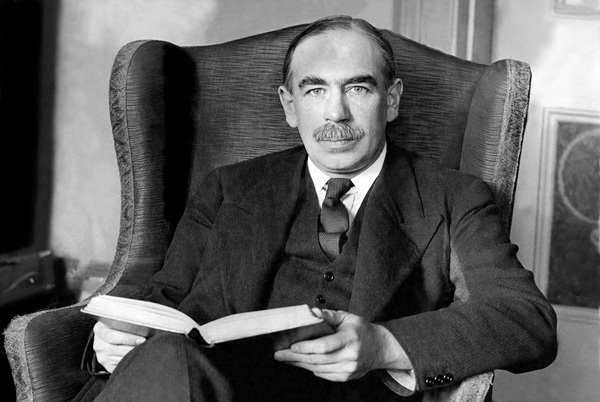
Birth Anniversary Remembrance | June 5, 1883
For a cataclysmic quarter century that saw two World Wars, the Great Depression, a pandemic and repeated financial market dislocations, John Maynard Keynes delivered sustained outperformance as First Bursar in charge of investments at the King’s College Cambridge Endowment Fund.
Over the interwar decades, he generated annualised returns of 16%, outperforming market benchmarks by an average of six percentage points a year — as per Chambers, Dimson and Foo 2013. A record that even today’s large endowment funds would find hard to match.
In today’s money, Keynes turned $82,000 invested at King’s in 1921 into the equivalent of $2.3 million by 1946. In real terms, the capital he managed multiplied many times over through crashes, depression and war.
In 1919 — thirty years before Alfred Jones launched what the world calls the first hedge fund — Keynes had already built one, run it, and watched it blow up. With Oswald Falk, he created the Syndicate, a leveraged currency fund. Initially spectacular. Wiped out within months. He scrambled to recover. The Crash of 1929 exposed the limits of macroeconomic foresight. He did not step away. He changed how he invested.
Capital Lessons
commodity speculation produced its own reckoning. Keynes made an enormous long bet on wheat futures — reportedly purchasing nearly a month’s supply for the entire country. When the market turned against him and physical delivery loomed, he reportedly spent a weekend measuring King’s College Chapel to calculate how much wheat it could hold. He is said to have informed his broker it could accommodate at least half. The market, fortunately, relented.
At King’s he took charge of an endowment dominated by real estate, with core holdings dating back to the mid-fifteenth century. Illiquid assets are not safe assets — their risk is invisible because they are never marked to market.
Princeton’s outgoing CIO, managing a $36 billion endowment, recently described private equity liquidity in 2024 as the “worst ever.” Keynes had diagnosed the pathology in his writing some eighty years earlier.
He ran King’s discretionary portfolio at well above 50% equity through the 1930s when no other Oxbridge college was close, and directed 40% outside the UK into US stocks when home bias was considered prudent.
He began as a macro investor on the theory that superior economic knowledge could time the cycle. It failed. He moved to concentrated, long-horizon, bottom-up stock picking — at one point holding rarely more than two or three positions.
What Buffett and Munger would make the dominant investment philosophy of the century — patience, concentration, conviction — Keynes was practising from a college bursar’s office a full generation earlier.
King’s was not the limit. Keynes invested for himself, for friends, for institutions — a steady and restless hand wherever capital needed direction. He advised Bloomsbury friends — Virginia Woolf, Duncan Grant, Lytton Strachey — helping them accumulate enough to paint and write, and managed funds for two insurance companies and Eton School. Markets were his natural habitat, not his occupation.
Tversky and Kahneman formalised cognitive bias in the 1970s. Thaler built behavioural economics on that foundation. Kahneman received the Nobel Prize in 2002 and Thaler in 2017 for insights building on the programme that Kahneman and Tversky had begun together. Tversky, who died in 1996, did not live to share the prize. His beauty contest analogy — that successful investing means anticipating not what an asset is worth but what other investors will think it is worth — prefigures what later became theories of momentum, reflexivity and herd behaviour.
Shiller and Akerlof titled their 2009 book Animal Spirits, a direct homage to Keynes. Each, in their own way, formalised what Keynes had already lived through markets, and expressed in his writings.
Markets made Keynes the economist, not the other way round. His theory of liquidity preference grew from watching capital freeze in a crisis. Animal spirits as a concept came from living through irrational surges that no model predicted. The beauty contest metaphor emerged from managing a portfolio driven by sentiment, not fundamentals. Each encounter with loss — the currency fund blown up in 1919, the commodity speculation, the 1929 crash — coincided with, and likely influenced, a revision not just of his investment approach but of his economic thinking.
The General Theory emerged out of a period in which Keynes was both observing and participating in markets under severe strain. He remained an investor until the very end — in the only element he ever truly inhabited. He did not merely write about markets. He lived within them. Many of the modern era’s most influential economic ideas have come from economists who also had money in markets, not just views about them.
.png)