.png)

India’s Global AI Vision Needs Reform at Home
Calls for democratised AI ring hollow unless India fixes data access rules, procurement bias, and compute policy to empower start-ups and domestic innovation
Meghna Bal is a lawyer with experience in media and emerging technology. She is the Director of the Esya Centre, a New-Delhi based think tank.
February 23, 2026 at 3:12 AM IST
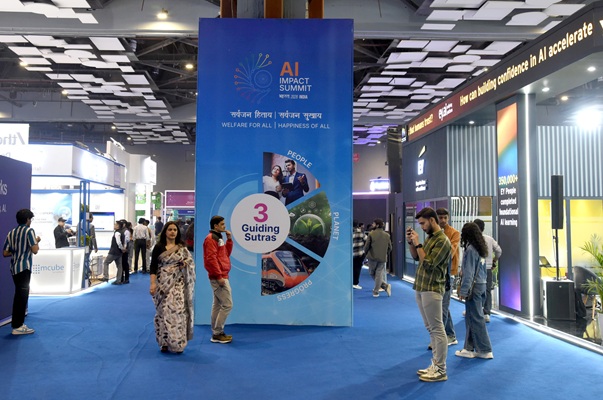
India’s AI Impact Summit culminated in the release of a declaration, signed by 88 participating States and international organisations, underscoring a shared commitment to shaping an inclusive, development-oriented AI future. A core theme of the declaration was democratisation. Illustratively, there is an emphasis in the declaration on voluntary frameworks, open platforms, capacity building, and equitable diffusion, which reflects India’s attempt to position AI as a global public good rather than a narrow commercial asset. However, for this vision to carry credibility and moral authority, India must first address structural constraints within its own ecosystem.
First, it must revise its data protection law to unlock access for local start-ups to publicly available datasets. Section 3 of the Digital Personal Data Protection Act excludes publicly available data from the Act’s ambit—but only where the personal data has been made public by the individual concerned or disclosed pursuant to a legal obligation. In effect, this means that the exemption is conditional: any entity relying on a public dataset must be able to demonstrate that each item of personal data within it satisfies one of these two criteria.
For AI developers working with large-scale, scraped or aggregated datasets—often compiled from millions of sources over many years—such verification is neither technically realistic nor economically viable. Metadata about the circumstances of original disclosure is frequently absent, and there is no scalable method to distinguish between data voluntarily shared by individuals and data uploaded by third parties without authorisation. The consequence is regulatory uncertainty that chills legitimate use of publicly available data, raises compliance costs, and disproportionately burdens smaller firms.
In a survey carried out by the Esya Centre of 162 Indian AI companies, nearly four in five firms reported that verifying the provenance of publicly available personal data is challenging to some degree, with over one-third describing it as extremely difficult or nearly impossible. Eighty-five percent of respondents expected the associated compliance costs to consume a significant share of their turnover—a concerning projection in a sector dominated by start-ups operating on thin margins.
The downstream effects are even more troubling: three in four firms indicated that they would defer or scale down investments in AI systems, data infrastructure, and analytics platforms under the current framework, while several suggested they might abandon AI development altogether. These findings underscore a stark reality—without targeted reform, Section 3 risks converting a nominal exemption into a de facto barrier to entry, undermining both competition and India’s broader ambition of democratising AI.
Second, India must democratise access to procurement for Indian start-ups. Public procurement is a powerful lever for facilitating market access for start-ups. But India’s current norms tend to favour incumbents, with projects often going to the lowest bidder. Larger firms are typically better able to absorb the costs of underbidding, whereas such conditions are prohibitive for smaller ones.
Third, India must place greater emphasis on hybrid or edge computing, and clear barriers to its uptake. Edge computing—where data is processed closer to the source rather than routed to centralised cloud data centres—offers a pathway to democratising AI by reducing latency, lowering bandwidth dependence, enhancing privacy, and enabling deployment in low-connectivity environments.
For a country as geographically and socioeconomically diverse as India, edge-enabled AI systems can power real-time agricultural advisories, smart manufacturing, telemedicine diagnostics, vernacular voice assistants, and urban mobility systems without relying on constant high-speed cloud access. In effect, edge computing reduces dependence on resource-intensive hyperscale infrastructure and allows domestic innovation to flourish closer to the user.
Currently, edge or hybrid compute finds little or no mention in any policies related to compute in India. As a starting point, decision-makers must formally recognise the hybrid AI ecosystem, and consider measures to enable to its adoption. This could include adopting on-device AI for some aspects of public service delivery and introducing trust labels that signal compliance with privacy, sustainability, and safety requirements, to build consumer confidence.
India cannot champion the democratisation of AI globally while tolerating structural rigidities at home. It must work to rationalise the impediments to inclusive AI uptake and development within its own borders. If it manages to do so, it will emerge credible model for how large, diverse, developing democracies can build open, competitive, and innovation-driven AI economies.
More From BasisPoint