.png)

India–EU FTA Anchors Ties, But CBAM Remains the Elephant in the Room
The EU’s Carbon Border Adjustment Mechanism remains outside the deal, creating a structural imbalance.
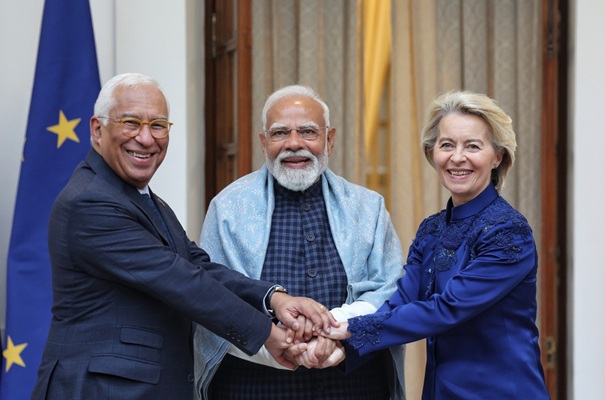

Ajay Srivastava, founder of Global Trade Research Initiative, is an ex-Indian Trade Service officer with expertise in WTO and FTA negotiations.
January 27, 2026 at 11:32 AM IST
India and the European Union have concluded negotiations on a free trade agreement at the 16th India–EU Summit. The deal delivers deep tariff cuts but leaves India’s most sensitive structural concern—the EU’s carbon tax, unresolved.
On market access, the EU will cut or eliminate tariffs on 98% of Indian goods. Since many EU duties were already low, India’s main gains lie in labour-intensive sectors where tariffs were still high. The biggest beneficiaries are garments (around 12% tariffs) and footwear (8–15%), along with marine products, gems and jewellery, handicrafts, chemicals and machinery.
India will cut or eliminate tariffs on about 97% of EU exports, with reductions phased in over 7–10 years. Duties on wines will fall from 150% to 20–30%, spirits to 40%, beer from 110% to 50%, and cars from 100–125% to 10% for up to 250,000 vehicles. India will also move to zero tariffs on a wide range of agri-food and consumer products—such as sheep meat, fruit juices, bakery items, pasta, chocolate and pet food—and phase out duties on most processed foods, chemicals, machinery, electronics and aircraft.
Beyond tariffs, India and the EU took different positions on government procurement, intellectual property, labour, environment and sustainability. The outcomes of these chapters will only be clear once the legal texts are released.
The biggest risk is the EU’s Carbon Border Adjustment Mechanism CBAM. From January 1, EU imports are taxed based on carbon emissions. As CBAM is not addressed in the FTA, EU goods could enter India duty-free while Indian exports continue to face carbon taxes in Europe. Although CBAM currently applies to only six products, including steel and aluminium, it is designed to expand to all industrial goods, potentially eroding much of the FTA’s tariff benefits.
The agreement does little to correct this imbalance. Plans for an EU–India cooperation platform in 2026 and possible EU funding of €500 million for India’s green transition do not address exporters’ carbon-tax burden, leaving CBAM a major unresolved issue.
More From BasisPoint