.png)


Ajay Srivastava, founder of Global Trade Research Initiative, is an ex-Indian Trade Service officer with expertise in WTO and FTA negotiations.
December 5, 2025 at 3:49 PM IST
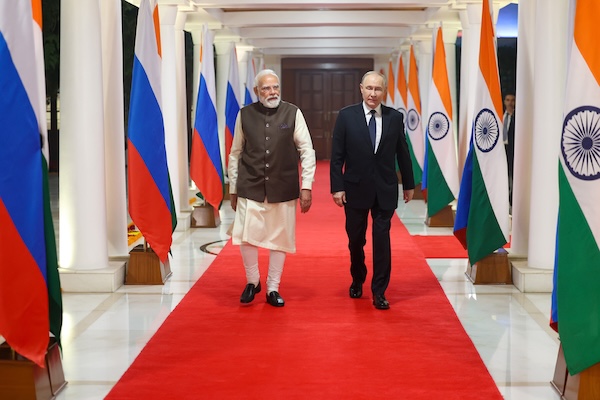
During President Vladimir Putin’s current visit to India, Moscow reiterated its ambition to lift bilateral trade to $100 billion by 2030, with stronger purchases of Indian goods for correcting the imbalance.
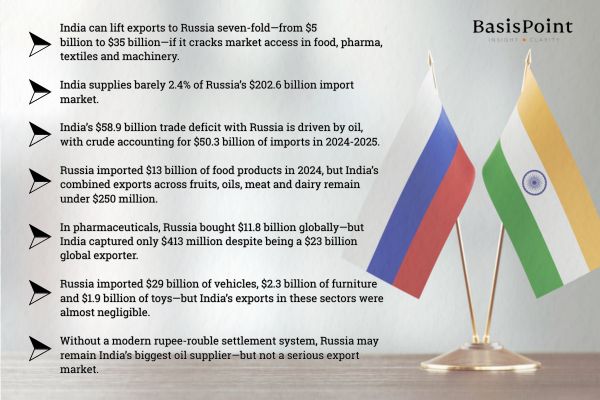
While bilateral commerce is nearing $70 billion, India’s exports remain stuck below $5 billion and imports are overwhelmingly dominated by crude oil. In 2024-25, India exported just $4.9 billion worth of goods to Russia but imported $63.8 billion, leaving a trade deficit of $58.9 billion. Crude oil accounted for $50.3 billion of total imports, underscoring how bilateral trade has become an oil relationship rather than a broad trade partnership.
Closing the trade gap, will depend on identifying and scaling high-potential product lines where India is globally competitive but commercially absent in Russia.
To identify where exports can realistically be scaled, the Global Trade Research Initiative has mapped product groups in which Russia is a large global importer and India is a major global exporter — but where India’s share of Russia’s import market remains below 5%. The analysis focuses on categories where Russia’s global imports exceed $500 million and India’s global exports are also above $500 million, isolating segments with both demand depth and export readiness. Since Russia no longer publishes comprehensive trade statistics, mirror import data for calendar year 2024 has been used from the World Integrated Trade Solution database.
Export Potential
In 2024, Russia imported $202.6 billion of goods globally but sourced just $4.84 billion from India — giving New Delhi a modest 2.4% share of Russia’s import market.
The shortfall is visible first in food and agriculture, where Russia depends heavily on imports but India’s penetration remains thin. Russia imported $4.34 billion worth of fruits and nuts, $1.62 billion of oilseeds, $1.21 billion of edible oils, $1.15 billion of vegetables and roots, $889 million of meat, and $518 million of dairy and eggs. Yet India supplied only $38.8 million of fruits, $79 million of oilseeds, $38.6 million of oils, $36 million of vegetables, $36.5 million of meat and just $7 million of dairy. Even in products where India is a major global exporter — such as meat ($3.95 billion worldwide), oilseeds ($2.17 billion) and fruits ($1.67 billion) — its share of Russia’s import basket is mostly below 5%.
Processed food reveals an even wider gap. Russia spent $689 million on cereal, flour and starch preparations and another $1.15 billion on processed fruit and vegetables. India sold a negligible $0.6 million in cereal-based foods and $42.7 million in processed produce, despite being a near $2 billion global exporter in food preparations. In tobacco, Russia imported $966 million, while India supplied $37.5 million, a 3.9% share of a market where India exports $1.84 billion globally.
India’s under-representation extends to fast-moving consumer products and chemicals. Russia imported $3.13 billion of perfumery and essential oils and $1.07 billion of soaps and detergents, but India exported only $21.8 million and $29.1 million, capturing well under 3% of either market despite being a $3.7 billion global exporter in these categories combined. In inorganic chemicals, Russia imported over $5 billion, while India exported just $219 million, giving it a 4.3% market share.
Pharmaceuticals remain India’s strongest high-value export to Russia, but even here penetration is shallow. Russia imported $11.8 billion worth of medicines in 2024, while India exported $413.5 million — a market share of just 3.5% despite India being a $23 billion-plus global pharma exporter. In plastics, Russia imported $7.5 billion, but India supplied barely $104 million; in rubber goods, Russia imported $3.1 billion, while India exported $75 million.
Textiles and apparel expose perhaps the clearest structural gap. Russia imported $730 million of man-made filaments and $566 million of man-made fibres, yet India exported only $25.6 million and $9 million despite being a large global supplier. Russia also imported $740 million worth of knitted fabrics, but India exported nothing at all in this segment.
In clothing, Russia bought $3.65 billion of knitwear and $3.03 billion of woven garments; India supplied just $24 million and $76 million, representing market shares of under 3% in categories where India’s global exports exceed $15 billion. Footwear shows the same mismatch: Russia imported $3.9 billion; India exported only $31.6 million.
Metals and engineering goods show scale without depth. Russia imported nearly $3 billion of iron and steel and another $3.5 billion of fabricated products; India exported $140 million and $76 million respectively. In industrial machinery, one of Russia’s largest import categories at $37 billion, India supplied $1.1 billion, about a 3% share, despite being a major global exporter. Electrical equipment imports into Russia stood at $20.5 billion, but India exported just $424 million. Russia also imported almost $7 billon in optical and medical instruments, while India’s exports were just $130 million.
Nowhere is the gap starker than in big consumer industries. Russia imported $29 billion worth of vehicles, but India’s exports were just $45 million. In furniture, Russia imported $2.3 billion, while India sold less than $4 million. In toys and sports goods, Russia spent nearly $1.9 billion but India exported only $6 million, and in other miscellaneous manufactures Russia imported $1.3 billion while India shipped a marginal $12 million.
Measures Needed
For trade with Russia to expand beyond oil purchases, India will need to rebuild the plumbing of commerce as much as the politics. With Russian banks largely shut out of SWIFT, payments remain the single biggest friction facing exporters, making deals slow, costly and uncertain. One way forward is a wider push on local-currency settlement, backed by credible clearing arrangements and greater involvement of Indian and Russian banks.
In the Soviet era, the two sides solved this problem through a fixed rupee–rouble system, under which trade was settled at a pre-agreed exchange rate rather than in dollars, shielding commerce from currency risk and hard-currency shortages. To revive exports, New Delhi and Moscow will need a modern equivalent—along with regular buyer–seller meets, trade missions and institutional support—to move trade from hydrocarbons to goods that actually fill Russian shelves and factories.
More From BasisPoint