The so-called “holdup” problem is a well-known phenomenon in the subfield of economics, known as Contract Theory. This problem arises when two parties hesitate to cooperate efficiently because they fear the other will exploit their initial investment. In other words, this problem occurs when one party makes a non-refundable, relationship-specific investment, which then gives the other party extra bargaining power to demand better terms at a subsequent point in time.
Interesting new research sheds valuable light on how the holdup problem affects activity in the Indian solar power market. The specific question that this research addresses is whether the threat of hold-up — where buyers exploit sellers’ sunk investments by renegotiating or defaulting on contracts — raises the cost of green energy and reduces investment in renewable capacity.
Context and Motivation
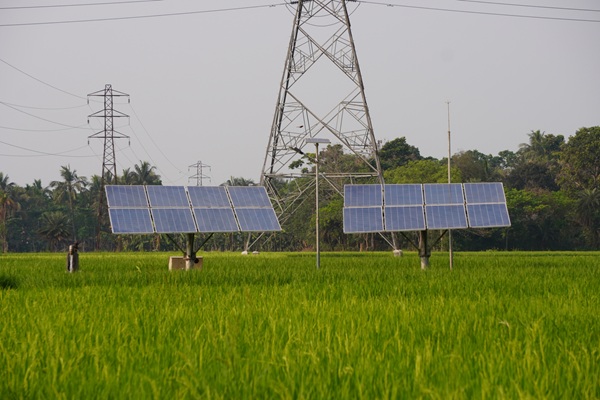
India’s electricity buyers are almost entirely state-owned distribution companies or discoms, many of which have chronic financial difficulties and long histories of delayed payments, strategic renegotiation, and outright default. Solar power investments are particularly vulnerable to hold-ups because they carry high fixed costs, but near-zero variable costs. Once a plant is built, the seller has lost bargaining power: the buyer can threaten to renegotiate contracts knowing the firm will continue operating rather than shut down. Rapid technological progress compounds the problem, as falling solar prices give buyers a ready justification for demanding lower tariffs on existing contracts.
India’s solar market offers an unusually clean way to measure counterparty risk which is the risk that a buyer will either default or want to renegotiate an existing contract. Both, individual states and the central government, run auctions to procure solar power. In centrally intermediated auctions — conducted through agencies like SECI or NTPC — the same technology, the same firms, and the same geographic locations are involved, but the central government absorbs the counterparty risk that would otherwise fall on sellers. This institutional variation allows this research to compare auction outcomes for essentially identical projects under high and low levels of counterparty risk, controlling for observable cost differences.
Counterparty risk is measured using Ministry of Power letter grades for state distribution companies, validated against data on late and disputed payments from the PRAAPTI payment-tracking system.
Empirical Findings
The first major finding is that counterparty risk increases solar bid prices by approximately 10% in auctions run directly by an average-risk state, relative to what the central government would have paid. This premium is economically meaningful — roughly equal to the average markup of bids over costs across all bidders, and equivalent in magnitude to moving a solar plant downward by 2.4 standard deviations in the distribution of solar irradiance. Central intermediation eliminates this premium entirely: once the central government absorbs counterparty risk, higher state risk no longer raises bid prices.
A second finding relates to the nature of the risk. The premium is concentrated among firms without thermal power capacity in the procuring state. Firms that also operate thermal plants can credibly threaten to withhold conventional power if a contract is breached, giving them stronger bargaining leverage. Solar-only firms, with no such threat, face the full risk premium. This heterogeneity provides evidence that the premium reflects strategic hold-up rather than merely external uncertainty.
Third, bilateral contracts negotiated directly between states and firms carry even larger risk premiums than state-run auctions, suggesting that the competitive and transparent nature of auctions provides some additional commitment on the part of buyers.
Ceiling Price Policy
This research contends that the risk premium does not merely redistribute surplus from buyers to sellers — it actively reduces investment because state demand for green energy is elastic. States trade off solar power against other sources, and several adopted binding ceiling prices on bids from 2018 onward to replicate the low prices achieved in central auctions. The data shows that capacity awarded fell significantly short of capacity sought after ceiling prices were introduced.
Using an elaborate auction model, this research quantifies the tradeoff. It finds that ceiling prices reduced solar capacity procured by 16% yet lowered actual procurement prices by only 1%. The reason is that bidders respond strategically: when ceiling prices reduce participation, remaining bidders shade their offers upward toward the ceiling, keeping realised prices nearly unchanged. Risky states face an especially severe version of this tradeoff — at average state risk levels, moving to uniform ceiling prices would cut capacity procured by 23%, while at high risk levels the reduction reaches 31%.
This research concludes that counterparty risk is a fundamental determinant of green energy prices in developing countries. Central intermediation is shown to fully eliminate the risk premium in India, but this solution depends on having a credible, fiscally sound central government willing to back contracts. The research notes that international analogs — such as the World Bank’s Scaling Solar guarantee programme — exist but remain far too small to address the scale of the problem. With energy demand growing the fastest in developing countries with the weakest credit, the challenge of holding up green energy may represent a significant obstacle to the global clean energy transition.
*Views are personal
.png)