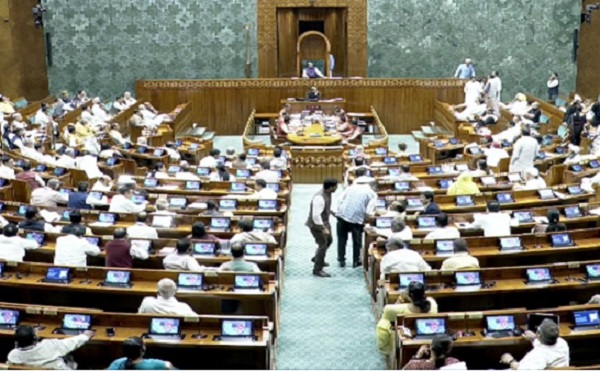
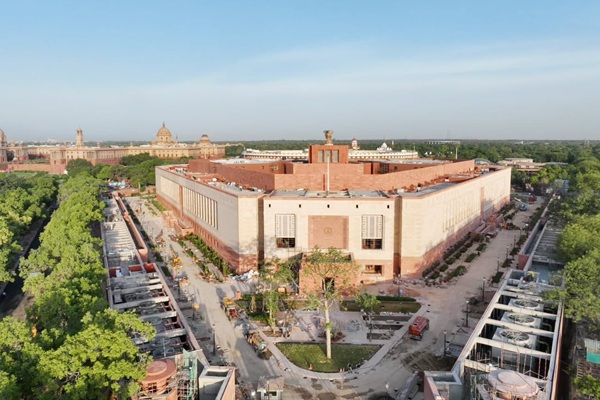
The government has refrained from outlining the contours of the upcoming delimitation exercise even as it moves to raise the maximum strength of the Lok Sabha from 550 to 850 — a step linked to the implementation of one-third reservation for women.
The Constitution (One Hundred and Thirty-First Amendment) Bill, 2026, introduced in the Lok Sabha on Thursday, proposes that the House of the People shall comprise up to 815 members elected from states, along with a maximum of 35 members representing Union Territories.
While the amendment sets the upper ceiling for expanding the Lok Sabha, it does not specify the formula for allocating seats across states. This will instead be determined through a separate delimitation exercise based on the latest available census data.
The accompanying Delimitation Bill, 2026, provides the legislative framework for the process, empowering a Delimitation Commission to allocate seats, determine reservations, and redraw constituency boundaries.
The Commission will be required to carry out the exercise on the basis of the latest published census figures. However, the legislation stops short of clarifying how competing considerations — such as population changes, regional balance, and existing seat shares — will be reconciled.
Delimitation remains a highly politically sensitive issue in India, with southern states — which have achieved lower population growth — fearing a potential loss of representation, while states with higher population growth stand to gain.
The amendment also operationalises the long-pending reservation for women, but only after the completion of the delimitation exercise. It provides that one-third of seats in the Lok Sabha and state legislatures will be reserved for women, with constituencies allocated on a rotational basis.
India froze delimitation based on the 1971 Census for 25 years — a freeze that has been extended multiple times and is set to end in 2026.
Delimitation refers to the process of redrawing the boundaries of legislative constituencies. Since Independence, India has undertaken four such exercises — in 1952, 1962, 1973, and 2002. While the first three increased the number of seats, the 2002 exercise only redrew constituency boundaries based on the 2001 Census without altering the total strength.
At present, the Lok Sabha has 543 elected members.
.png)