.png)



Dr. Smita Roy Trivedi is an Associate Professor at the National Institute of Bank Management (NIBM), Pune.

Dr. Abhiman Das is a Professor of Economics at the Indian Institute of Management Ahmedabad.
April 14, 2026 at 5:48 AM IST
...Intervention in the foreign exchange market is aimed at smoothening excessive and disruptive volatility without targeting any specific level or band for the exchange rate. This is consistent with our long-standing policy of the exchange rates being market-determined.
— RBI Governor’s Statement: April 8, 2026.
India has RBI-intervened market-determined exchange rates. Market participants know what it means. In all practical terms, intervention in the forex market has several dimensions, not just traditional buying and selling of currencies.
In the last week, as RBI curbed Indian financial institutions and corporate treasuries from taking bearish bets, and banks faced the possibility of mounting losses, there has been a growing narrative on the perils of intervention. We have written about both ineffectiveness and perils of consistent intervention. For the central bank, fighting the forex markets on rupee volatility is fighting the shadows: it’s futile and unsustainable. If managing volatility is a concern, what is required is to stop fighting speculators: instead, focus on dollar demand in the real sector, and use signalling effectively.
Policy Lessons
Figure 1: Movement in INR, DXY and Crude in 2013

However, the macroeconomic conditions in 2013 were different too: the rupee performed worst in the peer group as domestic inflationary conditions, political uncertainty and high CAD meant both fundamental factors and investor sentiment worked against the rupee. Added to this was the crude price escalation (Figure 1). RBI intervened in the spot market, and brought out an innovative forward market intervention strategy: the spot sale of USD, which led to liquidity shortage, was balanced by forward market intervention of USD/ INR buy/sell swap (effectively USD sales forward).
Since then, RBI has followed the rulebook of forward intervention: as we have highlighted, such a strategy is effective in the short run as it shields the domestic monetary policy from forex intervention repercussions. However, in the long-term, it leads to a build-up of dollar liabilities, which can be concerning.
However, the spirit of the 2013 intervention, was threefold. First, it was a prudent mix of consistent signalling on rupee management and volatility curbs, and sucking out real sector dollar demand with policies like 80:20 and oil swaps. Second, to attract capital, commercial banks were incentivised to mobilise NRI inflows by offering a concessional swap window for FCNR(B) deposits. Thirdly and most importantly, the policy rate was tightened, with the repo rate increased by 50 basis points by October 2013. Thus, the success of the policies was more from being attuned to ground realities and signalling effectively.
Market Reality
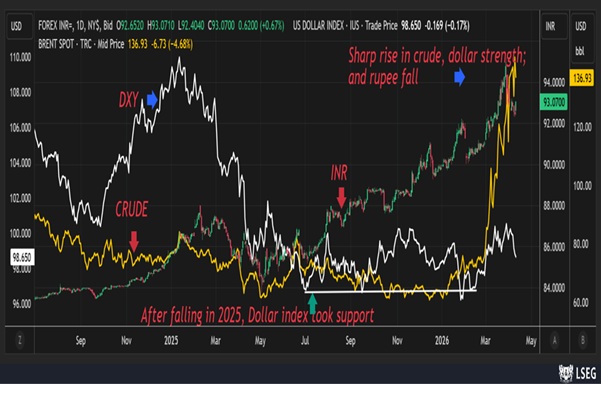
Note that the rupee was under unrelenting pressure much before the US-Iran war, notwithstanding India’s real economy clocking an impressive over 8% growth and low inflation. Where is the real sector demand for USD coming from? Import demand is mostly being driven by crude, and has played a crucial role in the rupee fall (Figure 2). Therefore, policies for easing crude hassles and dollar demand, from alternate trade partners, payment swaps, earmarking of reserves for crude, and partial pass-through of price to consumers, could be explored. Undoubtedly, a host of measures for export encouragement have come, but more are needed. For example, on the ground, smaller exporters would benefit more from ease of doing business rather than extension of payment periods.
Second, consistent and clear signalling is required. Following the 2013 episode, Raghuram Rajan was successful in giving a clear signal on preventing “extreme volatility of the rupee”, while not being “averse to adjustments” (Raghuram Rajan, 2014, Bloomberg TV). In August 2015, following the Chinese devaluation and consequent extreme volatility in currency markets, the Governor’s signal against competitive devaluations and rupee resilience worked well for allaying market fears.
After 2013, this episode of oil prices spikes is the first large macroeconomic supply shock faced by the Government. The oil price recorded high volatility during the Covid crisis, but it remained on the lower end. The geopolitical tensions during Russia-Ukraine war also resulted in high and volatile oil prices. However, the recent episode of volatility is unprecedented. Therefore, we are presumably less prepared.
Finally, the talks between the US and Iran have failed and there is no clear indication of withdrawal from either side. The window of apparent ceasefire may be a way to buy time for greater escalation. In that case, a short-term solution to curb exchange rate volatility may be unsustainable.
In the April 2026 MPC, Governor Sanjay Malhotra said the rupee is a market-determined currency, which has been the consistent narrative for the last three years, iterating that interventions were to “ensure that self-fulfilling expectations do not exacerbate currency movements beyond what is warranted by fundamentals”.
However, financial markets are meant to have deviations from fundamentals, and attempts to tie the currency to any value, even what the central bank considers fundamentally warranted is an action on currency value. When the RBI is intervening not only in spot and forward markets but also reportedly directing treasuries to square bearish bets, it would be difficult for market participants to think of the rupee as market-determined. There is a thin line between reticence, ambiguity, and unclear signals, which the central bank, in its capacity as the leader of the market, should be cautious of.
[1] Indian rupee is quoted directly, i.e. USD/INR, USD being the base currency. An increase in the exchange rate implies a depreciation of rupee.
More From BasisPoint