.png)


Alok Kumar Mishra is Professor of Economics at the University of Hyderabad.
March 26, 2026 at 6:49 AM IST
India’s cities are under immediate strain.
Commutes are getting longer, roads more crowded, and the bus—still the backbone of urban transport—has quietly become the slowest way to get anywhere. At the same time, we are placing a lot of faith in metro rail to fix this. It will help, no doubt. But it will not arrive everywhere, and certainly not in time.
Indian cities operate in an arena of stark contrasts. Cities like Indore, Bhopal and Pune have either fully or partially dismantled their existing Bus Rapid Transit systems. Delhi did the same in 2016. On the other hand, given the extreme congestion witnessed on Bengaluru’s IT corridor, there have been multiple instances in recent years where the idea has regained ground.
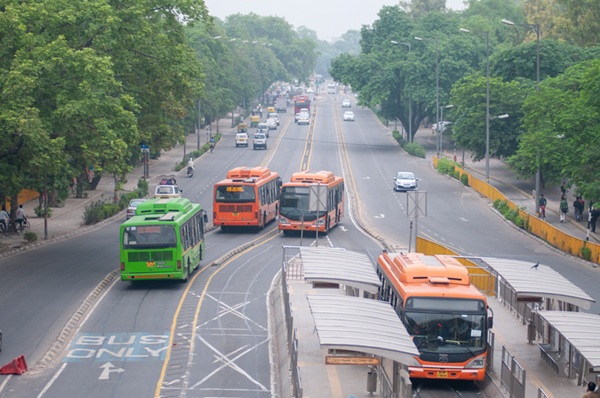
This is where BRT should have mattered more than it did. It combines the flexibility of buses with the speed and capacity of rail-based systems, they have the potential to transform how Indian cities move, breathe, and grow.
Cost Advantage
Urban transport is, in the end, a question of trade-offs. Cities do not have unlimited money or time, and choices have to be made about what can be built quickly and at scale.
Metro systems are capital-heavy and slow to expand. They make sense in dense corridors, but they cannot stretch across an entire city overnight. BRT sits at the other end of that spectrum. It takes something we already have—buses—and tries to make them work better.
With features like dedicated lanes, platform-level boarding, off-board fare collection, traffic signal prioritisation, and real-time passenger information systems, BRT ensures high-speed, high-frequency, and reliable public transportation at a fraction of the cost of metro systems. It can also be scaled in phases across corridors based on demand and financial viability. Additionally, it helps rebalance road space, correcting the imbalance created by rising private vehicle use.
While metro systems require over ₹2.5 billion per kilometer, BRT corridors can be developed at a tenth of that cost, enabling rapid and widespread deployment. This difference matters because it shapes ambition. With metros, cities tend to think in lines. With BRT, they can think in networks.
Globally, that has made a difference. Bogotá’s system carries millions daily. It integrates trunk routes with feeder services, fare unification, and a central control system to manage operations in real-time. Curitiba built its urban growth around bus corridors. Guangzhou’s BRT system, often cited for its design excellence, combines median-aligned busways with platform-level boarding, universal accessibility, and seamless integration with metro lines, pedestrian paths, and bicycle infrastructure. These are not identical cities, but they share one thing: they treated BRT as serious infrastructure, not a compromise.
Design Discipline
India’s engagement with BRT has seen both promise and pitfalls.
The early experiments told mixed stories. Pune tried first in 2006, then came Delhi, Ahmedabad, Indore, Surat. Some worked reasonably well. Others struggled almost from the start.
Delhi is still the reference point. Lanes were not fully segregated, enforcement was uneven, and the system never quite earned public confidence. Over time, it became easier to scrap it than to fix it.
But Ahmedabad’s Janmarg offers a quieter counterpoint with median-aligned dedicated corridors, GPS-based vehicle tracking, smart card ticketing, and multimodal integration. It is not perfect, but it works well enough to carry over 150,000 people a day. Surat built on that with better planning and steadier execution.
Indore, which had to scrap its BRT system recently following a Madhya Pradesh High Court order, had employed Intelligent Transport Management Systems for route planning and fleet monitoring, reflecting how technology can enhance BRT’s performance and responsiveness.
Twin cities of Hubbali-Dharwad in Karnataka have also made progress with BRT through the ‘Chigari’ project. The latter also used ITMS extensively.
Where design was taken seriously, the system held up. Where it was diluted, it unravelled. Yet this has not always shaped policy choices.
BRT systems in India have often struggled on multiple fronts, including encroachment on corridors, inadequate last-mile connectivity, insufficient maintenance budgets, and frequent political turnover that disrupts policy continuity. Moreover, many projects have failed to incorporate principles of transit-oriented development, resulting in suboptimal ridership and weak integration with other modes.
Policy Push
If it is to be taken seriously again, the basics need to be treated as basics, not optional extras. Lanes have to be physically protected. Stations have to work smoothly. Buses have to run often enough for people to rely on them. And the system has to connect with everything around it, from metro stations to the last stretch of the commute.
Investing in BRT aligns closely with India’s National Urban Transport Policy, and international commitments under the Paris Agreement and Sustainable Development Goals. BRT promotes environmental sustainability by reducing vehicle kilometres travelled and enabling a modal shift from private to public transport. It is also an instrument of social equity, offering affordable mobility to lower-income groups who are often excluded from the expensive metro rail system.
None of this is particularly radical. It just requires consistency.
There is also a political dimension. Bus systems do not carry the same visibility as rail projects, even though far more people use them. That often shows up in how resources are allocated and how much attention operations receive after launch.
Public perception plays its part as well. Reallocating road space can feel disruptive, especially in already crowded cities. Without clear communication, it can look like congestion is being created rather than reduced. That gap between intent and perception has hurt BRT more than once.
And yet, for all this, the case for improving bus systems remains strong. Most urban commuters still depend on them. Even modest gains in speed and reliability can make a noticeable difference to daily life.
BRT fits into that space. It is not a substitute for metro rail, but it does not need to be. The two can work alongside each other, one handling dense corridors, the other providing wider coverage.
India’s cities are changing quickly, and mobility will shape how liveable they evolve. Waiting for large projects alone to catch up is not enough. Systems that can be built faster, expanded steadily, and serve more people need attention as well.
BRT still offers that possibility. It just needs to be treated with a little more seriousness than it has received so far.
The idea was never the problem.
More From BasisPoint