.png)

Bangladesh at Risk: Elections, Radicalism, and India’s Strategic Nerve
How political flux next door tests India’s discipline, deterrence, and diplomacy

Lt Gen Syed Ata Hasnain is a former Commander of India’s Kashmir Corps and Chancellor of the Central University of Kashmir.
February 9, 2026 at 5:11 AM IST
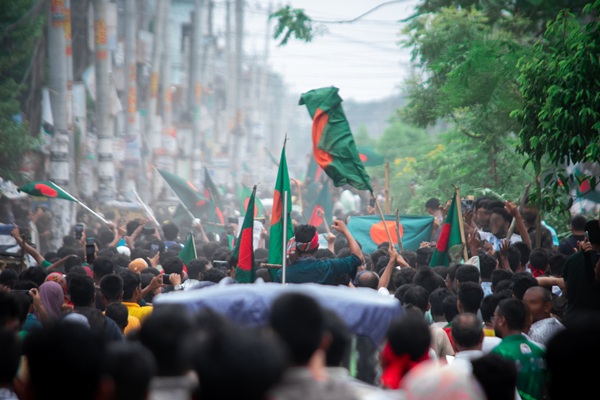
Too many people expect too much from the elections in Bangladesh on February 12, 2026. Bangladesh stands at a moment of profound uncertainty. The elections, however, are unlikely to restore clarity; at best, they may arrest further drift. At worst, they could institutionalise the turbulence that has marked the country since the fall of Sheikh Hasina. What is unfolding in Bangladesh is not merely a domestic political transition but a strategic inflection with consequences that will be felt across the eastern subcontinent, particularly in India’s security calculus.
The popular uprising that overthrew Sheikh Hasina was driven by legitimate aspirations. Bangladesh’s youth sought greater political freedom, more accountable governance, and a better quality of life. These were not ideological demands but social ones, born of rising expectations in a society that had experienced sustained economic growth but limited political space. Ideological narratives have since been attempting to rule the roost at the cost of the social ones. Yet revolutions rarely deliver outcomes proportionate to their intent. The political forces most likely to benefit from the current moment are not necessarily those best equipped to govern.
Current assessments suggest that the Bangladesh Nationalist Party may emerge as the single largest party, but without the strength to govern decisively. The Jamaat-e-Islami is expected to perform well, possibly becoming a critical supporting force. This arithmetic points towards a fragile coalition, one dependent on ideological bargaining and vulnerable to street pressure. Such a configuration is unlikely to produce administrative efficiency or economic confidence. Bangladesh’s previous growth story rested on continuity, security and integration with regional supply chains. All three are now under strain.
It is here that external misjudgement may have played a role. There is reason to believe that parts of the Western strategic community viewed the fall of Sheikh Hasina as a necessary disruption, assuming that disorder would eventually give way to a more open and democratic order. This assumption has echoes of earlier experiments elsewhere, where regime change was treated as an end in itself. Bangladesh, however, is not a blank slate. Political Islam there is deeply embedded, socially resilient and far less susceptible to external moderation than many assume. The expectation that Islamist political forces would evolve into benign, pro-Western actors reflects a misunderstanding of local political culture.
Unlike Pakistan, where the military still exerts a restraining influence over clerical power, Bangladesh lacks a comparable institutional counterweight. If Islamist forces entrench themselves in governance, the implications will extend beyond Bangladesh’s borders. Radicalism does not remain contained; it exports ideology, networks and influence. Over time, this could shift the centre of gravity of Islamist radicalism, creating a new arc of instability adjacent to India’s most sensitive regions.
For India, this is not an abstract concern. The return of Pakistan’s intelligence apparatus to Bangladesh is no longer speculative. The Inter-Services Intelligence has historically exploited moments of political flux to rebuild relevance, particularly through low-cost, deniable methods. What is visible today is likely only a preliminary probe. Bangladesh’s current disorder, when viewed alongside instability in Myanmar, narcotics flows into the North East and dormant insurgent structures, presents a permissive environment for such activity. The risk is not of immediate confrontation but of gradual strategic erosion.
India’s Response
Restraint, however, does not imply abdication. There is a clear distinction between ignoring rhetoric and tolerating actions that affect security. India’s red lines need not be announced to be effective; they need only be understood. Sanctuary to extremist groups, facilitation of narcotics or arms corridors, revival of insurgent linkages or overt intelligence collaboration with hostile agencies would alter the equation. Ambiguity, deliberately maintained, often deters more effectively than declaratory threats.
Economic reality also imposes its own discipline. Bangladesh’s dependence on India is structural, not optional. Connectivity, energy supplies, raw materials for its export industries, medical access and trade facilitation are woven into an ecosystem that no alternative partner can replicate quickly or at scale. China may offer infrastructure and credit; Pakistan may offer rhetoric and disruption. Neither can replace India’s geographic and economic centrality. A prolonged downturn in relations will therefore hurt Bangladesh sooner and more deeply than it will India.
The broader geopolitical implications are significant. Bangladesh’s trajectory will influence India’s eastern security environment, the management of multi-front pressure, and the ideological balance within South Asia. A Bangladesh that drifts towards radical capture would complicate India’s internal security management and offer adversarial actors new leverage. A Bangladesh that stabilises, even imperfectly, would preserve strategic depth and allow economic logic to reassert itself over ideology.
India’s task, therefore, is not to shape Bangladesh’s politics but to prepare for its consequences. This requires ensuring that there are no provocations from India’s side, no rhetorical overreach, no “motor-mouths” creating avoidable friction. Discipline in the public domain must be matched by vigilance in the strategic domain. Quiet strengthening of intelligence, careful management of the eastern theatre as a single security space, and sustained international narrative control are essential. Sharp rhetoric condemning Bangladesh politics and ideological developments may be counter-productive.
Internationally, Bangladesh’s turmoil must be framed as an internal political and ideological crisis, not as a product of Indian pressure or neglect. Engagement with Western capitals must be candid about the risks of destabilising functioning states in pursuit of abstract democratic outcomes. Outreach to the Islamic world must emphasise shared concerns about radical capture of politics. There is no common plane on which Islamic nations meet with the context of Political Islam; all equally wish to deny it space. Quiet diplomacy in that direction, rather than public lecturing, will keep opinion aligned.
The question of whether Sheikh Hasina or the Awami League can return remains open, but not in the immediate future. Sheikh Hasina’s personal return appears improbable under current political and judicial conditions. The Awami League’s ban is constitutionally questionable, yet reversing it would require either judicial intervention or a political reversal triggered by governance failure. Bangladesh’s history suggests that cycles do turn, but rarely in predictable ways. What is unlikely is a simple restoration of the past. Any future centrist force will emerge altered, shaped by the lessons of excess and collapse.
Bangladesh is entering a post-revolution phase marked by uncertainty rather than consolidation. Governance will be weaker, ideology louder, and external probing more persistent. India cannot prevent this trajectory, but it can manage its impact. Strategic patience will be an investment in options. If exercised with discipline, it can prevent the emergence of a hostile eastern front without coercion and without surrendering initiative. In recent times restraint has stood India in good stead and it’s that strategy which needs to be carried forward.
More From BasisPoint