.png)


Dr Arvind Mayaram is a former Finance Secretary to the Government of India, a senior policy advisor, and teaches public policy. He is also Chairman of the Institute of Development Studies, Jaipur.
January 10, 2026 at 11:52 AM IST
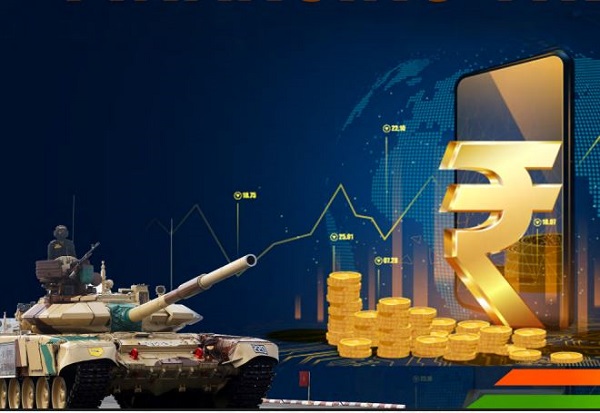
When nations debate security, the conversation almost always gravitates toward the visible: soldiers, weapons, budgets, and displays of resolve. These matter. But they are not decisive. The harder truth—borne out repeatedly by history and reinforced by contemporary conflict—is that armies fight wars, but nations win them. Victory depends less on battlefield bravery alone than on the economic strength, technological capacity, and social cohesion that sustain a country over time.
This distinction is not rhetorical. It reflects how power is now generated and exercised. Military capability is no longer an autonomous instrument; it is the outward expression of a nation’s ability to mobilise resources, innovate under pressure, withstand shocks, and preserve unity in prolonged stress. Where those foundations are weak, military strength proves brittle.
Economic Power Decides Who Can Endure
Economic depth has always shaped military outcomes, but its importance has grown as warfare has become more resource-intensive and prolonged. The Second World War remains the clearest illustration. The US prevailed not simply because of battlefield success but because it translated economic scale into unmatched industrial output—ships, aircraft, fuel, logistics, and finance.
Contemporary conflicts confirm the same logic. The war in Ukraine has demonstrated that modern warfare is as much an economic contest as a military one. Ukraine’s ability to sustain resistance has depended critically on external financial support, industrial replenishment, energy resilience, and access to advanced technologies. Russia, despite early battlefield advantages, has found its campaign increasingly constrained by sanctions, technological denial, and supply-chain disruptions. Outcomes have been shaped as much by fiscal resilience and industrial capacity as by tactics on the ground.
China’s military rise offers another instructive case. Its advances in naval power, missile systems, cyber capabilities, and space assets are inseparable from decades of sustained economic growth, manufacturing depth, and technological investment. Military modernisation follows economic transformation; it does not precede it. Nations with weak economic bases, by contrast, struggle to modernise forces or sustain readiness, regardless of strategic intent.
Technology Now Shapes the Battlefield
What distinguishes twenty-first century conflict most sharply is the centrality of technology. Warfare is no longer primarily about the number of platforms or personnel. It is about networks—of sensors, satellites, communications, data, and decision systems. The advantage lies in the ability to sense faster, decide faster, and strike more precisely than an adversary.
Artificial intelligence has accelerated this shift dramatically. AI-enabled systems now analyse satellite imagery, process drone feeds, optimise logistics, predict equipment failure, and compress decision-making cycles beyond human capacity. Recent conflicts have shown how relatively inexpensive, technology-driven systems can neutralise high-value conventional assets. Speed, data, and adaptability are reshaping the hierarchy of military power.
Crucially, these capabilities do not emerge from defence establishments in isolation. They depend on national technological ecosystems: semiconductor fabrication, high-performance computing, software talent, research institutions, and innovative private firms. The cutting edge of military power increasingly overlaps with the civilian economy. This is why semiconductors have become a focal point of geopolitical competition. Export controls and technology restrictions are not commercial instruments; they are strategic tools designed to shape future military balances.
India’s Security Rests on Economy and Society
For India, these shifts present both challenge and opportunity. India’s economic transformation over the past three decades has fundamentally altered its strategic profile. As a large and growing economy with an expanding digital and manufacturing base, India now possesses the scale needed to sustain long-cycle investments in defence, technology, and infrastructure. Economic size translates into fiscal space, diplomatic leverage, and strategic resilience.
Economic strength also protects against non-military coercion. Contemporary conflict increasingly involves tariffs, sanctions, supply-chain manipulation, and financial pressure. Economically fragile nations can be coerced without a shot being fired. Economically resilient ones can absorb shocks, reroute trade, stabilise employment, and negotiate from a position of strength. In this sense, economic resilience itself functions as national defence.
This perspective reframes the often-invoked tension between defence spending and development. Investment in education, health, infrastructure, and poverty reduction is not a diversion from security; it is a prerequisite for it. A nation that neglects education cannot sustain technological leadership. One that neglects public health cannot maintain productivity or readiness. Defence capability ultimately rests on human capital, fiscal strength, and institutional capacity.
Social Cohesion Is Strategic Capital
Social cohesion completes this architecture of power. Inequality erodes trust; persistent poverty limits talent and productivity; social fragmentation undermines unity of purpose in moments of crisis. History offers many examples of states that possessed military hardware but lacked the social legitimacy and cohesion to sustain conflict.
India’s diversity—of language, religion, culture, and region—is often portrayed as a vulnerability. In reality, when managed with inclusion and institutional fairness, it is a strategic asset. A plural, cohesive society is difficult to coerce and resilient under stress. The armed forces themselves exemplify this principle daily.
The conclusion is straightforward. Military courage remains indispensable, but it cannot substitute for economic depth, technological capability, and social unity. Nations that neglect these foundations may still fight bravely—but they will struggle to prevail.
If India is to remain secure in an increasingly contested world, national security must be understood in this integrated way. The choices made about economic structure, technological investment, and social inclusion are not separate from defence planning. They are its deepest determinants.
More From BasisPoint