.png)

A Coronation Disguised as a Funeral
Iran's elaborate entombment ceremony for Ali Khamenei may look like defiance aimed at Trump — it’s really about legitimising his son.
Bobby Ghosh is a New York-based journalist and geopolitics expert. He was formerly a member of the Editorial Board of Bloomberg News.
July 4, 2026 at 8:50 AM IST
Of all the images Iran has manufactured for the burial of Ali Khamenei, the strangest is a fist. His son Mojtaba, who has not been seen in public since the joint US-Israeli strike that killed his father in February, let it be known that he found the old man’s body with one hand clenched — a last gesture of defiance, the story goes, frozen in death. That fist is now on banners across Tehran and raised as a statue in Enghelab Square. No one else witnessed the deathbed detail. We have only the word of the son, who happens to need his father to have died like a hero, and who happens to be the sole author of the legend.
Start there, because it tells you what this funeral is really for.
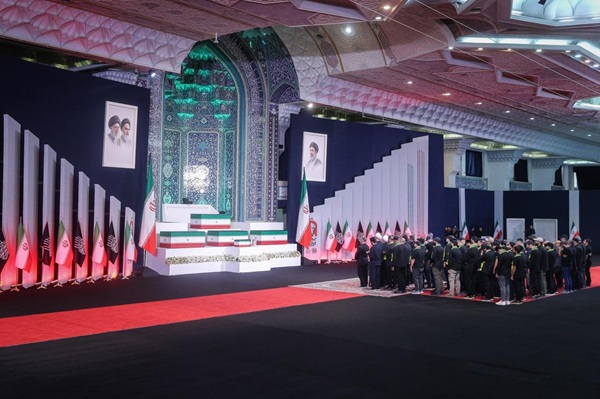
The spectacle is enormous, and meant to be. Seven days, five cities across two countries, the body was carried from Tehran through Qom and on to the Iraqi shrine cities of Najaf and Karbala before burial in Mashhad. The coffin is draped in a red flag that once flew over the shrine of Imam Hussein, the martyr at the heart of Shia Islam, and the whole procession has been timed to Muharram, the month of Hussein’s martyrdom. The Western press has fixed on a different date: Khamenei lies in state on the Fourth of July, while Trump toasts America’s 250th birthday. Defiance, the headlines say — a dead cleric shaking his fist at Washington from the grave.
That reading isn’t wrong. It’s just small. The taunt at Trump is real, but it is the cheapest thing on offer here and the least important. The audience that matters is at home. Saeed Laylaz, an analyst in Tehran and no dissident, put it plainly: the ceremonies will work almost, he said, “like a referendum” on the dead leader’s rule — and, as Khomeini’s funeral did in 1989, a way to launch the next one. Iranian officials confirm the point when they admit the event is meant to reinforce “the legitimacy of the leadership transition.” Take away the flags and the martyr’s shroud, and the funeral is a machine built for a single task: moving the sanctity of a dead father onto a living son.
The son needs it because he has almost nothing of his own. A Supreme Leader is meant to command three kinds of authority, and Mojtaba can claim none of them. He does not have the founding, revolutionary charisma of Ruhollah Khomeini, who made the state. He does not have the accumulated cunning of his father, who ran it for 37 years and outlasted every enemy who wished it gone. And at 56, he belongs to the generation that came after the revolution rather than the one that made it. He doesn’t even have a heroic record in the war with Iraq that could be carved into a legend.
There is even a problem with his robes. Iran’s own wire coverage now calls him “Ayatollah” Mojtaba Khamenei, but he is nothing of the sort. He is a hojjatoleslam, a rank below ayatollah in clerical credentials. The “promotion” was granted overnight, the evening he was named supreme leader, by a state that needs him to outrank his own learning. The constitution he now personifies demands a mujtahid, a jurist qualified to interpret God’s law. He is not a mujtahid.
In place of all this, what Mojtaba has is a surname and the protection of the Islamic Revolutionary Guard Corps.
Which is the scandal the pageant is built to bury? This is a republic founded, in 1979, on the wreckage of hereditary rule — a movement that told Iranians no country should belong to a family, that broke a shah precisely to stop the handing of a throne from father to son. It is now being handed down from father to son. Analysts have said the obvious out loud: that dynastic succession eats away at the very story the Islamic Republic tells about itself. The historian Ali Ansari has traced how carefully the ground was tilled for it: Khamenei, restyled in his last years as “the Ali of the Age,” after the first Shia Imam, whose authority ran down a bloodline — so that a hereditary handover could one day be dressed as holy continuity rather than as what it plainly is: A monarchy in a black turban.
The martyred father is the misdirection; the son sliding into his place is the trick.
And the men who will hold that son upright are the Guards. It was General Ahmad Vahidi, a pillar of the IRGC, who came out of hiding to sit beside Ali Khamenei’s casket this week — a tableau worth more than any eulogy. A leader who owes his throne to the Guards is a leader the Guards can keep. The surname may yet turn out to be a figurehead for the men with the guns, which is a demotion disguised, like everything else on display this week, as an elevation.
The Iranians at whom all of this is aimed do not, on the early evidence, seem to be buying it. As the state summoned its millions, a resident of Tehran told CNN that most people weren’t going to the funeral at all — they were going on holiday, and half the street had already packed up and left. This is the same public that filled those streets a few months ago to demand the fall of the man now mourned as a saint, and that the regime answered with live ammunition. They are being asked to grieve for their tormentor and to take his son as the price of the tears.
They have overthrown a throne once already. They can recognise a coronation, even one staged over a coffin — even one where the new king dares not show his face and sends a clenched fist to stand in his place.
More From BasisPoint