.png)


Sujit Kumar is Chief Economist at National Bank for Financing Infrastructure and Development.
July 9, 2026 at 4:25 AM IST
El Niño remains one of the most important climate phenomena affecting India. This year has once again underlined why. According to the India Meteorological Department, rainfall during June 2026 was around 40% below the long period average as the southwest monsoon made a weak start. Yet there is an encouraging shift beneath the immediate concern. Indian agriculture today is far less dependent on the monsoon than it was two decades ago.
Deficient rainfall in 2002, 2009, 2015 and 2023 did not translate into the same level of disruption seen in the past. Agriculture's Gross Value Added contracted by 6.6% in 2002-03 and by 0.88% in 2009-10. By 2015-16, however, the sector had returned to positive growth of 0.65%, while in 2023-24 it grew by 2.6%. Greater irrigation coverage, alongside mechanisation and improvements in agricultural practices, has steadily reduced the sector's dependence on rainfall.
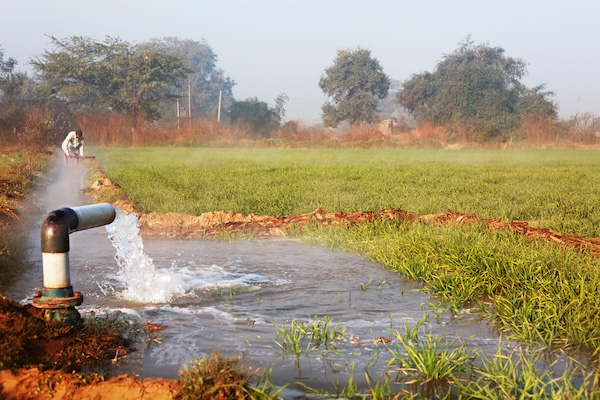
India has brought nearly two thirds of its cropped area under irrigation over the past decade. Even so, rainfed agriculture still produces roughly 40% of the country's food. That leaves considerable scope for expanding reliable irrigation and strengthening resilience against increasingly uncertain weather.
There is another reason why irrigation matters. States with greater irrigation coverage also tend to record higher cropping intensity. This allows farmers to grow more than one crop on the same land, increasing production without bringing additional land under cultivation. Punjab, where almost 99% of agricultural land is irrigated, records a cropping intensity of 202%. West Bengal and Madhya Pradesh, among the more extensively irrigated states, also report cropping intensities close to 190%. Reliable access to water continues to be one of the strongest drivers of multiple cropping and higher farm productivity.
Better Returns
India's irrigation infrastructure today comprises groundwater systems such as wells and tube wells, surface water networks including dams, reservoirs and canals, traditional storage structures like tanks and ponds, and micro-irrigation systems such as drip and sprinklers. Tube wells and canals together account for nearly 70% of the irrigated area. Government initiatives including the Pradhan Mantri Krishi Sinchayee Yojana, Command Area Development and Water Management, and various Surface Minor Irrigation schemes have expanded irrigation potential while improving the utilisation of existing assets. As a result, the share of irrigated cropped area has increased from about 52% to 63% over the past decade.
The momentum has continued through major projects. The Sardar Sarovar Project covers Maharashtra, Madhya Pradesh, Gujarat and Rajasthan. The Ken Betwa Link Project, scheduled for completion by March 2030, is expected to provide drinking water to 6.2 million people while generating hydroelectric and solar power. The Polavaram Irrigation Project will supply drinking water to 540 villages. Besides creating irrigation potential, these projects strengthen water security and generate wider social and economic benefits.
As India builds on these achievements, the emphasis should gradually shift from expanding infrastructure to improving its efficiency. Micro-irrigation offers one of the biggest opportunities in this regard.
Experience from several countries shows that fertigation, where water soluble fertilisers are delivered directly to plant roots through drip irrigation, significantly improves nutrient use efficiency. Conventional soil broadcasting typically achieves fertiliser efficiency of only 30% to 50%. Fertigation raises this to 80% to 90%, while also reducing fertiliser and irrigation water use by nearly a quarter. Better nutrient efficiency means lower fertiliser consumption, reduced subsidy requirements and greater fiscal space, making a strong case for expanding micro-irrigation across India's cultivable land.
India already has the world's second largest sprinkler and micro-irrigated area. Even so, micro-irrigation accounts for only about 19% of the country's irrigated area. Bridging this gap could substantially improve water use efficiency as well as farm productivity.
The Government of India's Per Drop More Crop scheme has made encouraging progress by benefiting more than 500,000 small farmers and bringing around 800,000 hectares under micro-irrigation during 2025-26. Going forward, the programme can become even more effective if it moves beyond measuring hectares covered. States should also be assessed on improvements in water use efficiency, crop yields and farmers' incomes.
India's irrigation story has so far been one of remarkable expansion. The next phase should focus less on creating new infrastructure and more on improving the efficiency of what already exists. Bringing more cultivable land under micro-irrigation, while enhancing the performance of existing systems, will strengthen productivity, improve water use efficiency and make Indian agriculture more resilient to climate shocks.
*Views are personal.
More From BasisPoint