.png)

GAIL is Embedding Itself at Scale into India's Energy Infrastructure
GAIL continues to be perceived as a mature utility even as it invests in becoming a total infrastructure play.

Dev Chandrasekhar advises corporates on big picture narratives relating to strategy, markets, and policy.
January 24, 2026 at 5:13 AM IST
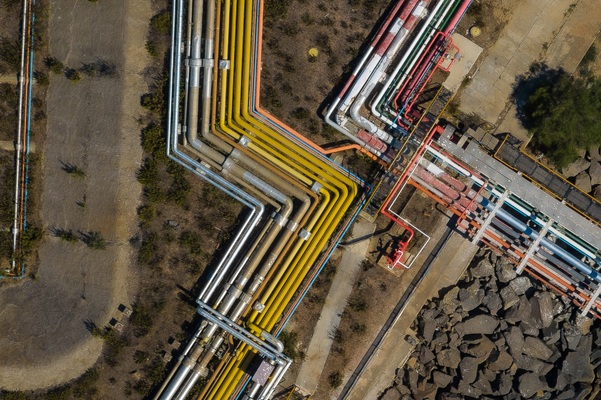
GAIL India Limited, the country's leading natural gas company and a Maharatna—the highest classification awarded by India to its state-owned enterprises—is executing the most aggressive infrastructure buildout in its history. The company transmits 65% of the natural gas flowing through India, operating a network of nearly 16,420 km of pipelines. This year alone, it is laying approximately 3,000 km of additional pipeline infrastructure across multiple ongoing projects, an expansion backed by ₹107 billion in 2025-26 capex and a planned ₹120 billion for 2026-27. All this while maintaining a debt-equity ratio well below 0.25 and funding growth entirely through strong internal cash generation.
Yet at ₹165 per share, GAIL trades at 9.9 times earnings and an enterprise value-to-EBITDA multiple of 8.5. The market is pricing GAIL as a mature utility with limited growth prospects, similar to National Grid in the UK or Power Grid Corporation in India.
The market's skepticism stems from legitimate near-term concerns. Petrochemicals operated at near-breakeven levels in 2024-25. Quarterly transmission volumes remain volatile, averaging 122.11 MMSCMD in the April-September half of 2025-26 due to early monsoons and soft power demand, down from the all-time high of 127.32 MMSCMD achieved in 2024-25. Management's gas marketing guidance of ₹40-45 billion PBT for both 2025-26 and 2026-27 signals limited upside in a segment generating roughly 45% of profits.
Yet what separates GAIL from typical utility playbooks is parallel diversification into tomorrow's energy vectors. Most utilities globally, from SSE and Centrica to NTPC and Indian Oil, maintain tight focus on core regulated businesses, prioritising predictable returns over transformational growth.
GAIL is pursuing a different path. The company operates India's first commercial-scale 10 MW green hydrogen plant at Vijaipur, producing 4.3 tonnes per day. It commands a 75% market share in biogas, having sold 31,937 metric tonnes in 2024-25. The target of 3.5 GW renewable capacity by 2035, including a recent 2.5 GW MoU with AM Green, positions GAIL at the forefront of India's energy transition. The company has advanced its net-zero target from 2040 to 2035, with ₹19 billion allocated for net-zero initiatives in 2025-26.
This diversification sits alongside aggressive core infrastructure expansion. The 1,702 km Mumbai-Nagpur-Jharsuguda pipeline, anticipated for completion by September 2025, penetrates high-growth industrial regions with minimal gas penetration. The 745 km Srikakulam-Angul pipeline targets eastern manufacturing hubs. The Jagdishpur-Haldia-Bokaro-Dhamra network already has 3,119 km commissioned. These aren't legacy routes serving established demand; they're infrastructure plays designed to capture latent consumption as India's per capita energy use climbs.
Chairman and MD Sandeep Kumar Gupta articulates a philosophy of building infrastructure ahead of consumption rather than waiting for demand to materialise, contrasting with the risk-averse capital allocation typical of established utilities. Management expects transmission volumes to normalise to 133-134 MMSCMD by 2026-27.
GAIL's dominant market position provides the distribution muscle to monetise this infrastructure. The company holds 54% market share in combined CNG and domestic PNG sales, authorised in 72 of 307 geographical areas India-wide. This is network-effect infrastructure at scale.
In 2024-25, GAIL reported PBT of ₹148.3 billion and PAT of ₹113.1 billion, both representing 28% year-on-year growth. The company funded its entire ₹105.1 billion capex without raising new long-term debt. With return on equity of 12.7%, GAIL maintains financial flexibility that typical utilities lack when pursuing transformational growth.
The geopolitical dimension adds commercial sophistication rarely associated with public sector undertakings. GAIL imported 141 LNG cargoes in 2024-25 whilst shipping 14 cargoes to Europe, the highest by any Indian company. Rather than shipping U.S. LNG across the Pacific, GAIL employs destination swaps, selling it to the closer European market whilst sourcing Middle Eastern gas for India's shorter Arabian Sea route. It significantly reduces shipping costs and emissions. The Singapore subsidiary handles global treasury operations, providing hedging capability and profit optionality.
Execution risks remain material. The 500,000-tonne Usar petrochemical plant faces delays, with commissioning expected in 2026-27. Transmission volumes remain sensitive to monsoon patterns and power sector demand.
Yet for investors willing to look through short-term volatility, the network effects of pipeline infrastructure strengthen with density, establish GAIL’s dominance across transmission, marketing, city gas distribution, and increasingly, green energy vectors. If India's gas consumption even partially materialises towards policy targets, GAIL's infrastructure investments may prove well-timed, the rare case where building ahead of demand becomes enduring competitive advantage rather than capital destruction.
The short-term noise will persist. The long-term opportunity, however, looks increasingly compelling for a company refusing to follow the typical utility playbook.
More From BasisPoint