.png)


Dev Chandrasekhar advises corporates on big picture narratives relating to strategy, markets, and policy.
May 5, 2026 at 1:46 PM IST
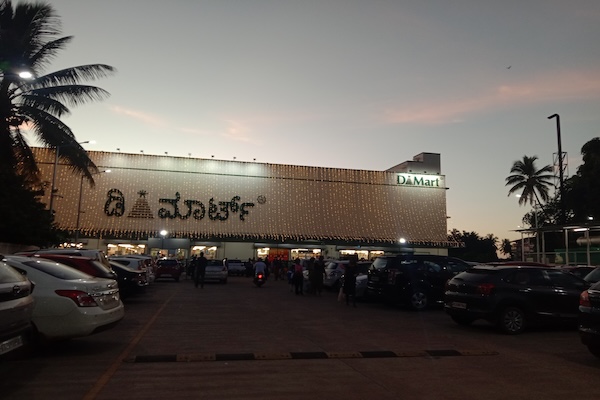
Avenue Supermarts crossed 500 stores in 2025-26. In the March quarter alone 58 stores were opened, the largest single-quarter addition in its history. Full-year standalone revenue grew 16% on year to ₹669.68 billion, with January-March rising 19%. Full-year EBITDA grew 15.7% to ₹52.55 billion. Two-year-old stores grew 10.8% in January-March, up from 8.1% a year earlier.
On those numbers, the operating line is doing what it should. The capital line, though, is doing something else.
Standalone ROCE was 17.1% in 2025-26. It was 17.8% in 2024-25, 19.1% in 2023-24, and 20.1% in 2022-23. Three consecutive years of compression and 300 basis points lost. While the COVID-era trough is well behind D-Mart now, the recovery from it stalled at the 20% mark in 2022-2023 and has slid since. The 2018-19 peak of nearly 26% is further away each year.
EBITDA margin has steadily fallen from 8.7% in 2022-23 to 7.8% in 2025-26, the lowest in the visible history.
The progression of net cash flow from ₹20.5 billion in 2021-22 to ₹41.7 billion in 2025-26 looks healthy until it is set against borrowings. Total debt rose from ₹6.93 billion as of March 31, 2025, to ₹22.67 billion after one year. The company also began issuing commercial paper, including a ₹ 5 billion tranche in early 2026 at 6.60%.
Operating cash, on the company's own series, is not funding the expansion. Years of balance sheet conservatism gave way in twelve months.
Working capital is the fifth signal, smaller but pointing the same way. Inventory days lengthened from 31.4 in 2024-25 to 33.2 in 2025-26, while inventory turnover fell from 13.6 times to 12.8 times. The changes might appear small, but they sit awkwardly with a value-retail model whose original moat was inventory turn.
To D-Mart’s credit, most of those continue to compound earnings as they always have. Like-for-like annual growth held at 8.1% for 2025-26 against 8.4% in 2024-25. But the run rate masks a third-quarter low of 5.6% as the fourth quarter recovered. The signals are about the marginal store. At lower like-for-like, new stores take longer to ramp. The marginal rupee of capex earns a smaller return for longer than it used to. The high-teens like-for-like of the DRHP era is gone.
The channel question is also getting louder. D-Mart Ready scaled down from 25 cities in 2024-25 to 18 in 2025-26. The company exited one city in the final quarter.Management has framed this as sharpening focus on home delivery in metropolitan markets. The framing, though, is harder to hold alongside the rise of quick commerce. Blinkit, Zepto, and Swiggy Instamart are compounding at rates D-Mart Ready has not matched. The retreat reads less as concentration. It looks closer to withdrawal from a channel where the economics did not work.
The historical analogues sit on either side. Between 2014 and 2016, Walmart slowed US openings, acquired Jet.com for $3.3 billion, and built an omnichannel layer that took a decade but worked. Tesco, between 2008 and 2014, expanded into the US and emerging markets, ignored online, and ended up writing down £6.4 billion. Both companies were profitable when they made the call. Only one was right.
None of this is an argument against Avenue Supermarts’ underlying business. The 500 operating stores remain among the most productive grocery formats in India. The argument is narrower. ROCE and margin have both compressed three years running. Free cash flow has been negative or barely positive in the last five years. Borrowings tripled in 12 months, inventory days lengthened, and the online channel is shrinking. Alone, none of these moves is large, but taken together, they point the same way.
The 500-store milestone is the right moment to ask whether the marginal rupee deployed by Avenue Supermarts today is earning a return above what it costs. By the 600th, the answer will be harder to reverse.
(This column reflects the author's personal views and is based on publicly available information. It is intended for general commentary and analytical purposes only and should not be construed as investment advice.)
More From BasisPoint