.png)

Benchmarks Post Weekly Losses as IT Rout Drags Equities Lower
An end-of-day recap of all that transpired in the Indian markets, highlighting the major price movements and the factors driving them

February 13, 2026 at 11:47 AM IST
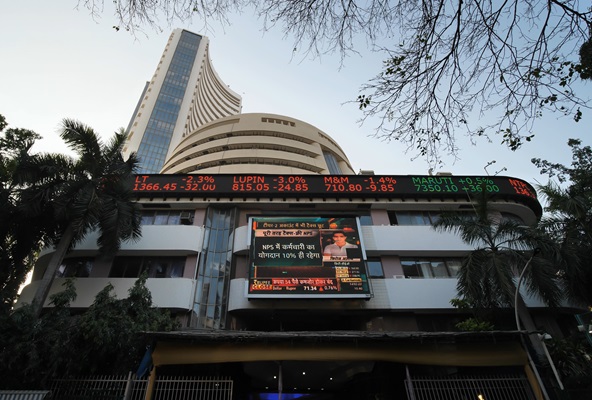
Indian equities extended losses on Friday, with a deepening sell-off in information technology stocks dragging benchmarks sharply lower amid concerns over AI-led disruption and fading expectations of a near-term US rate cut. The Nifty50 declined 1.16% to 25,506.6, while the BSE Sensex dropped 1.17% to 82,700.01, pulling both indices into weekly losses and erasing gains seen after the interim India–US trade agreement.
The Nifty IT index remained under heavy pressure, capping its worst weekly performance in 10 months, even after trimming early losses. Infosys fell 5.6%, while TCS, HCL Tech, LTIMindtree, Coforge and Wipro also weighed on sentiment. Among Sensex constituents, HUL, Eternal, Reliance Industries, Power Grid, Tata Steel, Titan and Adani Ports were key laggards, while Bajaj Finance, Tech Mahindra and SBI managed to hold gains. Broader markets mirrored the weakness, with the Nifty MidCap and SmallCap indices falling 1.58% and 1.66%, respectively. India VIX surged 13%, signalling heightened volatility, while the Nifty Metal index led sectoral declines with a drop of over 3%.
Top Movers of the Day
SpiceJet shares jumped sharply, rising around 8% to ₹53.20, after reports of improved passenger load factors and cost-efficiency commentary in Q3 results boosted travel name sentiment.
Tata Consultancy Services slipped about 2.5% to ₹4,050, as weakness in IT stocks continued to weigh on heavyweight tech names despite broader market strength.
HDFC Bank advanced nearly 2% to ₹1,820, with investors buying the stock on expectations of resilient credit growth and stable margins.
Infosys traded marginally higher by about 1% to ₹1,550, supported by selective buying despite ongoing sectoral pressure on tech names.
ICICI Bank gained around 1.8% to ₹950, as financial stocks attracted rotation amid mixed sectoral trends.
Axis Bank rose approximately 2.2% to ₹975, benefiting from improved investor focus on cyclical financial names post-earnings commentary.
Bajaj Finance climbed close to 1.5% to ₹7,400, tracking steady performance in consumer credit portfolios.
Mahindra & Mahindra edged up 1.8% to ₹2,100, with auto stocks showing resiliency amid broader market volatility.
Titan Company was modestly higher by about 1.2% to ₹3,680, lifted by defensive buying in consumer discretionary names.
ITC continued its weakness with a 1% decline to around ₹314.30, reflecting broader sell-off in the consumer goods space.
Grasim Industries saw selling pressure and was trading down modestly, around ₹2,900–₹2,918 in intra-day action.
Futures & Options
Nifty February 2026 futures closed at 25,481, a 9.9-point premium over the cash market closing of 25,471.10, after the index dropped 336.10 points (1.30%). India VIX jumped 13.36% to 13.29. Infosys, TCS, and HDFC Bank were the most traded F&O contracts, which expire on 24 February 2026.
Bonds
Government bond yields settled largely flat on Friday, with the benchmark 10-year 6.48% 2035 yield ending at 6.6842%, compared with 6.6833% on Thursday, marking an 8-basis-point decline over the past three sessions. The 10-year G-Sec yield slipped to around 6.67%, its lowest level in three weeks, after the government executed a debt switch, buying back ₹755 billion of FY27-maturing bonds and issuing ₹694 billion of 2040 securities, thereby easing near-term redemption pressure and reducing gross borrowing needs. January inflation came in at 2.75%, within the RBI’s 2%–6% tolerance band but slightly above expectations, limiting aggressive bullish bets, while supportive liquidity conditions
Forex
The rupee was largely unchanged on Friday, closing at 90.6350 per dollar, marginally weaker than 90.59 in the previous session, as persistent interbank dollar demand and weak domestic equities offset likely central bank intervention. The currency ended the week little changed, with pressure stemming from the maturity of non-deliverable forward positions and a broader risk-off tone in global markets amid concerns over AI disruption and tightening tech sector margins.
Crypto
Crypto market remained under pressure in mid-February, with Bitcoin slipping below the $67,000 mark as investors continued to search for a near-term bottom. Bitcoin fell 1.15% over the past 24 hours to $66,385.62, taking its market capitalisation to $1.32 trillion with $44.75 billion in trading volume. Ethereum declined 0.87% to $1,949.83, with a market cap of $235.33 billion and $19.64 billion in 24-hour turnover, while Solana dropped 2.23% to $78.67. Most major altcoins traded in the red, falling up to 1%, reflecting subdued risk appetite. However, Tron, Dogecoin and Cardano managed to buck the broader downtrend, offering pockets of resilience amid ongoing volatility.
US Stock Futures
US stock futures edged lower on Friday following a weak session on Wall Street, as investors awaited a key consumer inflation report for further cues on the Federal Reserve’s rate path. S&P 500 futures slipped 0.18%, Nasdaq 100 futures fell 0.12%, and Dow Jones Industrial Average futures declined 0.29% (about 144 points). In after-hours trade, Applied Materials surged 13% after reporting strong quarterly earnings and issuing an upbeat outlook, offering some support to semiconductor sentiment despite the broader cautious tone.
US Treasury Notes
US Treasury yields edged higher ahead of the delayed January CPI report, with the benchmark 10-year yield rising to 4.12% and the 30-year bond yield at 4.75%, as investors positioned for potential volatility. Markets are closely watching whether headline inflation, expected to ease to 2.5%, will reinforce expectations of rate cuts later this year, noting that bond yields move inversely to prices.
Top News
- Nomura drops April India rate‑cut call on firmer inflation, RBI ‘stealth easing’
- New consumer inflation data to bolster policy responses: CEA Nageswaran
- India's Reliance wins US licence for Venezuelan oil, sources say
- India's Honasa expects FY27 revenue beat as Mamaearth recovery continues, CEO says
- Volatile items such as food and oil have lower weight in new CPI series
- India explores increased gas use during peak hours to ensure power supply
- India's Alkem Laboratories unit to buy up to 55% stake in Occlutech Holding for $118 million
- Foreign allocations lag India's growth potential, Amundi says
- Gold rebounds from near one-week low; US inflation data in focus
- India's Q1 edible oil imports fall 2% on lower soybean, sunflower purchases
- As Budget renews push for social sectors, gap in implementation persists
- New CPI series will have less instability structurally, says Pronab Sen
- 'Misanthropic and evil': Elon Musk takes swipe at Anthropic in AI bias row
- Next round of peace talks on Ukraine is set for next week: Kremlin
More From BasisPoint