.png)


Krishnadevan is Editorial Director at BasisPoint Insight. He has worked in the equity markets, and been a journalist at ET, AFX News, Reuters TV and Cogencis.
April 18, 2026 at 5:24 AM IST
The yellow pillar stands just past security, where passengers begin to recalibrate time. Shoes are back on, laptops repacked, boarding passes checked again. Above it, in large type, a simple prompt: Forgot Something?
A traveller, already through security at Mumbai’s Terminal 2, has rentered a sealed environment. Liquids have been discarded, bags reorganised, and the clock has started ticking toward boarding. There is little room to reconsider, and even less to compare.
For years, that moment has been profitable.
A misplaced charger, a missing adapter, a remembered toiletry—each has typically meant a reluctant purchase at a kiosk where prices reflect not competition, but constraint.
Blinkit inserts itself precisely into that moment.
In partnership with Adani Airport Holdings, the quick commerce platform now lets passengers to order from a catalogue of over 2,500 items.
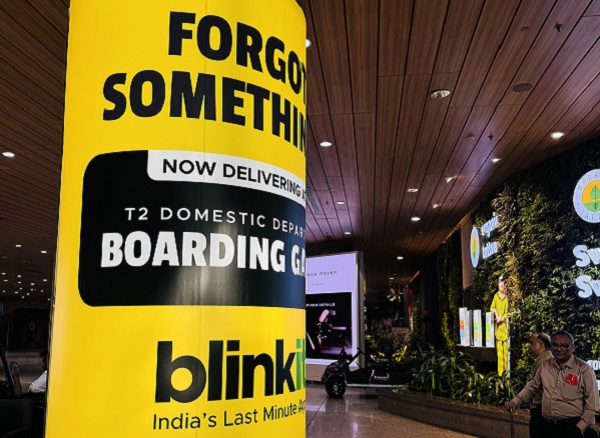
Mumbai’s domestic terminal handled 39.2 million passengers in 2025. A significant share passed through security having forgotten something. For perspective, a 2025 Booking.com and YouGov survey, in 2025, of Indian travellers found that 35% forget to pack a charger before leaving home.
Inside the terminal, intent is unusually sharp.
Unlike the typical quick commerce customer, who may browse, compare, or abandon a cart altogether, the airport passenger is already primed. The need is immediate, the alternatives are limited, and the likelihood of completing the purchase is higher.
That changes the economics.
Orders in this setting tend to skew toward higher-value, need-based purchases—chargers, travel accessories, personal care products—rather than the lower-ticket mix that dominates urban quick commerce baskets.
A single item can match or exceed the platform’s average order value. There is no need for repeated nudges or promotional spend. The customer has, in effect, self-selected.
The result is a combination that quick commerce platforms rarely achieve at scale: higher basket values, lower acquisition costs, and negligible abandonment.
Blinkit is not the cheapest platform. In several categories, it is not even close. Yet it continues to drive higher order values and a more premium customer mix.
Pricing comparison across categories and apps: Zepto & Flipkart Minutes offering lowest prices on most selection/Blinkit has least discounts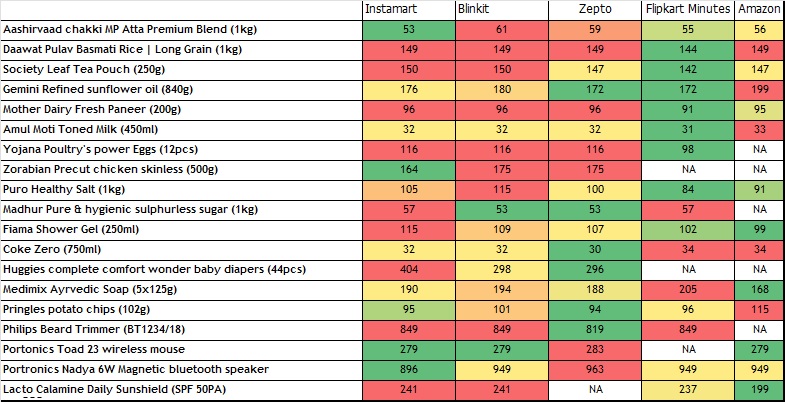
* Color: Green indicates cheapest price; Red indicates highest for the product
Source: BofA Global Research (Pricing survey for Mumbai location as on Apr 13, 2026)
The more consequential shift, though, is not in Blinkit’s margins, but how airport retail operates.
For airport operators, the real profits come outside aircraft landing charges. Retail, concessions, and advertising are the backbone of non-aeronautical revenue, built on a captive audience. The electronics kiosk charging ₹450 for a ₹40 charger did not depend on brand strength or service differentiation.
That assumption is weakening.
Adani Airport Holdings operates seven airports, and an arrangement built around revenue sharing rather than fixed rent, is not constrained by square footage or footfall. It follows the passenger, rather than waiting for the passenger to arrive.
For Blinkit, the advantage is equally structural.
No other quick commerce platform can replicate this model without securing comparable access. Zepto and Swiggy Instamart operate within urban delivery radii, built on dark stores and dense catchments.
The airport is not an extension of that network. It is a controlled zone, where entry is the primary barrier. Airside access requires a licensed operator relationship with the airport authority, and Adani Airport Holdings Limited controls that access across its network.
The partnership, therefore, cannot be easily challenged.
For the incumbent retailers inside the terminal, the shift is immediate. A passenger who can compare prices on a phone, is no longer a captive customer.
The adjustment will not be uniform.
Certain categories—impulse purchases, luxury goods, experiential retail—may remain insulated. Others, particularly those built around necessity rather than desire, are more exposed. A charger is a functional purchase. Its pricing cannot remain detached from the outside world once that world is made accessible again.
Over time, this could force a reset in airport retail lease rentals. Fixed-rent concession models, premised on predictable footfall and limited competition, may give way to more flexible arrangements. Some operators may adapt. Others may find the economics less forgiving.
For now, the change, though early, is already visible.
Adani controls the access. Blinkit controls the interface. The passenger controls the decision.
And in that reordering, airport retail has quietly lost its most reliable advantage—the certainty that once a traveller cleared security, the choice had already been made.
(This column reflects the author's personal views and is based on publicly available information. It is intended for general commentary and analytical purposes only and should not be construed as investment advice.)
More From BasisPoint