.png)


Dhananjay Sinha, CEO and Co-Head of Institutional Equities at Systematix Group, has over 25 years of experience in macroeconomics, strategy, and equity research. A prolific writer, Dhananjay is known for his data-driven views on markets, sectors, and cycles.
June 8, 2026 at 6:06 AM IST
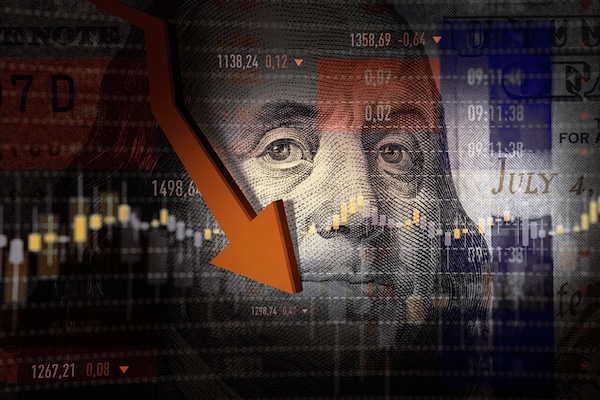
A single jobs report should not be enough to rattle the world's most powerful stock market. Yet, on a day in early June, that is precisely what happened. A stronger-than-expected US labour market reading triggered the worst single-day correction of 2026, erasing an estimated $1.8 trillion-$2.2 trillion in market value within hours. The S&P 500 fell 2.64%, the Nasdaq plunged 4.18%, and the VIX fear index jumped 37% to 21.51. The market's message was unambiguous: with inflation already running hot, good news on jobs had become bad news for investors.
The non-farm payroll report showed the addition of 172,000 jobs, roughly double economists' expectations. Under normal circumstances, that would have been a cause for celebration. Instead, it reinforced concerns that inflation, already running at 3.8% in April and well above the Federal Reserve's 2% target on its preferred Personal Consumption Expenditures gauge, is unlikely to fade quickly. With core Personal Consumption Expenditures inflation at 3.3%, driven by transportation costs, apparel and shelter, the strong labour market print strengthened the view that the Federal Reserve's next move is more likely to be a rate increase than a cut. Markets are now pricing a 98% probability of a 25-basis-point increase by June 2026.
The US 10-year Treasury yield has climbed above 4.5%, while the 30-year yield has crossed 5%, its highest level in two decades. The dollar index has reclaimed the 100 mark. Gold, traditionally viewed as a safe-haven asset, fell 3%. These are not the signals of a market at ease.
A closer examination of the jobs data, however, suggests caution before interpreting it as evidence of broad-based economic strength. Much of the payroll gain was concentrated in leisure, hospitality and healthcare, sectors benefiting from a specific set of circumstances. Deregulation and supply-side stimulus from the Trump administration's "Big Beautiful Bill" have provided support, but so has an unusual behavioural shift. With tensions in West Asia making international travel more costly and uncertain, and following the US government's global travel advisory issued in 2025, many Americans who might otherwise have travelled abroad have instead spent domestically. That redirection of spending has amplified seasonal hiring in hospitality. The headline payroll number is therefore partly a reflection of geopolitical disruption rather than a pure indicator of underlying labour market strength.
The Tech Reckoning
The sharpest losses were concentrated in the sector that had, until recently, appeared immune to macroeconomic gravity: artificial intelligence and semiconductors.
The immediate trigger was Broadcom's earnings report. Despite reporting artificial intelligence revenue of $10.8 billion in the second quarter, up 143% year on year, the company declined to raise its full-year artificial intelligence revenue guidance beyond the previously announced $55 billion. Markets, expecting more, reacted harshly. The stock fell 15%, wiping out roughly $300 billion in market value in a single session.
The weakness quickly spread across the sector. Marvell, Micron, AMD and Intel all declined. Even Nvidia, despite no earnings disappointment of its own, sold off sharply. The episode delivered an uncomfortable but useful reminder: the artificial intelligence trade, which had powered more than 30% growth in technology sector earnings and justified exceptionally high valuations, may have moved ahead of underlying fundamentals.
Broadcom had been trading at roughly 45 times forward earnings. The disappointment highlighted growing concerns that hyperscalers such as Google and Amazon are increasingly developing their own custom chips, reducing reliance on third-party semiconductor suppliers.
None of this suggests that the artificial intelligence growth story is ending. Technology companies are collectively expected to invest more than $700 billion in artificial intelligence infrastructure in 2026, up from roughly $400 billion in 2024. The global semiconductor market expanded 25.6% in 2025 and is expected to record similarly strong growth this year.
What is changing is the nature of the opportunity. The industry is moving from the training phase towards inference, and valuations built on peak-cycle assumptions become vulnerable when the narrative begins to shift. Key risks include intensifying competition from hyperscalers' in-house chip development, uncertain timelines for artificial intelligence returns on investment, and growing questions over whether annual artificial intelligence capital expenditure exceeding $700 billion can be sustained.
Elevated valuations and emerging structural shifts within the semiconductor industry could result in slower growth ahead, potentially tempering enthusiasm around the artificial intelligence boom. Rising US risk-free rates also force investors to reassess expected returns and valuation assumptions. Markets may increasingly recalibrate towards a slower-than-expected ramp-up in demand and greater competitive pressures, even if Nvidia remains dominant and custom chip developers continue gaining share in inference workloads.
Under The Surface
Beyond headline corporate earnings, the US economy appears considerably less robust than markets might suggest.
Real gross domestic product growth in the first quarter of 2026 was revised down to 1.6% from an earlier estimate of 2%, as slowing consumer spending offset gains in business investment. The unemployment rate remains at 4.3%, while the broader U-6 measure, which captures underemployed and discouraged workers, is rising more rapidly.
Consumer confidence has fallen sharply. Household delinquency data paint a similarly troubling picture. Serious delinquency rates among younger households have risen to 1.6%, approaching levels last seen before the subprime mortgage crisis. Auto loans, credit cards and student loans are all showing signs of stress.
The housing market is also weakening. Median listing prices fell 4% year on year in the first quarter, marking a seventh consecutive monthly decline and the sharpest fall since 2017. Mortgage rates near 6.5%, combined with house prices that remain around 30% above pre-pandemic levels, have significantly reduced affordability.
Yet corporate America, particularly its largest firms, continues to outperform expectations. Companies in the S&P 500 delivered an aggregate earnings surprise of 18.2% in the first quarter of 2026, driven largely by aggressive cost-cutting and automation. The widening gap between resilient corporate profits and weakening household finances has become one of the defining tensions in the US economy.
The recent sell-off is best viewed as a correction in a market that had priced in a considerable amount of optimism rather than as evidence of systemic stress. Banks remain well capitalised, deposits are at record levels and large financial institutions continue to generate double-digit returns on equity.
The risks, however, are becoming harder to ignore. A potential Federal Reserve rate increase, elevated oil prices linked to Middle East tensions, rising unit labour costs and stretched artificial intelligence valuations create a challenging backdrop. Moody's estimates the probability of a US recession at 40%-50%. If crude oil were to move back towards $125 a barrel, those risks would rise materially.
The technology sell-off may ultimately prove to be less about one jobs report or one earnings disappointment and more about a market beginning to question whether the foundations beneath the boom are as solid as recent valuations have implied.
More From BasisPoint