.png)


By Shyam Sunder Sharma
Lt Colonel Shyam Sunder Sharma, Shaurya Chakra, is a veteran of the Indian Army. A keen birdwatcher and poet, he has been published in several anthologies in India and overseas.
June 30, 2026 at 6:36 AM IST
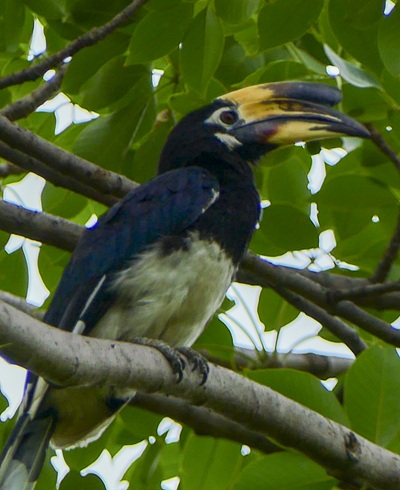
A female Oriental Pied Hornbill in Lodhi Garden has been feeding Grey Hornbill nests, turning a rare act of interspecies care into Delhi’s strangest nature story.
Over the past month, an enigmatic saga has been unfolding in Lodhi Garden, Delhi: a female Oriental Pied Hornbill has been fostering multiple Grey Hornbill nests. Interspecies interactions are always interesting, though often noticed. Interspecies parenting is rare.
The Oriental Pied Hornbill (Anthracoceros albirostris) is a forest dweller of the lower Himalayas and does not stay in or migrate to Delhi NCR. Yet, two females have been reported here for years, likely escapees or vagrants.
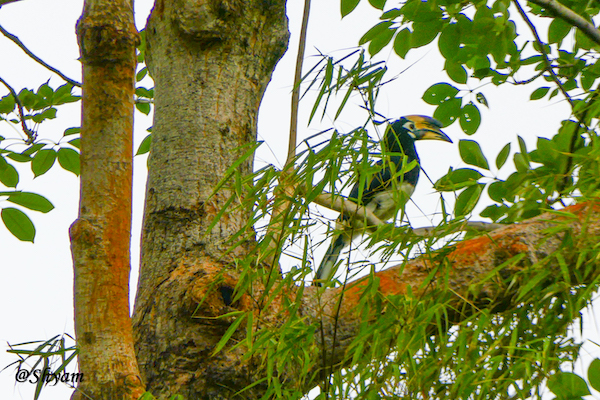
The Grey Hornbill (Ocyceros birostris), by contrast, is well adapted to human habitation and is found in urban wooded areas such as Lodhi Garden. Though both hornbills nest in tree hollows, sealing the female protectively inside while the male forages, they differ considerably in size and diet.
What makes this episode remarkable is that the female Oriental Pied Hornbill is actively feeding Grey Hornbill nests, while the resident male Grey Hornbill continues to feed his own nest. There has been concern that the female Oriental Pied Hornbill could be feeding the nest to eat the chicks later, as one such strange incident was reported in Punjab. But here, this female Oriental Pied Hornbill is feeding multiple nests.
Years without her own family may have triggered a profound maternal instinct, though not everything yields a scientific explanation. We humans strive to classify and rationalise everything, but nature can often be wondrously random and inexplicable. I firmly believe that several other species are capable of a wider range of behaviours and emotions than we credit them with, beyond survival and reproduction. There is still plenty we have not uncovered.
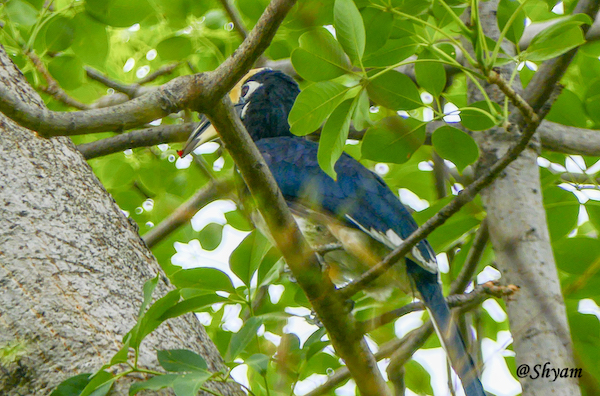
The media is also covering this, with some useful information peppered with masala, which is to be expected. From being dubbed a chudail, or witch, to mausi, or mother’s sister, this Oriental Pied Hornbill has served as a muse for many nature enthusiasts’ imaginations. Perhaps she has a wanderer’s spirit. Maybe she does not want a mate, but still wants to help nestlings or fellow cousin sisters.
For an hour, we had the pleasure of witnessing her dedicated efforts to fetch fruits and even a blue egg to feed at least two different nests. The Oriental Pied Hornbill is huge and may be seen as a threat by smaller birds. A crow family nesting nearby has tried to deter her. But the nesting Grey Hornbills appear to have grudgingly accepted her kindness.
The hollow cavities chosen as nests by both species differ, much like the birds themselves. The Oriental Pied Hornbill struggles to perch over the smaller hollow, lacking the foothold her larger claws need. She slips and balances precariously, delicately inserting her huge beak to feed the female hornbills and nestlings. Unrelenting and unfazed, she carries on her mission, driven by a zeal we cannot comprehend.
As an ethical birdwatcher, I shun clicking nests to avoid alarming nesting birds, which are extremely sensitive during this period. I refrained from going to see this spectacle for a month, until I was sure it was safe for the birds. The nest is at a good, safe height and thankfully out of reach. Volunteers with wildlife groups and birding communities such as Delhi Birders and eBird, along with Pankaj Gupta, are closely monitoring the activity.
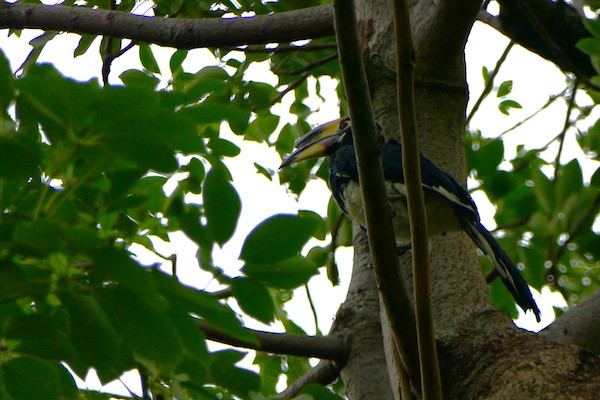
I hope these nests flourish under doubled parental care. Whether science solves this mystery or not, what matters to me, as a bird lover, is that we acknowledge and marvel at the magic of nature.
* Copyright for pictures belongs to the author
More From BasisPoint