.png)


Krishnadevan is Editorial Director at BasisPoint Insight. He has worked in the equity markets, and been a journalist at ET, AFX News, Reuters TV and Cogencis.
June 2, 2026 at 6:17 AM IST
Tata Consumer's food business has become larger than its beverages business just as the stock trades around 75 times earnings, a combination that strengthens the growth story while complicating the valuation. The company has executed well enough to move beyond its tea-company roots, but the share price assumes it can keep deploying capital as successfully as it has grown the business.
For 2025-26, India Foods generated ₹65.88 billion in revenue compared to ₹64.67 billion from India Beverages, reversing a long-standing mix where beverages dominated. Six years ago, Tata Consumer was largely a tea company. Today, investors are betting that households will continue moving from loose staples to branded products.
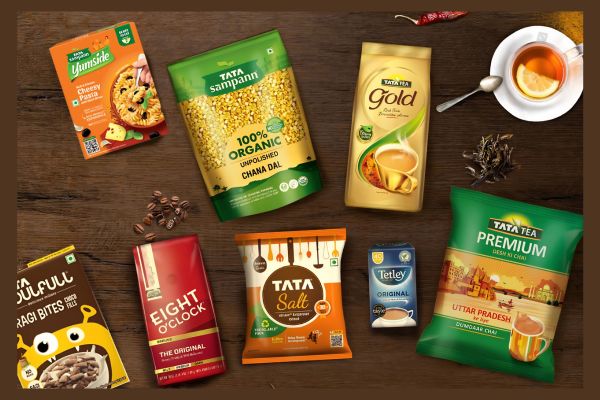
Sampann brand has moved Tata Consumer into pulses, spices, dry fruits and cold-pressed oils using the same consumer trust that made Tata Salt a household staple. In 2025-26, Sampann grew 46%, with growth accelerating to 69% in the fourth quarter, and now approaches ₹16 billion in annual sales. Dry fruits and cold-pressed oils, launched barely two years ago, are each nearing ₹5 billion in annual run rate.
India's kitchen remains one of the last large consumer markets where unorganised products still dominate. Tata Consumer has exploited that gap by investing in brands and distribution rather than production assets, allowing it to grow without a matching increase in capital intensity.
Investors now value Tata Consumer Products more like a growth company than a defensive beverage business. At roughly 75 times earnings, the valuation assumes management can keep finding new categories, scaling them profitably and putting surplus cash to work at high returns. Some parts of the business justify that optimism more than others.
Starbucks continues to grow, but expansion remains measured. Investors must decide whether it becomes a meaningful earnings contributor or remains an asset whose contribution to valuation exceeds its contribution to profits.
Deal Discipline
Tata Consumer ended the year with net cash of ₹29.78 billion. Asked about acquisitions, CEO Sunil D'Souza said, "What we like is not for sale. What is for sale, we do not like."
The remark suggests acquisition targets that meet management's return requirements may be scarce, while part of Tata Consumer's valuation assumes management can continue compounding capital through acquisitions and new categories.
The Capital Foods deal shows the hiccup that can be caused by acquisitions. Tata Consumer paid ₹38.25 billion for a 75% stake in the owner of Ching's Secret in 2024, a price that implied roughly 6.5 times sales based on expectations that growth could approach 30%.
Since the deal, Capital Foods has grown at roughly 8% annually, about half the rate of Tata Consumer's own business and well below the growth management expected when it bought the company. Tata Consumer must still acquire the remaining 25% stake, potentially requiring another ₹12.75 billion.
Capital Foods increasingly looks like a mid-growth food business acquired at a high-growth valuation. Tata Consumer's internally built food brands are producing better results than its largest acquisition.
Meanwhile, the business delivering the strongest growth requires relatively little capital. Sampann sources much of its products from third-party producers while Tata Consumer concentrates on branding, quality control, product development and distribution.
This allows the company to enter fragmented categories with limited upfront capital and scale them through distribution and brand building. The approach aligns with consumers' shift from loose to branded staples.
Tata Consumer generates cash, builds brands and reinvests behind market-share gains. The valuation assumes management can deploy surplus capital at returns equal to those generated by the core business. Starbucks and Capital Foods suggest that this may not always be possible.
Tata Consumer's strongest growth engine requires less capital than the market once assumed, while its valuation still assumes plenty of opportunities to deploy it.
More From BasisPoint