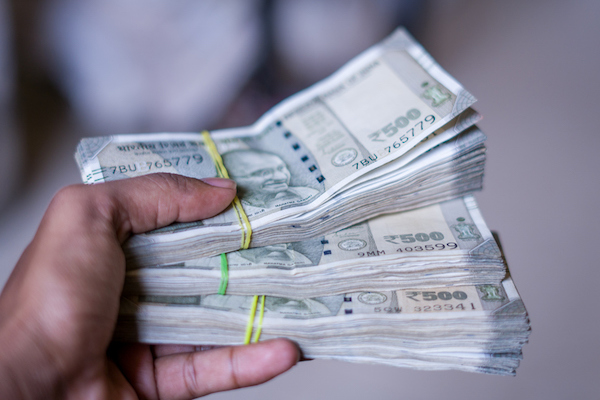
The Indian rupee’s renewed weakness raises two important questions: where is the real balance of payments fault line, and why have strong policy measures failed to contain depreciation pressure? The answer lies in tight global financial conditions, a problem that domestic policy measures can temporarily mitigate, but not fix.
The rupee’s response to recent risk events has been strikingly asymmetric. When oil prices rose nearly 70% after the West Asia conflict began in late February, the rupee fell almost 7% against the US dollar as markets priced in a wider current account deficit for India, potentially near or above 2% of GDP.
Yet with oil now almost 30% below its peak at a more manageable $85 per barrel, the rupee has barely recovered and continues to trade above 96 to the dollar. Meanwhile, spot reserve sales and the expansion of the RBI’s net short forward position have together approached $100 billion.
The RBI’s response has extended well beyond conventional foreign exchange intervention. The regulator capped banks’ daily net open rupee positions at $100 million to curb the impact of offshore-led speculation on the onshore exchange rate, proposed concessional foreign exchange swaps for public-sector external commercial borrowings, and offered to absorb the full hedging cost for banks raising fresh foreign currency non-resident deposits.
Combined with lower oil prices, these measures exceeded the expectations of many in the market. Many believed they could generate $50 billion-$120 billion of banking-sector inflows, enough to move the balance of payments into a meaningful surplus in 2026-27, alongside corrected oil prices. Yet the rupee remains under pressure.
We think tight global financial conditions lie at the heart of this paradox. Oil prices are much below the peaks in April and May, but global inflation concerns have not receded fully. Markets are increasingly pricing in tighter policy across major central banks, including a 25-basis-point hike from the US Federal Reserve over the next six months.
Higher-for-longer global rates were already weighing on foreign investment flows into India before the conflict. The recent repricing has strengthened that pressure, while geopolitics remains a turbulent theme.
Global investors today face a different opportunity set than in previous episodes of rupee stress. A US Treasury yield of around 4.5% offers a highly liquid, virtually risk-free return without currency exposure. Against that benchmark, every allocation to emerging-market assets must clear a much higher hurdle. With India’s interest-rate differentials compressed, the relative attraction of rupee assets has diminished.
The pressure extends beyond yield differentials. US equity returns continue to attract global capital. Strong nominal growth, resilient corporate earnings and improved profitability have reinforced the perception of American exceptionalism, even if in a narrow sense.
The technology sector, in particular, has absorbed capital on a remarkable scale. In that environment, emerging markets are competing not only against each other, but against the strongest US asset performance in years.
These shifts also help explain the muted response to the RBI’s measures. Nearly a month and a half after the announcement, market estimates suggest foreign currency non-resident deposit mobilisation remains around $10 billion-$15 billion. Inflows could accelerate before the September deadline, but the current pace makes earlier projections appear increasingly optimistic.
Among many teething issues, high offshore funding costs have reduced the attractiveness of leverage-driven strategies that previously amplified deposit inflows.
There is also an important mechanical distinction between attracting foreign currency and supporting the rupee. Much of the inflow generated by the RBI’s incentives will ultimately be swapped with the central bank, increasing reserves rather than directly meeting dollar demand in the market.
Depending on maturity, these transactions will also add to the RBI’s forward commitments. These inflows increase the RBI’s ability to defend the rupee now but with repayment commitments later.
Confidence Channel
Historically, the greater benefit of such schemes has come through confidence effects that play out when exporters convert receipts more quickly, importers reduce hedging demand, and portfolio inflows improve.
In 2013, when similar measures were introduced amid acute external stress, confidence improved rapidly, and the rupee appreciated almost 8% within a month. This time, despite a much stronger macroeconomic backdrop and stronger measures, the currency has weakened.
That contrast points to a broader lesson. The 2013 FCNR(B) scheme addressed a domestic vulnerability. India was part of the so-called Fragile Five – inflation was elevated, growth was slowing and faith in macroeconomic management had deteriorated.
Today’s environment looks fundamentally different. Growth is strong, inflation remains contained, banking and corporate balance sheets are healthy, and the current account deficit remains manageable.
Strong policy measures are most effective when domestic weaknesses are the source of market stress. They are inherently less powerful when the source of pressure originates beyond the borders.
The challenge confronting the rupee today is not a lack of policy action or a deterioration in India’s macro fundamentals. It is a world in which dollar funding has become more expensive, risk tolerance has declined, geopolitics is turbulent and global investors have more attractive alternatives.
That leaves the rupee unusually exposed to external shocks. Renewed oil-price volatility, Fed tightening, or another bout of risk aversion can quickly revive depreciation pressure, even if domestic conditions remain sound.
The vulnerability is amplified by India’s relatively low domestic interest rates, which make it inexpensive to position against the currency when global risks rise.
The uncomfortable conclusion is that India’s balance-of-payments challenge is no longer primarily about attracting capital. It is about attracting capital in a world where the price of money has risen sharply.
Until global financial conditions ease, the rupee’s real fault line will remain beyond the reach of domestic fixes.
.png)