.png)


T.K. Arun, ex-Economic Times editor, is a columnist known for incisive analysis of economic and policy matters.
March 31, 2026 at 7:44 AM IST
It is welcome that the government is accelerating and scaling up its National Efficient Cooking Programme, launched in November 2024 by Energy Efficiency Services Ltd, which has a good track record of bringing down the retail price of LED lamps by placing very large orders for procurement. In the case of LEDs, some significant advances in manufacturing technology and processes in China aided and abetted EESL’s campaign to replace the bulk of incandescent lamps in India with far more energy-efficient LEDs at affordable prices.
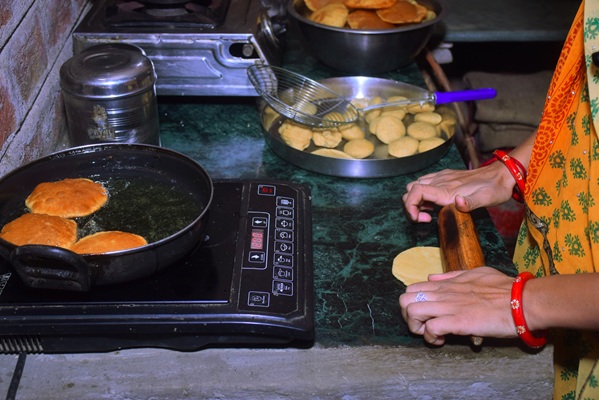
However, it is not enough to bring down the price of induction stoves over time. Their numbers must increase in the short term, to help those without assured household cooking gas connections and outside the range of piped natural gas networks. Nor is it sufficient to increase availability of induction cooktops, so must the supply of cooking vessels made of materials that allow the magnetic field created by the induction cooktops to produce current inside the vessel walls, to heat up the vessel.
While bulk production and supply would bring down induction cooktop prices and set a benchmark, cooking cannot be held off till prices fall. To make use of the available production of induction stoves, what the government must do is to instruct the Bureau of Indian Standards to expand its capacity to certify induction stoves, and mandate that only certified induction cooktops and cookware should be sold. This means that poor and lower middle-class households who invest in induction cooking would not be shortchanged as to quality.
However, even this is not enough. People have been scrambling to lay their hands on induction cooktops, in the wake of the LPG shortage. Eateries, canteens, etc can afford the cooktops and the magnetisable cookware, but often come up against landlord resistance. Landlords often ban induction cooktops, for two reasons: one, they do not always put separate electricity meters in individual premises let out by them, and two, induction cooktops put a heavy load on the building’s electrical system, risking electrical fires.
This calls for government intervention. It must be mandatory for anyone who earns income from letting their premises to a tenant to obtain sanction for sufficient electrical load from the electricity utility and to install wiring, meters, circuit breakers and power sockets that can bear 15 amperes of current. Typically, a 15-amp socket allows steady current flow of 12 amps and a maximum of 15 amps. So, it might be prudent for commercial establishments that deploy multi-stove induction units to have 20 amp or higher-rated sockets installed, and landlords should be obliged to instal them.
Any landlord who balks at rewiring his building to let renters make use of efficient electric cooking in these times of a national emergency must face significant penalties amounting to several year’s rental income. Tenants do not really have the freedom to go house-hopping, to let a market for electrically sound premises to solve the problem. The state must intervene, decisively.
Even if residential and commercial premises are electrically reinforced to permit induction cooking, that would still leave the power grid as a potential point of vulnerability. If everyone starts cooking in the evening, the load on the grid would shoot up significantly, and the grid must be strengthened to make it failsafe.
We live in times of global warming, and extreme weather events. Air-conditioners have moved from luxury to necessity in many parts of India. The grid must be reinforced to take on loads to sustain vastly larger-scale air conditioning, electric cooking and electric mobility.
A stronger grid would be useless if there is not enough power to meet consumer demand. Power generation would need to go up, renewable as well as conventional. Coal burning power plants would emit greenhouse gases. These must be captured and used innovatively and efficiently, not just mineralised and stored. Serious R&D must go into carbon capture and use technologies.
Even if all this is accomplished, the energy challenge would not be over. The extensive damage done to the Ras Laffan gas facility of Qatar, by Iranian bombing in retaliation for attacks on its own gas fields, is a major problem. India buys the bulk of its imports of natural gas from Qatar, and it will take many months, if not years, for supplies to resume from Qatar. This will call for serious reconfiguration and reprioritisation of natural gas use in India.
It is feasible to shop around for crude oil supplies and get the quantities you need, even if the price is a little higher. This is especially the case if your refineries are complex enough to handle different grades of crude, from the highly viscous, almost flow-resistant so-called sour crudes from Rajasthan and Venezuela, for example, to the sweet crudes available from the Persian Gulf. Several of India’s refineries can handle all grades of crude.
However, with natural gas, the diversity of supply is limited. India produces at home only about half its natural gas consumption, and imports the other half, mostly from Qatar. While there has been much discussion of importing gas to India via pipeline, the simple fact that such pipelines would need to come through Afghanistan and Pakistan has stalled progress on such ventures.
The only other way to transport gas is by first converting it into liquid, filling special containers with the liquefied natural gas, transporting the containers via ship, and regasifying the liquid at the export destination. Gas must be cooled to -162 degrees centigrade to liquefy it at only a little above the atmospheric pressure. Liquefaction and regasification facilities are expensive and time-consuming to build.
The US and Russia have plenty of gas to spare, outside the current theatre of war. But they have no spare LNG capacity. About two-thirds of the global trade in LNG is tied up in long-term contracts. Spot and short-term contracts account for at most a little over a third of LNG. And given Qatar’s retreat from the market for the near-term, the price of gas on the spot market would be very high. As things stand, India lets 20,000 MW of installed gas-based power generation capacity lie idle, because gas is too expensive for utilities to buy the power produced from it at a price competitive with other sources such as coal and renewables.
India should prioritise the production of fertilisers above all other uses, in the allocation of the available, home-produced gas. Fertiliser production, too, has been hit in the Gulf countries, and their exports will remain constrained for longish periods. India can import some from Russia, but the price would be high. So, the sensible course is to produce all of India’s requirement of urea at home, using domestic natural gas.
That means gas allocation for mobility and homes would need to be curtailed. This would be an extremely unpopular call for the government to make. But the alternative is to make food more expensive, by letting fertiliser prices soar. Higher inflation would push up interest rates, and constrain growth.
More From BasisPoint