.png)

India-US BTA: Negotiating in the Shadow of a Collapsing Bargain
Trade agreements should create durable commercial gains for both sides. They should not function as protection payments against future unilateral actions.
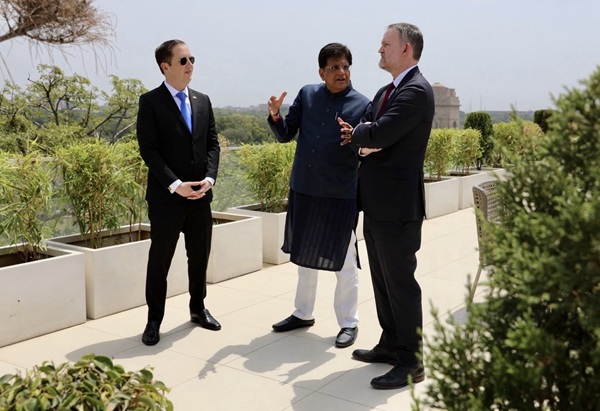

Ajay Srivastava, founder of Global Trade Research Initiative, is an ex-Indian Trade Service officer with expertise in WTO and FTA negotiations.
June 23, 2026 at 4:18 PM IST
India and the US formally launched bilateral trade agreement, or BTA, negotiations on February 13, 2025. The first glimpse of the emerging bargain appeared in the India-US Joint statement issued on February 6, 2026.
Washington promised to reduce its reciprocal tariff on Indian exports from 25% to 18%. In return, India signaled willingness to undertake deeper tariff reductions on US industrial and agricultural products, ease access for American medical devices and farm goods, facilitate cross-border data flows, accept digital trade commitments, align more closely with US economic and security priorities, and potentially purchase up to $500 billion of US goods over five years.
Yet before the agreement could be finalised, the foundation of the US offer collapsed.
On February 20, 2026, the US Supreme Court ruled that President Trump's reciprocal tariffs exceeded the authority granted under the International Emergency Economic Powers Act. The decision invalidated the legal basis for the reciprocal tariff regime.
The very tariff concession Washington had offered India—the reduction from 25% to 18%—effectively disappeared overnight.
Within hours of the ruling, Washington imposed a temporary 10% tariff on imports from all trading partners under Section 122 of the Trade Act of 1974. The measure can remain in force for up to 150 days without Congressional approval and is scheduled to expire on July 24, 2026.
The practical consequence of collapse of reciprocal tariffs and introduction of Section 122 tariffs was striking. Countries that had agreed to major concessions under new trade deals suddenly faced the same US tariff treatment as countries that had no deal. The principal benefit that justified the concessions had vanished. On March 15, Malaysia walked away from its trade arrangement with Washington after concluding that the promised benefits no longer justified the commitments being sought. India now faces a similar dilemma.
With the July 24 deadline approaching, the Section 122 tariff is set to expire. Its removal will have little effect on trade flows because the tariff applies equally to all countries and therefore does not alter competitive positions.
However, the expiry carries greater legal significance. Most US imports would once again face the country's normal WTO MFN tariff rates. It would effectively end the economy-wide tariff regime launched on "Liberation Day" on April 2, 2025 and later preserved through Section 122 after the Supreme Court struck down the reciprocal tariffs.
Some exceptions will remain. Section 232 tariffs on steel, aluminium and certain downstream products will continue, and new Section 301 tariffs could still be imposed. Even so, the vast majority of US imports would return to the normal tariff framework that existed before April 2025.
New Lever
One focused on alleged excess industrial capacity, while the other examined forced-labour concerns in global supply chains. India was included in both investigations.
On June 3, USTR released the findings of the forced-labour investigation and proposed additional tariffs of 12.5% on imports from India and 53 other economies. The proposal is not final, but decisions are expected in the coming weeks.
These developments have created the endgame now confronting India: negotiate under the shadow of new Section 301 tariffs or wait for Washington's next move.
Fragile Foundations
Washington wants India to make permanent commitments on market access for agriculture, energy, defence equipment, aircraft, digital services and advanced technologies, while also encouraging India to purchase up to $500 billion of American goods over five years, limit digital regulations and align more closely with US economic and security objectives.
In return, the main US concession was a reduction in reciprocal tariffs from 25% to 18%. That offer lost its legal foundation after the Supreme Court ruling of February 20.
Washington is now attempting to restore the same bargaining power through Section 301 tariffs, effectively replacing the invalidated reciprocal tariffs with a new set of country-specific duties.
For India, this could mean a tariff of 25% that may be reduced to 18% if New Delhi signs the BTA. Similar arrangements could be offered to the EU, Japan and South Korea to discourage them from abandoning negotiations, as Malaysia did.
If tariff levels are effectively predetermined and then adjusted through trade bargaining, questions arise about whether the Section 301 investigations are genuinely about unfair trade practices or simply a tool to extract concessions.
Even if a deal is signed, there is no guarantee that new tariffs will not follow. The United States has already launched Section 301 investigations against trading partners such as the EU and Japan despite existing trade agreements. Countries could therefore make permanent and legally binding concessions while still facing future unilateral US trade actions.
India's Choices
More importantly, India would avoid long-term commitments whose economic costs may exceed the impact of the tariffs themselves.
Trade data suggests the damage from tariffs may be manageable. Despite facing periods of exceptionally high US tariff barriers during 2025-26, India's exports to the United States still exceeded the previous year's level.
The central reality is that the rationale for rushing into a BTA largely disappeared on February 20 when the Supreme Court invalidated the reciprocal tariff framework. The US side of the original bargain no longer exists. What remains is pressure through Section 301 investigations and the promise of possible tariff moderation.
Trade agreements should create durable commercial gains for both sides. They should not function as protection payments against future unilateral actions. India should therefore treat the BTA negotiations and the Section 301 investigations as entirely separate matters.
Washington's Changing View
The United States increasingly appears to view India as a market for American goods, energy, aircraft and defence equipment rather than as a central pillar of its Indo-Pacific strategy.
The clearest signal came on June 16 when the Pentagon renamed the US Indo-Pacific Command back to the US Pacific Command. When the command was renamed in 2018, the purpose was to place India at the heart of America's strategy in Asia and acknowledge the growing importance of the Indian Ocean in balancing China's rise.
Reversing that decision suggests Washington no longer sees India as central to its regional security architecture.
India's changing place in US strategy reflects a broader reassessment of China. The Indo-Pacific strategy, the Quad and efforts to elevate India as a strategic partner were built on the assumption that China could be constrained through a coalition of regional powers led by the United States.
That assumption is becoming increasingly difficult to sustain.
Despite years of tariffs, technology restrictions, sanctions and military pressure, China has continued to expand its economic, industrial, technological and military capabilities. Recent developments in Ukraine and West Asia have reinforced the view that China possesses the economic scale and geopolitical reach to protect its interests despite US opposition.
For Washington, the lesson is increasingly clear: China cannot be contained in the way the Soviet Union once was. The US now considers China as equal hence the G2 concept.
As a result, American strategy is gradually shifting from containment toward a more pragmatic mix of competition, selective cooperation and accommodation. Managing relations with China is becoming more important than building ever-larger coalitions against it.
Viewed through this lens, India's declining prominence is not evidence of Indian failure. Rather, it reflects a reassessment of American priorities.
What increasingly replaces the strategic partnership is economics. American priorities now focus on expanding exports of agricultural products, energy, defence equipment, aircraft, digital services and advanced technologies. The proposed BTA reflects that shift.
More From BasisPoint