.png)

India’s New Playbook for Navigating Risk, Resilience and Uncertainty
From the Strait of Hormuz to the closing auction, India’s modern epic is a tale of resilience, hubris, and the art of navigating chaos.
Phynix is a seasoned journalist who revels in playful, unconventional narration, blending quirky storytelling with measured, precise editing. Her work embodies a dual mastery of creative flair and steadfast rigor.
August 31, 2026 at 2:57 AM IST
Dear Insighter,
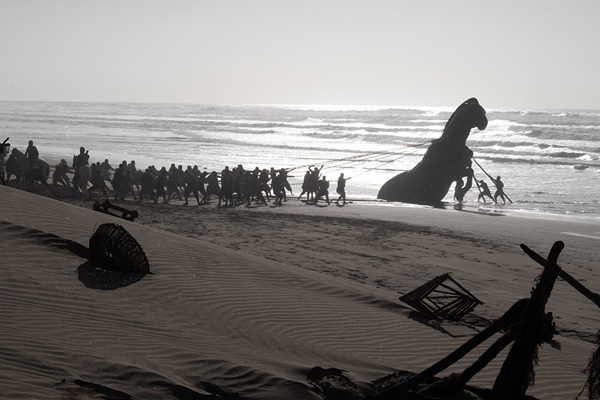
I remember picking up The Odyssey when I was younger, lured by the promise of adventure, gods and monsters, and a hero who just wanted to go home. I never finished it. It was one of those books that sits on your shelf like a moral obligation, the kind you start, stop, and return to days later, still heavy, still waiting. The poetry was beautiful, the monologues interminable, and every conversation felt like a sermon in disguise. But after watching the movie, with visuals that finally made the ancient world feel visceral, I found myself returning to the text. There is something about seeing a story come to life that makes you want to test the original against the spectacle.
And what a story it is. Odysseus spends a decade trying to get home, only to find that home itself has become a battlefield. The gods are capricious, the seas treacherous, and every island offers a new temptation, warning or reason to despair. The Sirens sing, the Cyclops rages, and the suitors feast on his absence. It is, in many ways, the first great epic of resilience, and a warning about what happens when civilisations forget that they are fragile.
That warning is ringing in my ears right now. The world is fracturing, and we are pretending it is not.
Michael Debabrata Patra reminds us that the global economy is “shrugging off the persisting uncertainty” of war in West Asia. The IMF has raised its growth forecast for 2027. On the surface, this is remarkable. Beneath it, unsettling. We are sailing through a strait that very few know if it is open or shut, while markets hum along as if the Fates have decided to be kind.
India, to its credit, is not waiting for the gods to intervene. As Patra notes, India is quietly redrawing its resilience playbook, expanding strategic crude reserves and establishing rare earth corridors across Odisha, Kerala, Andhra Pradesh and Tamil Nadu. ONGC has approved a 1.75-million-tonne expansion of its storage facility in Mangaluru, marking the first time a public sector unit has self-funded emergency national reserves.
The structural scaffolding is being rebuilt. In his Masterclass series, Patra notes the RBI's liquidity management has achieved "monetary marksmanship," keeping call money rates aligned with policy rates.
Yet even as we build our defences, we are creating new vulnerabilities. Anuj Agarwal warns that India’s AI boom is mimicking its oil vulnerability, with imports of computing hardware surging past $2 billion in a single month. We are trading one form of dependence for another, swapping crude for chips. “Chips could become the new crude,” he writes.
Praveen Pardeshi points out that India’s EV push risks swapping oil dependence for battery imports, with 70% of lithium-ion cells currently coming from China. Rakesh Khar echoes the concern, noting that China’s share of global refining across strategically important minerals is 70–72%, while for rare earths it exceeds 90%. We are building a clean-energy future on a foundation of imported dependence.
Dhananjay Sinha observes that the RBI’s dollar swap scheme has mobilised $72.8 billion, rebuilding its intervention capacity. But he cautions that this is “reserve rebuild, rather than reserve creation”. We are borrowing dollars to defend the rupee, rather than earning them through exports and investment.
V Thiagarajan adds that India’s reserves are back above $700 billion, but forward liabilities make part of that buffer “less usable than it appears”. The headline looks impressive; the footnotes tell a different story.
The financial markets, too, are a study in epic folly. Vivek Kaul reports that retail traders lost ₹3.85 trillion trading futures and options over five years. He coins the term “reversification” to describe how instruments created to hedge risk have become vehicles for speculation. Babuji K examines the new Closing Auction Session, which fixes the closing price but opens an expiry-day fault line. The mechanism is better, he argues, but it has made the final leg of convergence “less continuous and harder to hedge”.
Rabi Mishra warns that AI in banking, used for fraud detection, credit assessment, risk monitoring, creates a subtle systemic risk: common data, common vendors, common model architectures.
Krishnadevan V dissects the anchor investor mirage in India’s IPO boom, noting that weighted anchor exits rise from 3.5% at day 30 to 50.7% at day 365. An anchor list signals demand at the offer price, not conviction or permanent ownership. It is the financial equivalent of a marriage that lasts exactly as long as the reception. In the case of NSE’s IPO, Krishnadevan warns that the ₹15 billion settlement clears an overhang but not the governance test. An exchange sells trust in its systems as much as trading technology, he writes. Trust, once broken, is harder to rebuild than any balance sheet.
Rabi N. Mishra asks whether bank supervision should be procyclical, whether the RBI should ease up in good times. His answer is no, because “periods of apparent calm provide the best opportunity to detect vulnerabilities”.
And the storm is coming. The Nepal floods are another reminder of how vulnerable communities remain to increasingly erratic weather. Unseasonal rains and floods are recurring tests of infrastructure, preparedness and resilience. Yet the temptation remains to treat each event as an isolated disaster rather than part of a larger risk.
K. Srinivasa Rao reports on the RBI’s proposed ban on revolving credit by NBFCs, a move designed to curb hidden risks. But he notes that these facilities have become “the lifeline for many low-value entrepreneurs”. The regulator is trying to close a loophole, but in doing so, it may close the door on millions of borrowers.
Sagari Gupta writes about Central KYC 2.0, which aims to move India’s banked millions into insurance, funds and pensions. But she cautions that “India built cheap infrastructure to open a bank account and got 590 million accounts. It is now building infrastructure to sell a second product cheaply”. The question is whether this will mean deeper household participation in formal savings, or simply faster cross-selling.
Shilpashree Venkatesh examines BOT 2.0, the revised framework for private investment in highways. The policy is shifting from risk transfer to risk sharing, learning the lessons of BOT 1.0, which placed too much demand risk on developers. Private capital can absorb commercial risk, she writes, but it cannot efficiently absorb risks that it neither controls nor can reasonably price.
Indra Chourasia argues for longer trading hours to open Indian markets to the world. At a time when global exchanges are moving towards 24/5 trading, India operates for less than 6.5 hours.
Sanjay Mansabdar recounts the face-off between Scott Bessent and Stanley Druckenmiller over US Treasury yield intervention. It is a reminder that the same people who once bet against the pound are now on opposite sides of another macro trade. The lesson, as Mansabdar notes, is that fighting enormous and potentially unlimited capital flows, when they are aligned with economic trends, is a losing proposition.
And finally, Amitabh Tiwari examines the One Nation, One Election Bill, warning that its biggest beneficiaries may not be national parties but strong regional ones. The question, he writes, is whether Indian federalism can survive that arithmetic.
All of this, the reserves, regulations, reforms and elections, is the modern Odyssey. We are all Odysseus, trying to find our way home through a world determined to keep us lost. But here is the thing about Odysseus: he made it home. He refused to give up. He learned from his mistakes. He listened to the right people and ignored the wrong ones. He tied himself to the mast when he knew he could not trust his own ears.
The world may be fracturing, but we are building our own rafts, stockpiles and reserves.
Until next time.
Yours in the glorious, ongoing journey,
Phynix
Also Read:
- Corporate Rescue Has a Clock by Chandrika Soyantar: When a company teeters on the brink, time is not just money, it is the currency of survival itself.
- The Japanification of AI by Sanjay Mansabdar: The US AI boom echoes Japan's asset bubble, and history's rhyme may soon turn into a dirge.
- Who Wants to Be a Bank CEO? by R. Gurumurthy: Finding a leader for India's largest private bank has become a test of whether institutions can manufacture optionality.
- Don't Mess With Markets by Stephen S. Roach: Treasury Secretary Bessent's interventionist rhetoric betrays a fundamental misunderstanding of what markets are trying to tell him.
- Kevin Warsh Owes Us an Apology by Marco Buti and Marcello Messori: The Fed Chair's disorientation is unsettling markets, and Jackson Hole may be his last chance to restore clarity.
- The War Above Us by Lt Gen Syed Ata Hasnain: Space is no longer a specialist subject, it is the new high ground, and India cannot afford to be earthbound.
Beyond this Newsletter
The BasisPoint app brings you our latest insights, analysis and updates as soon as they are published.
Download the BasisPoint app from Google Play or Apple’s App Store and stay connected to the ideas shaping India’s economy, policy and markets.
You can also follow us on WhatsApp Channel:
https://whatsapp.com/channel/0029Vb6wYey3wtb36FzRg52S
More From BasisPoint