If India is to remain competitive in a changing global economy, energy security must sit at the centre of its Viksit Bharat agenda. Solar power is seeing rapid advancement, but the next test is to build a similarly deep battery ecosystem that can support the country’s Panchamrit commitments, and a sustainable transport transition.
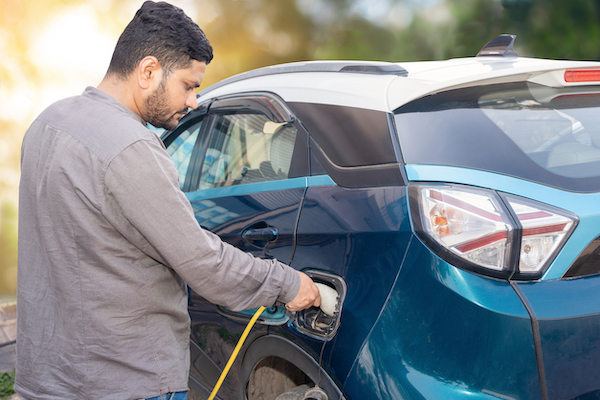
Electric mobility has moved to the mainstream as automakers widen model ranges, improve technology and make electric vehicles more practical for consumers. Yet the battery remains both the vehicle’s cost centre and its technological core. It accounts for 30–45% of an EV’s capital cost and determines driving range, charging requirements and much of the user experience.
Battery manufacturing is therefore more than an industrial opportunity. It will determine whether India’s transport transition strengthens energy security or merely replaces dependence on imported oil with dependence on imported cells, materials and technology.
India’s EV battery market is dominated by lithium-ion technology because of its high energy density, relatively low weight, faster charging and improving thermal stability. Supported by rising EV penetration, policy incentives and wider consumer acceptance, the lithium-ion battery market grew at a compound annual rate of about 20% between 2018–19 and 2025–26, reaching ₹216.7 billion.
CareEdge Research projects a much faster 34.2% annual growth rate from 2025–26, taking the market to ₹942.2 billion by 2030–31.
Lithium-ion battery market size
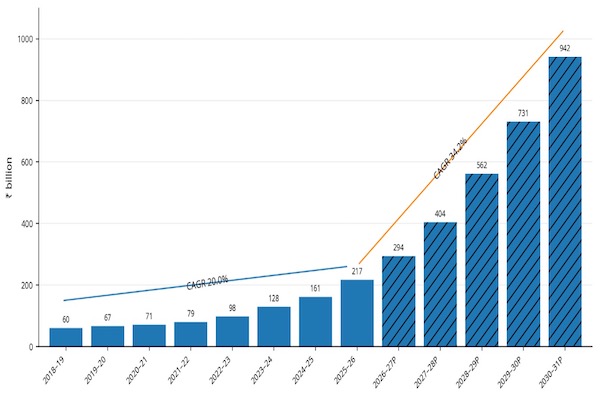
Source: CareEdge Research; P: Projected
Import exposure
Scale alone, however, will not create industrial sovereignty. India currently imports around 70% of its lithium-ion cells from China and Hong Kong. That leaves domestic manufacturers vulnerable to supply-chain disruption, geopolitical risk and commodity-price volatility.
The exposure could deepen following China’s decision to impose export controls and licensing requirements on high-performance lithium-ion batteries with an energy density of at least 300 watt-hours per kilogram, cathode materials, artificial-graphite anodes and related manufacturing technology. Such restrictions could constrain India’s ability to meet the rapidly growing battery demand.
Building capacity
India also imports large volumes of refined lithium, nickel and cobalt, while China refines most of the global supply of these minerals and controls lithium iron phosphate cathode active material production. This upstream concentration is a fundamental constraint on the development of a fully functional and self-reliant domestic battery industry.
By 2030, India will need significant investment not only in cell plants, but also in critical-mineral refining, upstream material processing, recycling and technology development. Cell manufacturing alone will not be enough. A viable indigenous ecosystem requires coordinated capacity across the value chain.
The government’s Advanced Chemistry Cell production-linked incentive scheme, with an outlay of ₹181 billion, aims to establish 50 GWh of domestic manufacturing capacity. Yet, major constraints remain, including limited access to technology, shortages of skilled personnel, dependence on imported machinery and inadequate availability of upstream components.
Recycling is the other missing link. As early-generation EV batteries reach the end of their useful lives, India will need a robust system to collect, transport, pre-process and recover valuable materials such as lithium, cobalt and nickel. Scaling capacity will require investment in collection networks, logistics, pre-processing facilities and advanced material-recovery technologies.
The economic case is strengthened by rising demand for critical minerals, Extended Producer Responsibility regulations, and the need to reduce raw-material imports. A circular battery economy will be essential to long-term sustainability and supply security.
Demand for lithium-ion batteries will continue to be driven by transport electrification, renewable-energy storage, consumer electronics and improvements in battery chemistry. But supply-chain vulnerabilities, the concentration of critical minerals, safety concerns and emerging alternatives such as sodium-ion and solid-state batteries will remain important constraints.
India’s strategic choice is whether electrification reduces external dependence or simply changes its form. Domestic capability spanning minerals, refining, cells and recycling will determine whether the country emerges as a global EV manufacturing hub, or remains reliant on external supply chains.
India’s electric-mobility transition will ultimately depend not only on how quickly EV adoption accelerates, but also on who controls the battery ecosystem powering it.
(This article is published by arrangement with CARE Analytics and Advisory Private Limited)
.png)