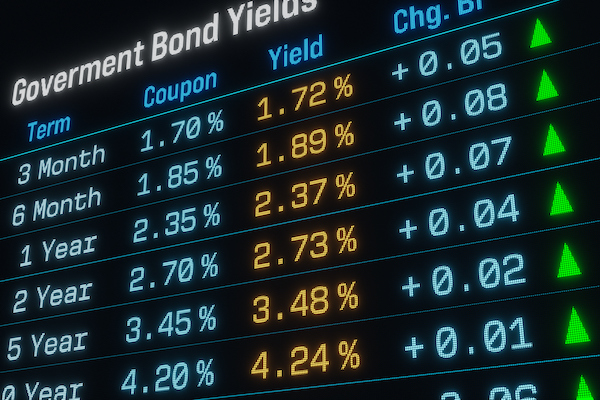
India’s bond market is moving from a sharp rally into a period of consolidation as renewed West Asia hostilities and higher US Treasury yields offset domestic support from foreign-currency inflows. The benchmark 10-year Indian government bond yield has risen by 13 basis points over the past week, reversing part of the 45-basis-point decline from its mid-May peak.
The significance of that repricing extends well beyond sovereign debt. Government-bond yields influence borrowing costs across the economy and feed into bank funding, corporate issuance, the rupee and foreign portfolio allocations. The next phase will therefore be determined not by a single monetary policy call, but by the interaction of dollar funding costs, oil prices, foreign-currency deposit inflows and domestic food inflation. That combination points to a range-bound market rather than another one-way rally.
The 10-year government bond yield reached 7.13% twice in April and May as concerns about oil-led inflation and the fiscal outlook intensified. At one stage, the two-year overnight indexed swap market was pricing the equivalent of almost five policy-rate increases.
The subsequent US-Iran memorandum of understanding, together with measures announced by the Reserve Bank of India at its June policy meeting, including changes to the tax treatment of foreign portfolio investment in government bonds and the introduction of a Foreign Currency Non-Resident (Bank) deposit scheme, drove a sharp reversal. By the June lows, the 10-year yield had fallen to 6.68%, while the two-year overnight indexed swap rate declined to 5.87% from 6.58%. Yields on two- to three-year AAA corporate bonds fell by 80–90 basis points.
Renewed hostilities and a rise in US Treasury yields have since interrupted that rally. Over the past week, the two-year overnight indexed swap rate has increased by 20 basis points, while yields on three-year AAA-rated public-sector bonds have risen by about 30 basis points.
Part of the June move reflected light positioning before the Monetary Policy Committee meeting. Conditions are different now. Traders have increased their exposure to short-duration assets on the assumption that the deposit scheme could attract about $50 billion. With positions heavier and geopolitical risks again affecting oil and global rates, follow-through buying has weakened.
Funding Test
Market reports suggest that about $10 billion has been mobilised through the Foreign Currency Non-Resident route since the scheme’s frequently asked questions were released three weeks ago. The final outcome remains uncertain, however, because US dollar funding costs have risen.
The five-year US Secured Overnight Financing Rate swap rate moved from about 3.85% at the end of June to 4.08% in July before easing to around 4.00%. Because leverage is central to the economics of these deposits, higher funding costs reduce the potential scale of collections. Stronger mobilisation would require either lower dollar rates or more attractive deposit pricing by banks. A final amount below $50 billion could therefore disappoint market expectations.
The same funding conditions extend beyond the deposit scheme. They will affect banks’ overseas foreign-currency borrowing and Indian companies’ external commercial borrowing plans, including the relative cost of raising funds offshore rather than in the domestic bond market.
Global rates and oil have consequently become important domestic variables. With Brent crude near $85 a barrel and the 10-year US Treasury yield around 4.55%, some of the earlier exuberance in Indian bonds has already been removed. Federal Reserve Chair Kevin Warsh may continue to communicate cautiously as he establishes credibility with markets and the Federal Open Market Committee. Even so, recent US inflation data suggest that the Federal Reserve could leave rates unchanged at least through its September meeting. Such an outcome would provide some relief to foreign-currency deposit mobilisation and overseas borrowing plans.
Domestic inflation still supports a near-term pause by the Reserve Bank of India. India’s June inflation reading was slightly above market expectations, but inflation in the April–June quarter was 27 basis points below the Monetary Policy Committee’s projection. Core consumer-price inflation excluding precious metals remains subdued at 2.5%, strengthening the case for no change at the August meeting. The October decision is less certain and may depend on the Federal Reserve’s September policy path and the effect of El Niño on food prices during the monsoon.
Foreign portfolio investors have, meanwhile, returned decisively to Indian debt. They bought about ₹550 billion of debt in June and a further ₹90 billion in July to date. Expectations of foreign-currency deposit inflows, overseas borrowing by banks and companies, and possible inclusion in the Bloomberg Global Aggregate Index have supported the rupee and could sustain foreign demand for bonds.
September Window
Short-term funding markets nevertheless show signs of pressure. Three-month certificate of deposit yields have risen to about 7.00%, while 12-month certificate of deposit yields are near 7.30%. The increase reflects the elevated incremental credit-deposit ratio and has contributed to a roughly 30-basis-point rise in short-duration corporate bond yields. An upside surprise in foreign-currency deposit collections could ease these pressures by improving banking-system liquidity.
September is likely to be the key point for reassessing the market. By then, investors should have greater clarity on final deposit collections, the monsoon’s effect on food inflation, any Bloomberg index decision and the Federal Reserve’s rate trajectory.
Against that backdrop, the 10-year Indian government bond yield is likely to trade in a 6.65%–6.85% range, barring a further escalation in West Asia. The five-year overnight indexed swap rate is expected to remain within 6.15%–6.45% through September, with the two-year rate in a 5.90%–6.18% range. Three-year AAA-rated public-sector bond yields could revisit 7.15% if geopolitical tensions do not intensify.
On a relative-value basis, five-year assets appear more attractive than three-year assets, partly because much of the deposit-related demand has so far been concentrated in the five-year segment. Corporate bond performance will also depend on whether issuers favour domestic debt or overseas borrowing once hedging costs are included. US bond yields are therefore likely to remain an important driver of Indian yields over the next few months.
Brent crude currently appears to contain a geopolitical risk premium of about $7–$8 a barrel, against an estimated fundamental value near $75. A broad $65–$85 range would remain consistent with healthy foreign inflows into Indian debt; a sustained move above that range would present a more difficult combination for inflation, the rupee and local rates.
The broader message is that Indian fixed income is no longer being driven by a single domestic catalyst. Its next phase will reflect the interaction of global rates, oil prices, currency funding and local liquidity. A period of consolidation would therefore be constructive: it would allow the market to absorb June’s rapid repricing while preserving medium-term support from capital inflows and contained underlying inflation.
.png)