.png)

T.K. Arun, ex-Economic Times editor, is a columnist known for incisive analysis of economic and policy matters.
April 24, 2026 at 10:15 AM IST
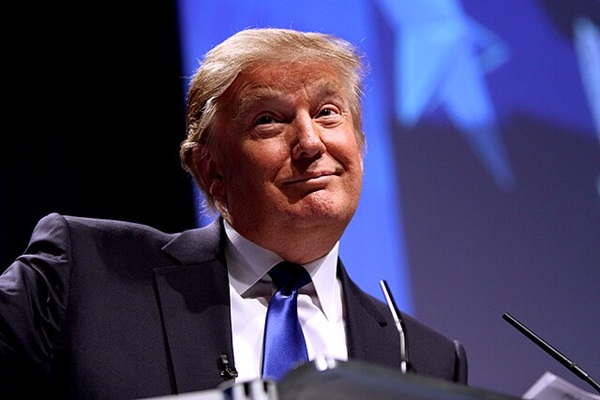
President Donald Trump posted on his social media platform, Truth Social, the transcript of a vituperative podcast by a Make-America-Great-Again champion that describes India and China as hellholes.
What is at stake is not the veracity of what the podcaster says about Indian immigrants to the US or the conditions in which Indians live back home. That could, at best, have figured in a debate with the podcaster, whose name, strangely enough, is Savage. There is candour there, and the possibility of disabusing him of his notions born out of racial prejudice. But when President Trump posts it on his social media account, it becomes a slur, an attack on India.
Donald Trump, as an individual, is not finest representative of humanity. Unlike the beasts of the wild engaged in a ceaseless struggle for survival, in which the fittest prevail, humans are potentially capable of empathy, cognition beyond what directly manifests to the five senses, appreciation and creation of beauty and culture, constant expansion of the frontiers of knowledge and conversion of that knowledge into the means of enhancing the quality of their existence. Humans have a sense of fairness and justice, an instinct for protecting the weak and capacity for enlightened self-interest that abdicates present consumption for future sustainability.
These human qualities are, of course, superimposed on the features of survival-seeking animals, which fight for territory, resent bands and groups that are not their own, even if of like species, and live and die by the rule of the jungle, that might is right.
It does not require a genius to figure out on which set of characteristics, if a Venn diagram were to be drawn of the characteristics of humans, in general, and the characteristics of Donald Trump, there would be maximum overlap. But we do not say this to Donald Trump when we engage with him as President of the United States. He might lack the civility and the grace to conduct himself according to his station, but that would be no excuse for others, who have such civility and grace, to imitate him.
There is a United States beyond Donald Trump, and India must seek to maintain good relations with that US, and not forsake its principles of respect for sovereignty or concern for national dignity, when dealing with a man who threatens to wipe out a civilisation and jokes about dropping bombs for the Hegseth of it.
Our relations with the US have to be shaped in the context of the realignment of geopolitics that the MAGA worldview’s isolationist and imperialist articulation by President Trump has wrought. Europe is acquiring its own defence posture, fully aware that the NATO of yore no longer guards Europe. Japan has recently shed its restriction on sale of offensive weapons to outside powers. While East and Southeast Asian countries will reach an accommodation with China, they will still feel the need to ground their security in their own strength, particularly with a rogue power like North Korea around, more empowered than before, fortified by fresh infusions of Russian defence technology.
One reason why the rest of the world holds so much of US dollar assets is the US current account deficit, which has to be financed by the rest of the world. Trump wants to eliminate that current account deficit. That desire can be fulfilled only by curtailing dollar dominance.
Over the last ten years, the share of global reserves held in the dollar has come down by ten percentage points, even if still remains over half the total. The rise of gold signals the decline of the dollar. India’s timidity in responding to the attack on a fellow member of BRICS — Iran is a member since 2024 — has weakened the grouping, but not terminally. It can take the lead in forming a new currency for settling international transactions that do not involve the US as a counterparty, in cooperation with the EU, Canada and Japan, of course. Putting that currency on the blockchain would eliminate payment delays, release payments from the rickety Swift messaging system and greatly contribute to ending the US government’s ability to weaponise the dollar.
A great deal of modern exercise of power depends on technology, both of military and civilian, shaped by artificial intelligence, advances in cryptography, communications, robotics, materials, biotechnology, space technology, technologies for the desperately needed Green Transition in energy, reticular chemistry capable of producing crystalline structures with precise, tunable spaces between lattices that can be used as molecular sieves, and the like.
In the new, fragmented world, technology also fractures along national lines. Depending on American military satellites for global positioning might be not just futile but dangerous at critical moments. Buying American fighter jets is to lock the buyer into dependence on sustained support from US systems, intelligence and upgrades, jettisoning kit from other sources.
Anthropic’s latest release, Mythos, reveals the imbalance in national power between countries that can leverage AI to safeguard their systems against hacking and countries that do not have access to such AI tools to protect their systems. Technology no longer presents itself as presumed global commons. Rather, technology is a national asset, to be shared or withheld, depending on political will.
Global alliances would have to take into account national capability to develop technology, readiness to create complementary technologies and share among like-minded nations and groups of nations. Frameworks for regulation of AI and other dual use technologies can be built collegially only if nations other than the US and China have the wherewithal to make significant contributions to the technology itself.
India can potentially be a major provider of technological commons for the world, or force superpowers to add their tech to a shareable pool. That potential lies in the millions of young Indians who are of an age to receive advance training in diverse technologies and fields of the imagination, and become creators and innovators. Right now, Indians are content to slave away developing intellectual property at Global Capability Centres for foreign companies and their national governments, instead of working on projects to develop and deploy Indian capability in diverse fields.
At least on ambition, whether of Indian entrepreneurs or of the Indian government, to convert India’s potential into achievement, the Savage verdict is probably right: India does represent a deep hole, wherever it leads.
The way to sustained improvement in India’s relations with the US and other countries lies through realising India’s own innate potential for advance. That calls for participatory democracy, not sectarian politics crawling towards schism.
More From BasisPoint