.png)



Dehuti Jani is an experienced project manager who also works as an independent financial journalist.
Richard is an independent financial journalist who tracks financial markets and macroeconomic developments
August 26, 2026 at 4:07 AM IST
The Indian rupee has come under significant pressure over the last few months, and the situation is unlikely to get any better for the currency any time soon as the sharp global rally in gold and silver prices coincides with the start of the festival and wedding season, which will potentially increase demand for imported bullion and, in turn, dollars.
Over the past month, gold prices have risen nearly 13% globally to over $4,600/oz, according to London Bullion Market Association data. Silver prices have surged by over 16%.
“Shifting monetary policy expectations, a weaker US dollar, and renewed inflows into gold ETFs supported gold prices, contributing to the recent recovery in the gold market,” Kavita Chako, research head for India for World Gold Council said in her blog last week.
WGC data showed gold imports rebounded sharply in July, suggesting a recovery in physical demand and inventory replenishment ahead of the festive season, according to the World Gold Council. Import value rose to $4.16 billion from $1.97 billion in June, while estimated volumes increased to 40-45 tonnes from 20 tonnes.
A further pickup in physical and investment demand during the festival and wedding season could increase foreign-currency requirements for the world’s second-largest gold consumer, adding to existing sources of dollar demand.
“Gold, silver prices are again shooting up, which is very negative for the rupee,” said Ashutosh Mishra, senior vice-president at JSW Steel, who tracks currency, rates and commodity markets.
Mishra said investment demand through bullion-backed exchange-traded funds could add to the pressure because such products require physical metal to support their holdings. A revival in physical purchases during the festive and wedding season could add another layer of demand for imported bullion.
The timing is significant for the rupee, which trades around 95.75 per US dollar. Although a weaker dollar has provided some support to other Asian currencies, higher oil prices and persistent importer demand have limited the domestic gains.
Against this backdrop, an increase in dollar demand from bullion imports could add to the pressure on the rupee if festive and wedding purchases remain resilient despite elevated prices.
The precious-metals channel is unlikely to be the primary driver of the currency’s weakness, but it could add to dollar demand at a time when India’s external funding position remains under pressure.
“Even if the dollar weakens globally, we are still short of dollars,” Mishra said, pointing to India’s external funding requirements and insufficient capital inflows to offset the current-account deficit.
Recent measures to attract foreign currency, including the relaxation of rules for foreign investment and the FCNR(B) deposit window, have provided temporary relief. But such measures may not fully address the underlying demand-supply imbalance in the foreign-exchange market, Mishra said.
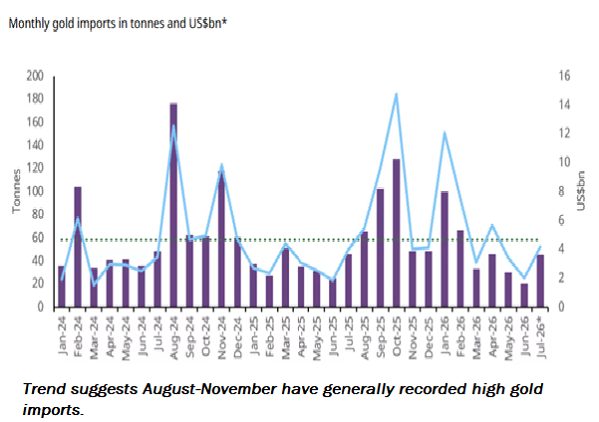
|
Month |
Import value in $ billion |
|
Apr-25 |
3.10 |
|
May-25 |
2.55 |
|
Jun-25 |
1.84 |
|
Jul-25 |
3.97 |
|
Aug-25 |
5.44 |
|
Sep-25 |
9.61 |
|
Oct-25 |
14.72 |
|
Nov-25 |
4.02 |
|
Dec-25 |
4.14 |
|
Jan-26 |
12.07 |
|
Feb-26 |
7.45 |
|
Mar-26 |
3.06 |
|
Apr-26 |
5.63 |
|
May-26 |
3.42 |
|
Jun-26 |
1.97 |
|
Jul-26 |
4.16 |
The festive and wedding season could make the bullion channel more relevant if elevated prices do not materially deter buyers.
“If prices become more normalised, people will start buying again,” Mishra said, referring to gold and silver demand during the upcoming festive and wedding season.
While recycled gold--primarily from the exchange of old gold jewellery for new--continues to supplement supply, the recovery in imports points to stronger physical demand in India compared with recent months, Chako said in the blog.
For the rupee, any increase in bullion-related dollar demand would come alongside payments for crude oil and other imports. Brent crude oil is currently trading above $90 a barrel, adding to the pressure on India’s import bill.
The extent of the currency impact will depend on whether elevated precious-metal prices suppress physical demand or encourage further investment buying. But with the rupee already struggling to gain despite a softer global dollar, a seasonal revival in bullion demand could make the currency’s adjustment more difficult.
More From BasisPoint