.png)

Phynix is a seasoned journalist who revels in playful, unconventional narration, blending quirky storytelling with measured, precise editing. Her work embodies a dual mastery of creative flair and steadfast rigor.
June 8, 2026 at 4:25 AM IST
Dear Insighter,
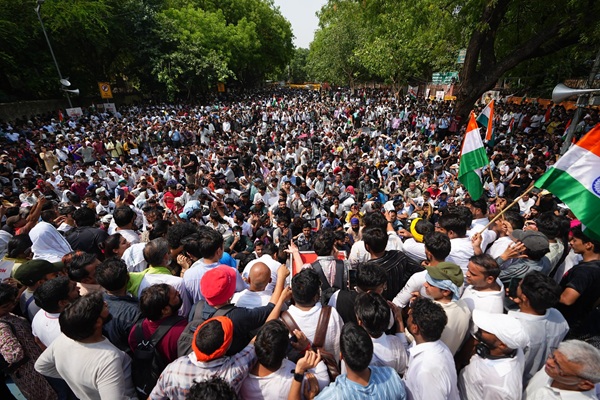
A few weeks ago, someone in a position of constitutional authority decided the best way to describe unemployed young Indians was to compare them to household pests. It was the kind of unforced rhetorical error that usually keeps political consultants employed and crisis managers on retainer. Instead, it gave birth to the Cockroach Janta Party, which now boasts more Instagram followers than many mainstream political outfits have voters and held its first street protest this week at Jantar Mantar.
Hundreds of young people in cockroach masks, clutching dog-eared exam guides like sacred texts and waving the national flag with the kind of furious hope that has not yet learned cynicism. They want the Education Minister's resignation. They want answers for paper leaks, technical glitches and cancelled tests. They want to know why students preparing for NEET are taking their own lives while the system that failed them issues statements about resilience.
The party's founder, 30-year-old political strategist Abhijeet Dipke, flew in from Boston to tell the crowd that "cockroaches don't ever fear." It's a good line, the kind that fits neatly on a placard and travels even better on social media. It is also, as Rajesh Ramachandran notes, a template with familiar architecture. Dipke was once an AAP volunteer. The hashtag #Mainbhicockroach echoes the older #Mainbhianna that helped Arvind Kejriwal delegitimise the UPA.
The debate has predictably centred on whether this is a Western-scripted regime-change attempt, the latest instalment in a South Asian series that has already rattled governments in Pakistan, Sri Lanka, Bangladesh and Nepal. A master's degree from Boston University does not come cheap, nor does the kind of political startup that scales to 22 million followers in weeks.
But fixating on foreign funding, legitimate as the question may be, risks missing the rot that is entirely homegrown. As Ramachandran argues, this may be an inflection point in the decline of public trust. Paper leaks, re-tests and students taking their own lives in frustration are not foreign implants. They are governmental failures at their most intimate and devastating. If the state cannot conduct annual examinations without descending into farce, what exactly is the basis for believing it can make people's lives better? The question writes its own answer, and that answer is wearing a cockroach mask at Jantar Mantar.
While young India was making its frustrations visible on the streets, the Reserve Bank of India was addressing a different set of pressures. The Monetary Policy Committee left the repo rate unchanged at 5.25%, maintained its neutral stance, and rolled out measures aimed at supporting external financing conditions. As Kalyan Ram notes, the June policy is best understood as a problem of policy assignment. External financing stress crossed the threshold for action and was met with a barrage of capital-flow measures. Inflation risk crossed the threshold for vigilance but not yet for higher rates. The wager is that by separating these two problems now, the RBI can make the next rate decision cleaner, more credible and more firmly grounded in the domestic inflation process.
There is, however, a less elegant interpretation of the same story: that the RBI has effectively rolled out the welcome mat for foreign capital in the hope of easing pressure on the rupee. Shailendra Jhingan estimates the package could attract around $50 billion of inflows, enough to push the balance of payments into neutral territory and buy time for the MPC to focus on growth-inflation dynamics. That time, however, may be shorter than the RBI hopes. As Dhananjay Sinha argues, the package may buy time, but it does not buy a solution. The strategy may ease near-term stress, but deeper vulnerabilities remain.
Not everyone is convinced the inflow arithmetic adds up. V Thiagarajan points out that each measure in the package runs into market constraints that regulation alone cannot easily overcome. The measures appear calibrated for a financing shortfall measured in billions of dollars when the challenge, Thiagarajan warns, may ultimately be measured in tens of billions.
R. Gurumurthy reads the RBI's latest balance sheet not as an accounting statement but as a window into an evolving relationship between the monetary authority and the sovereign. The headline number was the record ₹2.87 trillion surplus transfer to the government. But the ₹7 trillion increase in government securities sitting on the RBI's balance sheet is a shift in composition away from foreign assets and towards domestic sovereign debt that raises the question of whether these developments are becoming structural rather than cyclical.
Alpana Killawala sharpens the point by asking what is more desirable from a central bank: surplus or strength. Killawala, channelling the wisdom of the CAFRAL study that found the RBI about 5% under-capitalised relative to the emerging economy average, suggests the euphoria may be misplaced.
This is where Michael Patra's historical masterclass, delivered as part of his NIBM lecture series, lands with the weight of a well-preserved archive. Patra traces the RBI's ancestry back to the Presidency banks of the East India Company, through its birth in 1935 as the first central bank in a British colony, to its nationalisation in 1949. Patra then offers the defining line of his career, borrowed from Dr. C. Rangarajan, under whom he learned the craft: the RBI does not consider itself independent from the government; it considers itself independent within the government. That phrase, at once elegant and evasive, captures a delicate dance that the ₹7 trillion in government securities on the current balance sheet suggests is tilting once again towards a tighter embrace.
BasisPoint Groupthink notes that the central bank chose not to give the rupee a speaking role in monetary policy, reinforcing the assignment rule that has served India well over the past decade: inflation and growth remain monetary policy's primary mandate, while exchange-rate pressures are addressed through other instruments. It's a principled position, and it may even be the right one. But it places an enormous burden on communication, and as Srinath Sridharan writes, markets now focus not only on what central banks do but on what they believe. Every word, said and unsaid, matters.
There was, however, one piece of linguistic tightening that markets genuinely craved. In a caustic pre-policy note, BasisPoint Insight urged Governor Malhotra to retire the Goldilocks trope. Goldilocks has had a distinguished career in Indian macro commentary, the piece notes, but crude oil has since entered the cottage, global uncertainty has eaten from all three bowls, and the rupee has become the loudest bear in the room.
Meanwhile, the structural story of the Indian economy continues to diverge from the headline growth numbers. Sinha argues that India may now be trapped in a low-equilibrium growth path, where the economy keeps expanding on paper but too slowly and too unevenly to lift household confidence, consumption and private investment.
Arvind Mayaram says India's growth challenge may lie less in capital or demand and more in whether the economy is building the capabilities to compete, innovate and move up the value chain. The fiscal, regulatory and pricing mechanisms used to finance inclusion have often transferred costs to the productive sectors of the economy, reinforcing some of the very constraints that limit investment.
Sagari Gupta notes that India's fiscal architecture is now managing states undergoing fundamentally different demographic transitions. Kerala is ageing. Bihar remains young. Yet the transfer architecture continues to treat these divergent realities through a common framework.
And while all this unfolds, corporate India continues to tell its own stories. Bharat Dynamics spent last year telling a growth story and then reported a 27% revenue decline. Dev Chandrasekhar notes that most of BDL's profit now comes from interest on its ₹47 billion cash pile rather than from building missiles. Zydus Lifescience's ₹11 billion buyback, as Chandrasekhar also observes, is a promoter cash-out dressed as capital discipline, sending roughly three-quarters of the cash back to the founding Patel family while doing almost nothing for everyone else's per-share economics.
Not every corporate story is a cautionary tale. Tata Consumer Products has executed well enough to move beyond its tea-company roots, with its foods business now eclipsing beverages, but Krishnadevan V notes that at 75 times earnings the valuation assumes management can keep finding new categories and deploying surplus capital at high returns. Hindustan Unilever's parent is betting heavily on India, with CEO Fernando Fernandez declaring the group "will not get late to the Indian party," but the premiumisation story that justifies HUL's lofty valuation will need to survive a competitive landscape that now includes Reliance's ambitions in the same categories.
What connects these disparate threads is a shared question about credibility. The Cockroach Janta Party may or may not become a lasting political force. The frustrations that produced it are likely to prove more durable. The cockroach is an excellent metaphor not because it is foreign or domestic but because it survives. It adapts. It outlasts the insecticides thrown at it. The question is whether India's institutions can say the same.
Until next time, watching what crawls out next.
Phynix
ALSO READ
● El Nino May Lower Harvest; But Won't Compromise Food Security by G. Chandrashekhar: Past procurement ensures India's granaries stay full even if El Nino weakens the monsoon.
● Crop Output Targets For 2026-27 Are Out, But Are They Realistic? by G. Chandrashekhar: Government targets for next year's harvest appear to have skipped the weather forecast and the geopolitical news.
● The NEET Paradox and India's Fragile Demographic Dividend by V Thiagarajan: Rising youth disengagement now threatens the very demographic dividend that was meant to power India's growth story.
● When ESOPs Create Debt Before They Create Wealth by Krishnadevan V: SEBI's ESOP pledge ruling risks trapping startup employees in a debt spiral before their stock is even worth anything.
● AI Doesn't Take Toilet Breaks, It Doesn't Spend Money Either by Vivek Kaul: AI may be brilliant at shrinking headcount, but it raises an awkward question—who will consume if workers lose their incomes?
● Can a Machine Fulfil a Director's Fiduciary Duty by Indra Chourasia: AI might soon be the smartest voice in the boardroom; whether it should ever get a vote is an entirely different question.
● Supreme Court's Ruling on Gaming Tax Leaves Industry Fighting for Survival by Shruti Mahajan: After an outright ban, retrospective taxes may now deliver the final blow to India's online gaming industry.
● Health Cess Promise Lost in Fiscal Accounting by D. V. Ramana: The CAG finds that over half the health cess collected over seven years never made it to the designated fund—a fiscal sleight of hand with real consequences.
● Keynes Was Doing Buffett Before Buffett Was Born by Chandrika Soyantar: Decades before behavioural finance had a name, Keynes was running a Buffett-style portfolio from his rooms on Trinity Street, Cambridge.
● How a Wartime Rent Freeze Became Mumbai's Strange Inheritance by Aadya Tyagi: What began as a wartime safeguard for tenants evolved into a hereditary ticket to some of Mumbai's most prized addresses.
● At the Next Table by Kalyani Srinath: In a dimly lit Khan Market café, three young diners turned their meal into a full-blown film production—then barely ate any of it.
● Sarci-Sense: How Weather Became India's Safest Topic by Srinath Sridharan: When politics, cricket, and markets all feel too risky, middle-aged India has found refuge in discussing the one thing nobody can fight about—the weather.
● When Markets Run on Empty by Mohamed A. El-Erian: US markets are flying on debt-fuelled optimism, but a painful reckoning looms sooner rather than later if the Strait of Hormuz remains closed.
● The US and India Have Become Regional Rivals by Brahma Chellaney: The US wants India as a China counterweight but resists Indian dominance in the neighbourhood, going so far as to court Pakistan.
● Why There Will be No Single Model of Future War? by Lt Gen Syed Ata Hasnain: Future conflicts will be as varied as the theatres they are fought in—each shaped by geography, technology, and national resilience, not a single template.
More From BasisPoint