.png)


Rochelle Prakash is an economics associate at Koan Advisory Group

Deep Pal is Director, Geopolitics and Policy, at Koan Advisory Group.
June 8, 2026 at 6:51 AM IST
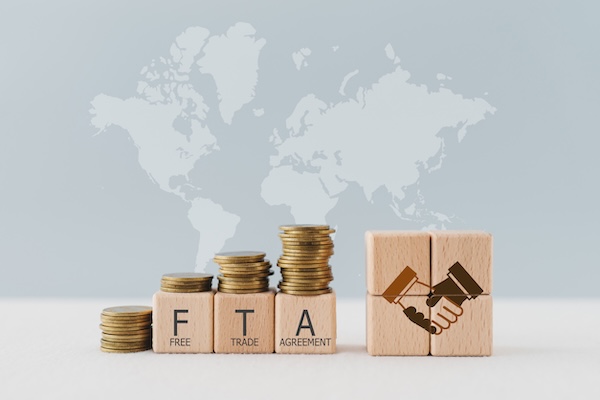
On June 4, Commerce Minister Piyush Goyal told investors that each of the nine free trade agreements that India has signed over the past three years will come into force within ten months. Spanning 38 economies and nearly two-thirds of the global GDP, these agreements come at a time when countries are reassessing supply chains, market dependencies and trade partnerships.
The rise of economic nationalism, supply-chain disruptions and intensifying strategic competition between major powers are reshaping global trade. The United States' efforts to reduce its trade deficit and lessen dependence on Chinese manufacturing have led to a reconfiguration of global supply chains. Against a backdrop of recurring tariff disputes with the United States and intensifying US–China economic competition, India has accelerated its pursuit of FTAs to diversify markets, attract investment and embed itself more deeply in global value chains.
However, more FTAs may not necessarily solve the problem. The answer to how India can close the gap seems to lie in India making deliberate choices about which markets, sectors and partnerships to prioritise as it seeks to balance economic openness with strategic resilience.
Reassessing Existing Deals
To assess the effectiveness of trade agreements, they need to be evaluated against their potential for trade. There is a need for India to reassess and address existing issues as new FTAs begin to operationalise. India’s record of FTA utilisation so far suggests a long way to go. Unlike other emerging economies like Vietnam, Mexico and Chile, which have utilisation rates of around 40-50%, India’s score ranges from 5-25%.
The low utilisation rates are reflected in the trade outcomes of several of India's existing agreements. India operationalised four major trade agreements, ASEAN, Korea, Japan, and Malaysia, from 2010 to 2012. After the implementation of these trade deals, it experienced a prolonged slump in merchandise exports. As Figure 1 illustrates, a majority of India’s FTAs lead to a sustained decrease in its trade balances, with each passing year of the deal’s implementation.
Figure 1. India’s trade balances over the years with its FTA partners
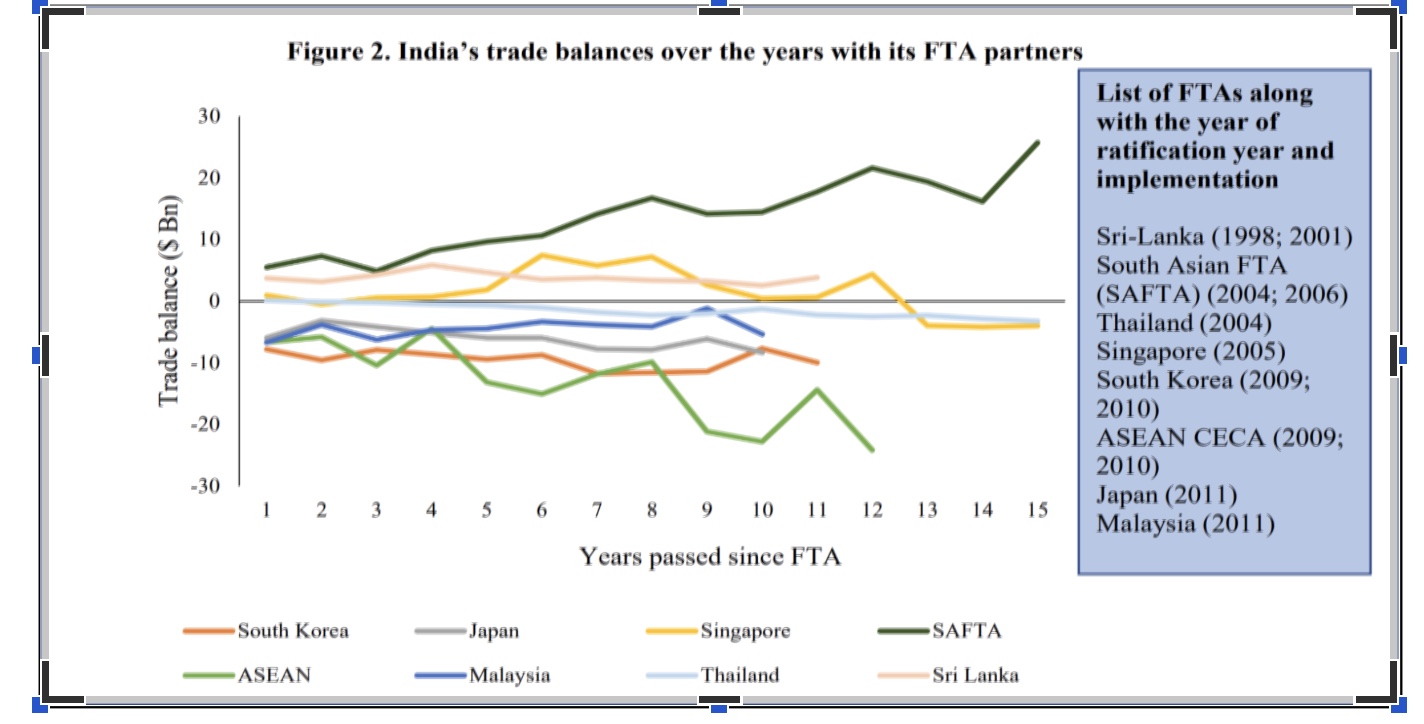
Source: D. Pandey, M. Unnikrishnan, Free Trade Agreements (FTAs) by India: Review and Implications for Future, IIMA, (2023), UN Comtrade trade database.
An increase in imports is not necessarily a problem, provided the imports support investment, manufacturing, exports, and job creation. However, India’s top exports predominantly feature low-value-added goods such as textiles, refined petroleum, gems and jewellery, and organic & inorganic chemicals. Since 2019-20, India's electronics exports have grown by 151% to reach $38.6 billion in 2024-25. Yet they still account for just 7% of its total merchandise exports. To improve export potential, India needs to shift its focus from low-tech or low-skill products to manufacturing sophisticated goods over the medium term to better compete with low-cost producers in Asia. Moreover, the FTAs have not necessarily helped India increase exports, attract investment, strengthen manufacturing, or improve access to important technologies and inputs.
Coordinated Policymaking
There is a broader challenge underlying India's FTAs. Trade policy, industrial policy, investment frameworks and domestic regulation often operate independently of one another, limiting the gains that trade agreements are intended to deliver. The disconnect is evident in export promotion measures, where exporters must navigate GST refund procedures and Remission of Duties and Texes on Export Products claims separately, even though both are designed to enhance export competitiveness.
Neighbouring manufacturing hubs have had better success in aligning trade, investment and industrial policy. Vietnam has paired market access with investment facilitation, regulatory predictability and sustained support for export-oriented manufacturing. The results are evident: in 2023, Vietnam attracted around $36.6 billion in FDI compared with India's $28.1 billion, while electronics exports alone were valued at $250 billion in 2025.
Existing FTAs must be evaluated based on export outcomes rather than headline trade volumes, non-tariff barriers should be rationalised without compromising standards, and the regulatory and investment ecosystem must evolve alongside India's manufacturing ambitions.
Proactive Policymaking
Another area that warrants attention is the rationalisation of non-tariff barriers. Measures such as Quality Control Orders, technical barriers to trade and sanitary and phytosanitary requirements serve important regulatory objectives, but their design and implementation can influence the effectiveness of trade agreements. Recognising this, recently concluded agreements such as the Australia–India ECTA include provisions to address TBT and SPS-related barriers.
As India seeks to attract export-oriented manufacturing investment through initiatives such as the PLI schemes, its investment architecture must evolve in step with its trade ambitions.
While initiatives such as the PLI schemes seek to attract global manufacturers, the restrictive nature of the 2015 Model BIT has raised questions about investor confidence and regulatory predictability. A calibrated update to the framework, including broader investor protections, a reconsideration of the Most Favoured Nation clause, and a more effective dispute-resolution mechanism, could help better align investment policy with India's manufacturing and export ambitions.
The effectiveness of FTAs is also often constrained by complex certification requirements, rules-of-origin provisions and other non-tariff barriers that increase compliance costs for exporters. While FTAs reduce tariffs, businesses must still navigate testing requirements, customs procedures and documentation obligations, which, without complementary regulatory measures, can erode the gains that trade agreements create.
For example, the Sri Lanka–India FTA requires products to be tested twice, at the port of origin and at the destination port, which leads to logistical delays and disruptions. The resulting trade rules increase administrative costs, delay shipments, and diminish the practical value of the market access negotiated under the agreement. This is precisely where mechanisms such as Mutual Recognition Agreements become important.
India's Mutual Recognition Agreement framework, which allows products tested and certified in one jurisdiction to be accepted in another without duplicate procedures, remains extremely underused. Outside a telecom arrangement with Singapore, Indian exporters in most sectors must still navigate separate testing and certification requirements in every market they enter. As more FTAs come into force, the focus must shift from solely negotiating market access to ensuring that domestic policies support their effective utilisation.
With India targeting $1 trillion each in goods and services exports by 2030, these FTAs arrive at a pivotal moment. Existing FTAs must be evaluated based on export outcomes, rather than headline trade volumes. Non-tariff barriers must be rationalised without compromising standards, and the regulatory and investment ecosystem must evolve in step with India's manufacturing ambitions. India's success in global trade integration will be determined by how effectively it navigates its trade relationships, as the lines dividing geopolitics and economics become increasingly blurred.
Rochelle Prakash is an economics associate, and Dr Deep Pal is Director, Geopolitics and Policy at Koan Advisory Group. This article draws from their recently published Resilience in a Fragmenting World.
More From BasisPoint