.png)

Bangladesh After the Verdict: Normalisation, Borders and Strategic Patience
Bangladesh’s verdict brought clarity, not closure. Stability now hinges on inclusive politics, secure borders, minority protection and patient India engagement.
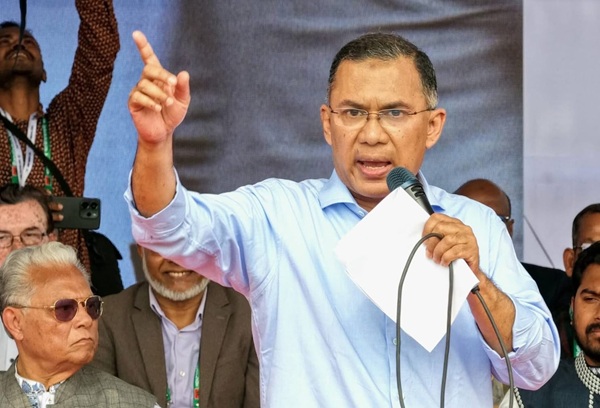

Lt Gen Syed Ata Hasnain is Governor, the State of Bihar, and Former Commander of India's Srinagar-based Chinar Corps.
February 14, 2026 at 10:13 AM IST
Bangladesh’s recent election has brought political clarity but not closure.
The two-thirds majority secured by the Bangladesh Nationalist Party, or the BNP, has stabilised the arithmetic of power. Yet the deeper test now begins: whether Bangladesh can move from agitation to administration and normalcy, from ideological contestation to institutional consolidation.
One of the most encouraging signs has been the peaceful conduct of the elections. In a region accustomed to street mobilisation turning violent, it was reassuring to see restraint. Streets are meant for movement, commerce and civic life — not permanent agitation or confrontation. The absence of widespread reprisals against profiled Awami League members, despite the ban on the party, reflects a degree of maturity in the system. That must be preserved.
Yet it must also be acknowledged that the absence of the Awami League has diluted the democratic texture of the contest. An election can be free and fair in process and still incomplete in representation. Political normalisation in Bangladesh will ultimately be measured by how and when the ban on the Awami League is lifted, and whether its space in the political spectrum is restored. Durable democracy rests not on exclusion but on accommodation.
The defeat of Jamaat-e-Islami in terms of executive control is undeniably positive. However, the 68 seats it has secured represent the highest number in its electoral history. This duality is important. Jamaat has been denied the centre of power, but it has expanded its parliamentary presence. It will not govern, but it will influence. Ideology, once mobilised, does not recede easily.
Border Dynamics
That said, it is important not to default to alarmism.
The BNP leadership appears conscious of the past record of its relationship with India when it held power in Dhaka. Historically, there were phases when cross-border insurgent presence was tolerated. Those lessons have likely been internalised. The cost of strategic adventurism is far higher today. A strong India–Bangladesh relationship serves the economic and political interests of Dhaka far more than friction ever could.
Prime Minister Narendra Modi’s prompt call to Tarique Rahman was therefore not a routine diplomatic gesture. Being the first foreign leader to congratulate the new leadership signalled continuity, respect and readiness to engage. Symbolism matters in transitional moments.
Economically, the logic is compelling. Bangladesh’s recent downturn correlates closely with deterioration in India–Bangladesh ties. Connectivity corridors, energy trade, supply chains, port access and transit arrangements form an ecosystem that cannot be easily substituted. Reviving these flows will directly support employment, manufacturing and export recovery in Bangladesh. Pragmatism, not ideology, will determine economic revival.
Governance First
The role of the Bangladesh Army in this transition also warrants recognition. It maintained professional discipline during turbulence and ensured the electoral process remained orderly. Institutional steadiness, rather than overt intervention, helped preserve constitutional continuity. Going forward, its professionalism must remain intact, neither politicised nor drawn into ideological contests.
A sensitive issue will surface quickly: the question of Bangladesh’s demand for Sheikh Hasina’s repatriation. Her presence in India and her occasional political statements will inevitably generate pressure from sections within Bangladesh. India will need to navigate this with care. It does not wish this matter to dominate bilateral relations, yet demands are foreseeable.
Here, historical precedent offers perspective. India has hosted the Dalai Lama for decades without allowing his presence to derail the broader trajectory of India–China relations. Differences have arisen from time to time, but the larger framework endured. India has a tradition of offering refuge to those with whom it shares historical ties. That principle should not be lightly abandoned.
At the same time, India must ensure that its territory is not used as a platform for destabilising rhetoric. A careful balance will be required — protecting humanitarian principles while preventing the issue from becoming a recurring irritant.
Bangladesh now stands at a strategic crossroads. It must decide whether ideological mobilisation will continue to define its politics or whether administrative pragmatism will regain primacy. The electorate appears to have chosen consolidation. The responsibility lies with the BNP to resist pressure from the flanks and focus on governance.
Playing a Straight Bat
If Bangladesh secures its minorities, restores political inclusion and revives economic momentum, relations will improve naturally. If ideological pressures reassert themselves, friction will follow. The choice lies largely in Dhaka’s hands. The treatment of minority communities in Bangladesh will remain a sensitive indicator of the country’s political direction and of the health of India–Bangladesh relations.
Tarique Rahman’s leadership now carries the responsibility of ensuring that no element—whether ideological or opportunistic—is allowed to harass or intimidate vulnerable communities. Even isolated incidents, if unchecked, can quickly assume symbolic significance and create avoidable strain in bilateral ties. If the BNP administration succeeds in doing so, it will remove one of the most persistent irritants in the relationship and reinforce its credentials as a stabilising force.
This election has created an opportunity. It has reduced the risk of immediate radical capture and restored parliamentary coherence. But it has not eliminated ideological undercurrents or border vulnerabilities. Normalisation is a process, not an event.
Cricket, often underestimated in strategic analysis, remains one of the most sensitive emotional connectors in the India–Bangladesh relationship. Sporting rivalry has periodically been allowed to spill into political signalling. It would be wise for both sides to ensure that cricket returns to being what it should be — competitive but civil, intense but not ideological. People-to-people engagement through sport, culture and education can quietly reinforce normalisation in ways formal diplomacy cannot.
Equally, the evolving Bangladesh–Pakistan equation bears close scrutiny. Tactical warmth between Dhaka and Islamabad may emerge, particularly as the BNP recalibrates its regional positioning. However, historical memory in Bangladesh runs deep. Any overt intelligence or ideological footprint by Pakistan would quickly generate domestic unease. The irritant potential exists, but structural alignment is unlikely so long as economic pragmatism prevails.
Finally, for India, there must be calm confidence regarding the Siliguri Corridor. Speculation about vulnerability often exaggerates the reality. Infrastructure upgrades, layered defence preparedness and strategic depth in the eastern theatre have significantly strengthened deterrence. Assurance, not alarmism, should define India’s posture. Stability in Bangladesh enhances that security; it does not define it.
South Asia’s stability often hinges less on dramatic gestures and more on disciplined statecraft. Bangladesh has taken a step toward order. Whether that order matures into lasting stability will determine not only its own trajectory but the strategic balance of India’s eastern frontier.
More From BasisPoint