.png)

Asia Markets Turn Risk-off as Trump’s War Warning Jolts Sentiment
Here’s your quick read to start the day: a chatty, no-fuss look at overnight moves, the big story, what’s on the docket, and the tickers you need to watch.
Richard is an independent financial journalist who tracks financial markets and macroeconomic developments
April 2, 2026 at 2:00 AM IST
GLOBAL MOOD: Risk-off
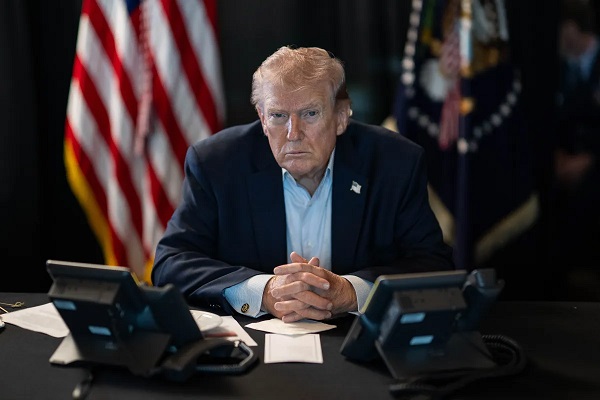
Asian markets shifted back to a clear risk-off mood as initial gains faded following a hawkish address by US President Donald Trump on the Iran conflict. Investors turned cautious after Trump warned of intensified military action over the next two to three weeks, tempering earlier hopes of de-escalation. The Nikkei 225, Topix and Kospi all slipped into losses as geopolitical uncertainty deepened.
Crude Oil prices surged sharply, with Brent and WTI rising over 4–5%, reflecting fears of supply disruption and renewed inflation risks. Conflicting signals — including US claims of a ceasefire request from Iran, which Tehran denied — further unsettled sentiment. Markets are now increasingly focused on the Strait of Hormuz situation and the trajectory of US military involvement, both of which remain key drivers of risk appetite.
TODAY’S WATCHLIST
- US Initial Jobless Claims Data
On the energy front, Trump advised countries struggling to source jet fuel amid Iran's Hormuz blockade to simply buy American but analysts quickly highlighted a fundamental problem: the US exports just 219,000 barrels per day of jet fuel against the roughly 500,000 barrels per day that normally transit the Strait, making a US supply substitution mathematically impossible at current export capacity. Separately, the Trump administration is set to announce tariffs as soon as Thursday on drugmakers that have not struck deals guaranteeing low US prices with a 100% tariff on imported branded and patented medicines under consideration. The pharmaceutical tariff threat has already prompted global drugmakers to accelerate US manufacturing investment and stockpile inventory, adding another layer of supply chain disruption to an already stressed global trade environment.
Data Spotlight
Private payrolls added 62,000 jobs in March well above the 40,000 forecast and extending February's upwardly revised 66,000 gains led by education and health services, construction, and information, though trade, transportation, and utilities shed 58,000 positions and manufacturing lost 11,000.
February retail sales rebounded strongly at 0.6%, the best performance in seven months and above the 0.5% forecast and with broad-based gains across department stores, clothing, motor vehicles, and health care, while the GDP-linked control group rose 0.5%, above the 0.3% estimate.
Takeaway:
WHAT HAPPENED OVERNIGHT
- US stocks extend rally as Trump's "out of Iran pretty quickly" fuels third straight session of gains
- The S&P 500 gained 0.72%, Nasdaq rose 1.16%, and the Dow climbed 0.48%, a third consecutive sessions of gains as ceasefire optimism built steadily.
- Trump said the US will be "out of Iran pretty quickly" with the option of "spot hits" if needed provided the primary catalyst.
- Alphabet surged 3.4% while Meta and Amazon each gained over 1%, with tech heavyweights leading the recovery for a second straight session.
- SpaceX confidentially filed for an IPO, sending space-related stocks sharply higher, Intuitive Machines gained 9%, Planet Labs rose 10%, Rocket Lab added 2%, and the Destiny Tech100 fund jumped 9.1%.
- The SpaceX IPO filing injected an independent positive catalyst into markets beyond the geopolitical relief trade, signalling corporate confidence in the longer-term outlook.
- Three consecutive periods of gains have now recovered a significant portion of the five-week selloff, with Nasdaq up over 7% from its correction lows.
- The S&P 500 gained 0.72%, Nasdaq rose 1.16%, and the Dow climbed 0.48%, a third consecutive sessions of gains as ceasefire optimism built steadily.
- US Treasury yield holds at 4.31% as ceasefire signals and resilient data offset inflation fears
- The 10-year yield held little changed at 4.31% as markets balanced tentative ceasefire optimism against a month that saw yields surge nearly 37 basis points, one of the sharpest monthly moves in years.
- Trump said the US would consider Iran's ceasefire request once the Strait of Hormuz is open, secure, and fully operational, tying the yield outlook directly to the waterway's status.
- Oil pulling back from recent highs provided modest yield relief, easing the near-term inflation premium embedded in Treasuries.
- ADP private payrolls added 62,000 jobs in March was well above the 40,000 forecasts, signalling the labour market remains more resilient than February's shocking payrolls miss suggested.
- February retail sales rose a stronger-than-expected 0.6% giving another sign the US consumer has not yet buckled under the energy shock.
- The 10-year yield held little changed at 4.31% as markets balanced tentative ceasefire optimism against a month that saw yields surge nearly 37 basis points, one of the sharpest monthly moves in years.
- US Dollar slips for second straight session as ceasefire signals drain safe-haven demand
- The US dollar index fell 0.07% to 99.67, extending its retreat for a second consecutive session as ceasefire optimism built.
- Trump told Reuters the US will end its Iran war "fairly soon" and could return for "spot hits" if needed, a measured wind-down framing rather than a clean exit.
- Trump's Truth Social post claiming Iran's new leader had asked for a ceasefire was the session's most market-moving development, directly undermining the safe-haven dollar bid.
- The Swiss franc and euro both strengthened against the dollar, reflecting a broad unwinding of conflict-driven safe-haven positioning.
- The dollar's modest 0.07% decline suggests markets are not yet fully pricing a ceasefire.
- The US dollar index fell 0.07% to 99.67, extending its retreat for a second consecutive session as ceasefire optimism built.
- Crude oil retreats as Trump confirms war will end "fairly soon"
- Brent crude fell 2.7% to $101.16/barrel, touching a session low of $98.35 before recovering, briefly breaking below the psychologically critical $100 level.
- WTI slipped 1.2% to $100.12/barrel, also touching an intraday low of $96.50 before paring losses.
- Trump's confirmation that the US would end its Iran war "fairly soon" was the direct catalyst for the selloff.
- The intraday lows of $98.35 and $96.50 are significant as markets briefly priced a post-conflict oil reality before caution reasserted itself.
- The partial recovery from session lows reflects lingering scepticism about Hormuz remains disrupted, Iran has not formally agreed to terms, and structural infrastructure damage across the region is not quickly reversible.
- Brent crude fell 2.7% to $101.16/barrel, touching a session low of $98.35 before recovering, briefly breaking below the psychologically critical $100 level.
Day’s Ledger*
Economic Data
- India Manufacturing PMI
- US Trade Data
- US Initial Jobless Claims Data
Corporate Actions
- Satani Bearings board to consider stock split
- Panth Infinity board to consider fund raising
Policy
- Fed Logan Speech
Tickers to Watch
- YES Bank names S Anantharaman as CRO to strengthen risk management
- Glenmark takes direct control of Ryaltris sales in US from April 2026
- Jubilant FoodWorks extends Domino's India franchise pact by 15 years
- Maruti Suzuki may raise prices as Iran conflict drives up commodity costs
- Swiggy's investor relations head Abhishek Agarwal quits; CFO to take charge
- CBI files fresh case against Anil Ambani, RCom in ₹3,750 cr LIC fraud case
- APSEZ handles 500 MT cargo in FY26, eyes 1 billion tonnes by 2030
Must Read
- Iran war pushes solar module prices up 15-20%: SAEL CEO Laxit Awla
- Oracle layoffs impact over 2,500 in India; 30,000 get pink slips globally
- India Inc hits pause on manufacturing facility expansion in March
- Indian drugmakers may lose up to $750 mn if West Asia conflict persists
- Electric vehicle sales surge in FY26 on strong Q4 push across segments
See you tomorrow with another edition of The Morning Edge.
Have a great trading day
𝐖𝐡𝐲 𝐖𝐚𝐬𝐭𝐞 𝐚 𝐆𝐨𝐨𝐝 𝐂𝐫𝐢𝐬𝐢𝐬: 𝐓𝐡𝐞 𝐏𝐢𝐩𝐞𝐥𝐢𝐧𝐞 𝐏𝐚𝐫𝐚𝐝𝐨𝐱
India’s energy policy is trying to move in two directions at once. One push doubles down on gas pipelines and fossil infrastructure. The other commits to an electro-state future built on renewables, grids and electrification. Both cannot define the same decade.
Sharmila Chavaly writes, if this is a moment of crisis-driven choice, what is India really optimising for—security today or resilience tomorrow? And are we building systems that solve the next constraint, or extending the last one?
(*Compiled from various media sources)
More From BasisPoint