.png)

Act East 2.0: Looking East, Thinking Indo-Pacific
The Prime Minister's current visit to Indonesia, Australia and New Zealand is more than diplomacy. It signals the beginning of Act East 2.0—a strategic shift from engaging the East to shaping the Indo-Pacific.
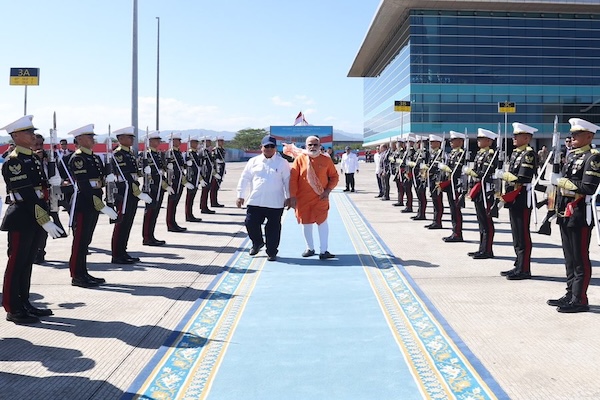

Lt Gen Syed Ata Hasnain is Governor, the State of Bihar, and Former Commander of India's Srinagar-based Chinar Corps.
July 10, 2026 at 6:55 AM IST
It struck me recently that I had not looked east for quite some time—physically through travel, or intellectually through sustained strategic attention. Much like India's own strategic gaze, my thoughts had been drawn elsewhere by an unrelenting succession of crises. The conflict in Ukraine, the turbulence of West Asia, Pakistan-sponsored terrorism, the continuing challenge in the North East, and the demands of managing a volatile neighbourhood had understandably occupied the nation's diplomatic and strategic bandwidth.
Yet, a nation aspiring for prominence in the international order can hardly allow one set of crises to permanently dictate its strategic imagination. Great powers do not merely react to events; they consciously decide when to shift their gaze towards emerging opportunities.
Prime Minister Narendra Modi's current visit to Indonesia, Australia and New Zealand should therefore be viewed in that larger context. It is not merely a series of bilateral engagements but rather strategic communication in its most effective form. Nations communicate priorities not only through official statements, but through the geography of their highest-level diplomacy. The destinations themselves send a message—to partners, competitors and the wider international community—that India is once again looking east with purpose.
From Act East to Act East 2.0
When the Act East Policy succeeded the earlier Look East Policy, its principal objectives were connectivity, economic integration, institutional engagement and the strengthening of relations with ASEAN. It reflected India's recognition that its future prosperity was inseparable from the dynamism of East and Southeast Asia. That phase has served India well. But the strategic environment has changed fundamentally.
The Indo-Pacific has emerged as the principal theatre of geopolitical competition. Maritime security, resilient supply chains, critical technologies, undersea infrastructure, energy flows, the Blue Economy and critical minerals now occupy the centre of strategic discourse. Defence partnerships and maritime domain awareness have become as important as trade agreements. Island territories have acquired strategic significance. Economic diplomacy can no longer be separated from security policy.
Act East 2.0 must, therefore, represent evolution more than continuity. If the first phase connected India with East Asia, the second must help shape, not just connect, the strategic environment of the Indo-Pacific.
Strategic Communication Beyond the Quad
The visit also signals that India's eastern strategy cannot remain hostage to the pace of the Quad. The grouping remains a valuable strategic platform, but it is neither an alliance nor the only instrument for shaping the Indo-Pacific. At a time when the US appears less invested in advancing the Quad as a central strategic construct, India must pursue its own eastern agenda—strengthening bilateral ties with Japan and Australia, while placing ASEAN at the heart of Act East 2.0.
Indeed, the present moment demands precisely the opposite. Strategic autonomy has always required India to pursue its own interests while strengthening partnerships with like-minded countries. The current outreach suggests that New Delhi intends to deepen bilateral and regional relationships with fellow Quad members Australia and Japan, while simultaneously investing greater diplomatic energy in ASEAN.
This is neither a departure from the Quad nor a dilution of it. Rather, it is an acknowledgement that geography imposes responsibilities which no multilateral framework can postpone.
A Changing Strategic Landscape
The international environment itself appears to be undergoing a subtle transition.
The United States continues to remain the world's pre-eminent military power in the Indo-Pacific. Yet, its strategic attention increasingly appears concentrated on managing competition with China, particularly around Taiwan, while balancing pressing domestic political and economic priorities. This is not a withdrawal from the region, but it has created a perception across Southeast Asia that Washington's political engagement is becoming more selective. Strategic vacuums are rarely left unoccupied.
China has consistently demonstrated its ability to expand influence through economic integration, infrastructure investments, maritime presence and sustained diplomatic engagement. It excels in operating within the grey zone—expanding influence without necessarily provoking direct confrontation.
The challenge for regional states is therefore not one of choosing between competing blocs. It is one of preserving strategic equilibrium. This is where India acquires renewed significance.
ASEAN at the Centre
For too long, ASEAN has often been discussed as an important component of the Indo-Pacific. The reality is that ASEAN is increasingly becoming its strategic anchor. Most Southeast Asian nations seek neither confrontation with China nor exclusive dependence upon any external power. They seek stability, strategic flexibility and reliable partnerships.
India is uniquely positioned to meet those expectations. It comes without alliance obligations or hegemonic ambitions, and with civilisational links that long predate contemporary geopolitics. Its credibility rests on respect for sovereignty, inclusive regionalism and a commitment to a free and open maritime order. Yet, for too long, India has projected these strengths with excessive caution. Act East 2.0 will end that hesitation. It is time to match strategic capability with strategic confidence and engage the Indo-Pacific with greater purpose and resolve.
The growing defence relationship with countries such as the Philippines, including India's export of the BrahMos missile system, and expanding security cooperation with Indonesia illustrate an important transformation. India is no longer merely exporting goodwill and training. It is increasingly exporting capability, confidence and strategic reassurance. Defence partnerships have become instruments of diplomacy as much as of security.
Thinking Like a Maritime Power
Perhaps the most profound implication of Act East 2.0 lies in India's own strategic mindset. For decades, India's security thinking has understandably remained continental, shaped by successive challenges on its northern and western borders. Those concerns will not disappear. Yet the twenty-first century is increasingly becoming a maritime century.
Trade, energy security, submarine communication cables, supply chains, technological ecosystems and global commerce all converge across the waters of the Indo-Pacific.
Projects such as the development of Great Nicobar, therefore, deserve to be understood in their true strategic context. They are not merely infrastructure initiatives. They reflect India's gradual transition towards becoming an integrated continental-maritime power. Located close to one of the world's busiest maritime corridors, Great Nicobar symbolises India's intention to play a larger role in ensuring the security and stability of the eastern Indian Ocean.
This is not about confrontation, but more about presence and preparedness. Above all, it is about recognising that maritime geography will increasingly shape India's economic and strategic future.
Looking East, Thinking Indo-Pacific
Prime Minister Modi's current visit should therefore not be remembered simply for the agreements it produces or the goodwill. Its larger significance lies in the signal it sends—that India has regained the confidence and strategic bandwidth to look beyond immediate crises and invest once again in its eastern horizon.
Neither the turbulence of West Asia nor the tragedy of Ukraine can be allowed to permanently absorb India's strategic attention. India's natural interests extend across the Indo-Pacific, and those interests demand sustained political engagement, stronger maritime partnerships, closer cooperation with ASEAN, deeper ties with fellow Quad members and an independent strategic rhythm that reflects India's own priorities.
The Indo-Pacific will define the strategic balance of the twenty-first century. India cannot merely be present in that story; it must help write it. Prime Minister Modi's eastern journey may well come to be remembered as the moment India consciously began doing exactly that.
More From BasisPoint