.png)

Two Speeches, One Lie, and an Uncomfortable Reality
Rubio soothed Europe with familiar stories. Carney stripped them away. Two speeches, one anxious West, and what the gap means for India.
Phynix is a seasoned journalist who revels in playful, unconventional narration, blending quirky storytelling with measured, precise editing. Her work embodies a dual mastery of creative flair and steadfast rigor.
February 23, 2026 at 11:36 AM IST
Dear Insighter,
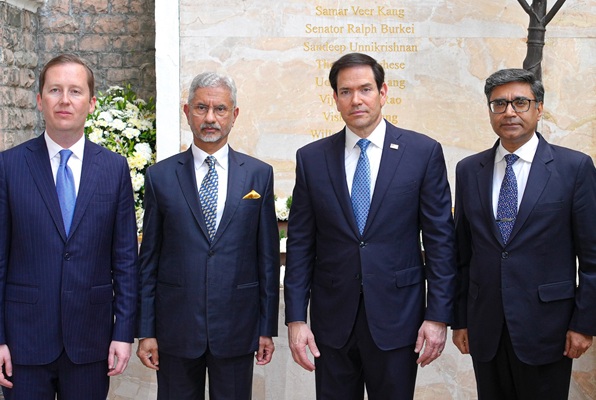
When Marco Rubio finished speaking in Munich, the applause lasted longer than the argument required. You could hear the relief in it. Europe had been waiting to be told that nothing fundamental had changed, that the Atlantic still mattered, that history still bound, that whatever turbulence was coming out of Washington, the old family remained intact.
A few weeks earlier in Davos, Mark Carney had said almost the opposite. He told his audience that the rules-based order had always been more fragile, more selective, and more self-serving than its champions admitted. He called this moment a rupture, not a transition.
Same continent. Very different diagnoses.
When Rubio arrived at the Munich Security Conference, Europe was in need of something close to emotional first aid. The memory of JD Vance’s blunt assault on European political culture at the same forum the year before still lingered. So did the unease created by a president casually floating ideas about Greenland that sounded half-comic, half-threatening. Underneath the formal communiques and strategic panels was a simpler anxiety: does Washington still see Europe as a partner, or merely as a convenience?
Into this uncertainty walked America’s “chief diplomat” with no new ideas, but with very familiar language. He spoke again and again about shared history, Christian faith, common heritage, common ancestry, and how “together” Europe and America had always been. He returned to these themes so often that they began to work like a kind of reassurance loop. And when he said that America would “always be a child of Europe,” the hall responded with something close to gratitude.
Nobody dwelt on the reality that much of this “shared history” is a catalogue of wars, rivalries, and imperial competition. Few people lingered on the awkwardness of invoking Christian civilisation in societies that are largely secular and constitutionally committed to keeping religion out of politics. And almost no one seemed interested in the people missing from this story: the millions whose labour and suffering helped build the modern West but who do not fit easily into its preferred self-portrait.
The congregation wanted its sermon. Rubio delivered it.
As Rajesh Ramachandran has observed, this was not ordinary diplomatic language. It was civilisational language, in which Christianity and culture were not invoked as lived realities but as political symbols, markers of belonging that once justified empire and now seek to justify alignment. What Rubio was really doing was auditioning for a relationship that America needs Europe to believe in, at least for now: one anchored in identity rather than transaction. It was effective. It calmed the room. It worked. But it was also, in important ways, a carefully curated fiction.
Carney, speaking in Davos, offered no such anaesthetic. Invoking Václav Havel’s idea of “living within a lie,” he told his audience something most of them had known for years and rarely acknowledged in public: that the so-called rules-based order had always been selective. Powerful countries followed rules when convenient and bent them when costly. Middle powers complied because compliance bought stability. Everyone participated in the ritual because the alternative seemed riskier.
“We knew,” Carney implied. “And we chose not to look.”
The force of his speech came not only from its content but from its source. He is not an outsider. He ran two of the world’s most important central banks. For years, he helped keep this system going. Which is why the speech sounded less like a manifesto and more like someone finally dropping the polite language.
When he said this was a “rupture, not a transition,” he meant that we are not drifting into a new phase. We are breaking out of the old one. That is not the kind of thing people usually say in rooms full of optimistic slides and forward projections. It was unsettling precisely because it refused to reassure.
It also created an obvious problem. If the old script is finished, what replaces it?
“Variable geometry,” Carney said. Different coalitions. Different arrangements. Flexible partnerships. All reasonable. All much harder than they sound. It sounds neat, but it won’t be. Still, in a world where many leaders cling to exhausted myths or retreat into vague nationalism, his willingness to say “the emperor has been underdressed for decades” was rare.
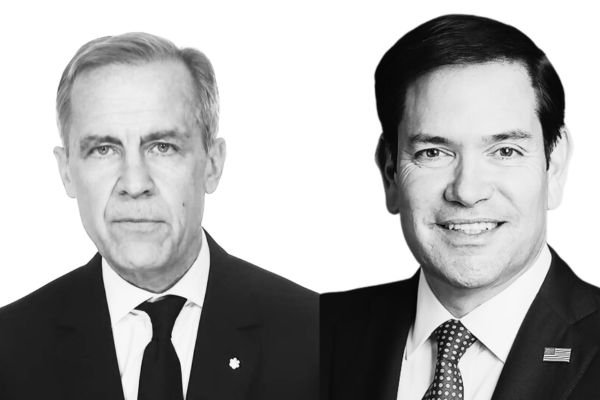
Put next to each other, they are describing different worlds. Rubio offered reassurance that the old family still exists. Carney admitted that the family was always dysfunctional. Rubio spoke of roots and heritage. Carney spoke of rot and repair. Rubio sold continuity. Carney named rupture. Neither was entirely wrong. The transatlantic relationship is not collapsing, and remains strategically important. But neither is it anchored in timeless civilisational unity. It is contingent, negotiated, and increasingly transactional. The Europeans in Munich probably sensed this, even as they applauded, much like someone thanking a doctor for good bedside manner while quietly suspecting the diagnosis is grim.
Nowhere is this clearer than in trade. The US Supreme Court’s decision striking down Trump’s sweeping reciprocal tariffs under IEEPA has scrambled calculations. India, after making concessions under pressure, now faces a flat 15% tariff on goods. As Ajay Srivastava notes, this undercuts the original logic of negotiation. One reaction is to claw back what was given. TK Arun’s analogy is more persuasive: a patient who lost weight under a wrong diagnosis should not regain it simply because the diagnosis changed.
The same tension between comfort and discomfort runs through India’s financial landscape. On the rupee, Michael Debabrata Patra shows how stability-seekers and volatility-seekers read the same data differently. One sees the rupee in free fall, heaping everything from structural weaknesses to the kitchen sink on the hapless currency. The other, the IMF's view, classifies the rupee as a crawl-like arrangement, adjusted in small amounts at a fixed rate. Can both be correct? As Patra notes, it takes at least two views to make a market.
The RBI’s new FX framework, as V Thiagarajan explains, reflects quiet realism by integrating offshore markets rather than pretending they do not exist. On liquidity, apparent surpluses conceal structural strain, observes this BasisPoint Groupthink. On bonds, a pause is mistaken for a turn, writes Yield Scribe. Lower core CPI numbers and reduced gross borrowing have cooled yields temporarily, but heavy supply keeps bears around.
The new CPI base year, Barendra Kumar Bhoi argues, improves confidence for bold policy, showing headline inflation at 2.75% under the new series. This opens window for another rate cut in April, promoting transmission and accelerating private capex. On rates, “neutral” has become a resting place rather than a waypoint. None of this is dramatic. All of it is consequential.
The AI debate reflects similar dynamics, as Rajesh Mahapathra and Srinath Sridharan dissect in this episode. At the India AI Summit, ambition collided with institutional confusion. Sridharan and Anand Ventakanarayanan warn that reskilling slogans are not enough without compute, research depth, and patient capital. Nilanjan Banik highlights how enterprise AI threatens the volume model of Indian IT. Ninupta Srinath reminds us that writing code is no longer the same as owning technology. TK Arun goes further: sovereignty in AI rests on chips, memory, and manufacturing capacity, not conference banners. Yet Amitrajeet Batabyal’s reminder is useful too. Diffusion is slow in critical systems. Human judgment still matters. As R. Gurumurthy neatly put it, “AI may be artificial, but stupidity is organic.”
Across regulation, taxation, climate finance, and corporate restructuring, the pattern repeats. There is no shortage of ambition. Delivery is another matter.
Krishnadevan V examines the RBI's new M&A funding framework: banks may now fund up to 75% of acquisition value, but the remaining 25% must come from the acquirer's own funds, shrinking room for pledge-heavy structures. Buying control now requires steady cash generation, not a strong share price. R. Gurumurthy, in another piece, examines Total Return Swaps on corporate bonds, warning that derivatives amplify markets but do not create them. India's corporate bond market lacks breadth of participation; synthetic overlays may remain just that.
Sangeeta Jain traces the shifting taxation of buybacks, from the Companies Act 1956 through the Finance Act 2026. The latest changes restore capital gains taxation on buybacks while adding a promoter levy.
Sharmila Kantha sees early signs of private capex revival. Anupam Sonal warns that macro stability breeds complacency. Arvind Mayaram shows how climate commitments now require delivery, not rhetoric.
Even politics reflects this mood. Amitabh Tiwari’s reading of West Bengal suggests a volatile contest shaped by local discontent rather than grand narratives. Authority is becoming granular. Power is becoming conditional. No one gets to rule by myth alone anymore.
Thus, we return to Havel’s greengrocer. For decades, much of the world has played that role, displaying the sign, saying the words, performing belief in systems we privately knew were inconsistent. Rubio offered Europe permission to keep performing. Carney suggested it might be time to stop.
India’s challenge is not to choose between them wholesale. It is not to buy into civilisational sorting of the world, nor to retreat when rules wobble, nor to cling to arrangements that favour the strong. It is about building the capacity to choose partners without illusions, and compete without resentment.
Carney has named the lie. Rubio has decorated it. Neither, by himself, offers a roadmap.
The rupee will move, liquidity will ebb and flow, AI will unsettle jobs, and elections will test incumbents. Through it all, the deeper contest is between soothing stories and stubborn facts, between continuing to perform and learning… to govern without a script.
We know which path is harder. We also know which one lasts.
Until next time. Let’s see how long the applause lasts.
Phynix
Also Read
- India's Trade Pact With Europe Offers Promise, Not Quick Gains by G. Chandrashekhar: The India–EU FTA offers scale and promise, but strict standards, climate rules and structural gaps mean gains will be gradual, uneven and hard-earned.
- January Jobless Rate Ticks Up, Women Hit Harder by Akshi Chawla: A 1.5 percentage point jump in women's unemployment is not easy to dismiss as routine variation.
- Rising Imports and Costly Supply Chains Squeeze India's Apple Economy by Ajay Srivastava: India's apple economy is at a crossroads, with imports now equal to roughly one-fifth of domestic production.
- AI and the Global South's Next Leap Forward by Nandan Nilekani and Ashish Khanna: AI-ready grids will be as crucial to the Global South's development as traditional infrastructure like roads and ports.
- AI Will Transform Business, Not Just Jobs by Diane Coyle: Corporate leaders should think about how AI can enhance organisational capabilities and increase economy-wide productivity.
- Those Who Most Need to Understand AI Don't Get It by Charles Ferguson: If recent history is any guide, mainstream economists' tunnel vision on AI should worry us all.
- Munich 2026 and The Limits of Strategic Comfort by Lt Gen Syed Ata Hasnain: Munich 2026 signals erosion of the US-led order as Europe seeks autonomy and India leverages strategic resilience.
- The Rooms We Raise and Reduce — Who Decides Success Earns It? by Kalyani Srinath: When you walk into a room with influence, do you expand it, or dominate it?
- Why We Lie: The Psychology Behind Reputational Inflation in India's Innovation by Kirti Tarang Pande: A mature culture for innovation is built by asking why fakery seems more alluring than honesty.
- Financing the Global South's Infrastructure Boom by Rakesh Mohan and Divya Srinivasan: Without institutional capacity and financial depth, the PPP model can backfire, creating debt, delays, and disillusionment.
- The End of a Lie by Antara Haldar: Mark Carney's Davos speech declares the rules-based order a comforting fiction, urging nations to abandon complacency.
More From BasisPoint