.png)

Replacing Powell with Warsh Didn't Work, At Least Not Yet
Trump changed the Fed chairman hoping for cheaper money. At the first big test, his new chairman raised rates instead: a reminder that presidents can change the occupant of the Fed, but not the arithmetic of inflation.
Gurumurthy, ex-central banker and a Wharton alum, managed the rupee and forex reserves, government debt and played a key role in drafting India's Financial Stability Reports.
September 17, 2026 at 3:28 AM IST
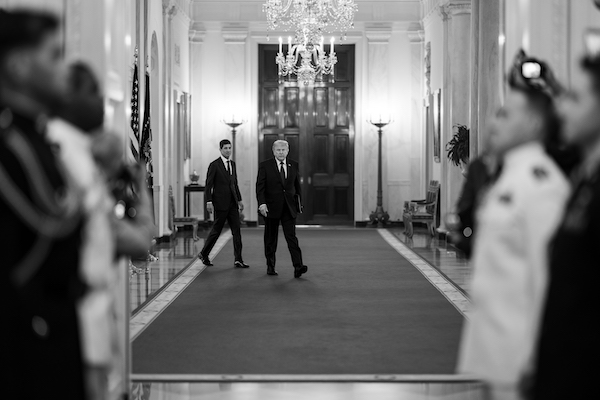
There is an unmistakable irony in the latest US interest-rate drama. Donald Trump spent years attacking Jerome Powell for not cutting rates fast enough. He eventually got a new Fed chairman, Kevin Warsh, whose appointment was widely seen as offering the administration a better chance of getting the lower rates it wanted.
At Warsh's first major policy test, however, the Fed did the opposite.
On September 16, the Federal Reserve raised its benchmark rate by 25 basis points to 3.75–4.00%, its first rate increase since July 2023. The decision of the voting FOMC members was unanimous, 12–0. More significantly, the Fed's projections showed that 16 of 18 participants saw at least one more increase by the end of the year.
Trump's response was predictable. After the hike, he demanded that US interest rates should be 1% or lower, arguing that America is the “Best Credit in the World — BY FAR.”
That assertion contains a revealing confusion. Being the world's best credit does not mean being entitled to the world's lowest interest rate.
Creditworthiness affects the risk premium investors demand to lend. A central-bank policy rate, by contrast, is primarily an instrument for managing monetary conditions. A country can have exceptionally strong credit and still require high interest rates if inflation is too high.
That is precisely the problem confronting the Fed.
The Fed's own projections put PCE inflation at 3.7% for 2026, against its 2% objective. Core PCE inflation was projected at 3.4%. The Committee said inflation remained elevated even as economic activity, productivity and capital investment remained strong.
Warsh's message was therefore straightforward: monetary policy cannot be dictated by the political desire for cheap money. After the decision, he said the “plain fact” was that inflation was too high and had been so for too long. The Fed, he argued though, had to be confident that underlying inflation was moving towards its 2% objective at a sufficient speed!
This is where Trump's argument becomes economically problematic.
Lower interest rates would certainly be attractive to the US government. America carries a huge federal debt, and lower borrowing costs would eventually reduce the government's interest burden.
Cheaper money would also support housing, investment and asset prices.
But monetary policy cannot simultaneously serve as a cheap-financing mechanism for the Treasury and an anti-inflation instrument without creating a conflict.
If inflation remains above target, cutting rates because the government wants cheaper debt risks stimulating demand when the Fed is to try restrain it. The eventual consequence could be an even higher cost of money.
Trump's “best credit” argument also misses another distinction. The US enjoys an extraordinary privilege from issuing the world's principal reserve currency and from the depth and liquidity of its Treasury market. But that privilege does not make inflation disappear. Nor does it give the president a mathematical formula by which the Fed can determine that rates “should be 1%”.
The more interesting issue is therefore not whether Warsh is politically loyal to Trump. It is whether the institutional logic of central banking can survive political demands for cheaper money.
And the first answer is encouraging, though it is far too early to call it a final answer.
Warsh was appointed by Trump. Yet his first FOMC decision was a rate hike. More importantly, the Fed's projections point to the possibility of another increase.
That does not prove that Warsh will always oppose Trump. Nor does one rate hike establish a permanent tightening cycle. If inflation falls sufficiently, Warsh could eventually cut rates. Indeed, the Fed's own projections show a lower policy rate over subsequent years!
But that is precisely the point.
A president can choose the Fed chairman. He cannot choose the inflation data that the chairman has to confront.
Trump's experience with Powell was essentially a political battle over the person sitting in the chair.
His experience with Warsh may become a lesson in the limits of changing the person in the chair.
There is an even larger danger. Once markets begin to believe that the central bank will subordinate inflation control to the government's financing needs or electoral timetable, the supposed benefit of lower policy rates can quickly disappear. Investors can demand higher yields on longer-term government debt to compensate for inflation and policy uncertainty. The government may then discover that forcing down the short rate does not necessarily make borrowing cheaper across the economy.
That is why the phrase “best credit” is almost beside the point.
The United States may indeed possess the world's most powerful sovereign financial position. But creditworthiness is not a substitute for price stability.
The irony of the Warsh episode is therefore not that Trump chose the wrong chairman. It is that he may have discovered something more fundamental; changing the chairman does not change the economic constraints under which the chairman operates.
Powell could be replaced. Warsh could be appointed. But inflation still gets a vote.
More From BasisPoint