.png)

Michael Patra is an economist, a career central banker, and a former RBI Deputy Governor who led monetary policy and helped shape India’s inflation targeting framework.
December 1, 2025 at 7:39 AM IST
“Close bosom-friend of the maturing sun,” wrote the poet John Keats to describe the autumn of 1819.
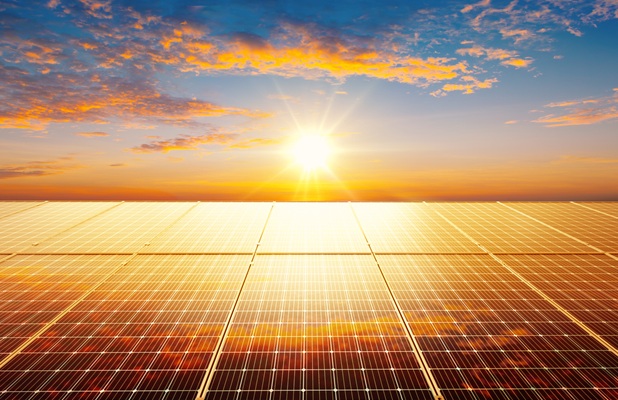
The sun is central in cultures all over the world. This is best reflected in their mythologies. The sun's daily rise and set symbolise the victory of light over darkness, of rebirth over death. In many pantheons, the sun is either the primary creator or a crucial sustainer of life, fertility, and cosmic order. Since the 7th century BC, humans have sought to harness the light and heat from the sun to generate the most inexhaustible, environmentally clean and cheap renewable energy known to them.
What began as the passive collection and concentration of the sun’s heat was transformed in the 19th century AD through the discovery and use of photovoltaic and thermal technologies. Albert Einstein’s groundbreaking work on the photoelectric effect proved that light consists of energy packets or photons that eject electrons from metals. It provided the foundation for how PV cells work and earned him the Nobel Prize in Physics in 1921. The invention of the silicon solar cell in 1954 turned solar power into a practical technology, especially in space exploration.
Today, significant reductions in manufacturing costs and support from policy incentives, particularly in response to the urgency of climate change, have made solar electricity cost-competitive, sparking massive global growth of residential rooftop solar and utility-scale solar use. Global solar PV capacity crossed 2.2 terawatts by the end of 2024, doubling in just two years and constituting over 10% of the world's electricity. Along with onshore wind, solar energy is currently the cheapest form of electricity generation in most countries.
China accounts for around 60% of global new solar installations and has over 1 TW of cumulative capacity. It is also the world's leading manufacturer of solar panels. In fact, the boom in Chinese manufacturing capacity has led to an oversupply of solar panels, causing prices to decline by nearly 50% year-on-year.
The European Union is also adding significant capacity across member states, driven by strong climate and energy security policies. The US is seeing continuing strong expansion in utility-scale and residential markets. Brazil and Australia are other key regional growth centres, demonstrating that solar is viable across geographies and climates. At the COP28 climate summit in Dubai in 2023, over 130 countries agreed to work toward tripling global renewable energy capacity to at least 11 TW by 2030, with solar energy expected to be the primary driver of achieving this goal.
India is rapidly positioning itself as a global clean energy leader, with 256 gigawatts of non-fossil fuel energy capacity. Interestingly, India has achieved its COP26 goal of 50% non-fossil capacity five years early (the target was for 2030), driven by specific schemes aimed at decentralised power focused on massive utility-scale projects and rooftop solar for households. Solar is central to India's energy transition. With 127 GW of installed capacity comprising 97.15 GW ground-mounted and 21.52 GW rooftop solar, India is the world’s third-largest solar energy producer. With about 30 GW of capacity installed in 2025, the year is shaping up to be record-breaking for solar installations in India. Its target of 500 GW of non-fossil fuel capacity by 2030 is expected to be powered by solar as the largest contributor, providing 280 GW. Blessed with about 300 clear, sunny days annually, India receives approximately 5,000 trillion kilowatt hours of solar energy incidence on its land area per year. The National Institute of Solar Energy estimates the country's utility-scale technical potential at approximately 748 gigawatt-peak.
Solar Momentum
India’s ode to autumn saw a flurry of solar energy events in the month of October, including the India Solar Expo 2025, the International Conference on Solar Technology, the Battery Show India, and notably, the eighth session of the International Solar Alliance. In the latter, India launched several initiatives, including SUNRISE — the Solar Upcycling Network for Recycling, Innovation & Stakeholder Engagement; a dedicated One Sun One World One Grid initiative to drive cross-border solar grid interconnections; the Global Capability Centre, envisioned as a “Silicon Valley for Solar” in India; and an in-principle SIDS Procurement Platform, developed jointly with the World Bank for small island developing states. Together, the initiatives mark a significant shift from advocacy to implementation and signal India’s intent to position the Global South at the centre of the solar revolution ahead of COP30 in Brazil.
Going solar is not without its challenges. Outdated electricity grids and transmission systems in many countries struggle to cope with the influx of intermittent solar power, requiring massive investments in smart grid technology and upgrades. Moreover, solar only works during the day. Scaling up affordable and reliable battery storage solutions is the single biggest technological challenge to making solar a 24/7 power source. Furthermore, while solar is cheap, securing financing remains a bottleneck for projects, particularly in developing economies, apart from supply chain risks and geopolitical tensions due to the concentration of manufacturing capacity in a few countries.
System Strength
Despite flagship schemes, the residential rooftop segment faces operational challenges due to slow, numerous, and time-consuming approvals from multiple agencies, meter shortages, and procedural inefficiencies. The mandate to use domestically manufactured modules (DCR-compliant) for certain schemes drives up capital costs compared to cheaper imported variants. Low public awareness about financing models and persistent concerns over the quality of installations and inconsistent after-sales service remain barriers to adoption.
For large-scale utility projects, physical execution remains a significant challenge on account of land acquisition delays, slow environmental clearances, securing the right-of-way for transmission corridors, and local community issues.
Quite appositely, therefore, the focus is shifting from simply adding capacity to ensuring system strength and reliability. A ₹2.4 trillion transmission plan is being executed to build high-capacity inter-regional transmission lines linking renewable-rich regions (like Rajasthan, Gujarat, and Ladakh) to demand centres across the country. Improving transmission efficiency, reducing grid congestion, and allowing for the dynamic sharing of transmission corridors between solar, wind, and storage projects will be the motif of this consolidation phase.
All new large-scale solar projects will need to have energy storage (typically two hours of storage); wind-solar hybrid and round-the-clock projects will be boosted so as to combine different renewable sources and storage to offer stable, dispatchable power. Viability gap funding for Battery Energy Storage Systems is gaining importance to make storage projects financially viable. India is also seeking trade agreements that ensure secure access to minerals like lithium and cobalt that are vital for batteries.
The challenges are formidable, but the sun still shines. The classic song "Here Comes the Sun" by The Beatles, written by George Harrison and regarded as one of the most beautiful and hopeful in music, portrays the sun as a metaphor for things getting better.
More From BasisPoint